MICRO-FUNDING
Capital for the other 99%.
The biggest gap in the energy transition isn't technology — it's access to capital. Homes, farms and small businesses are ready to go clean, but capital markets weren't built to see them. We fix that — for customers across the globe, not just in rich countries.
Video transcript
Okay, let's talk about funding your project. So we did a lot of focus groups way back over a decade ago on if we develop all these products, how can we make sure that the market can consume the volumes that we plan to make? So 10,000 windmills, water turbines, solar trackers, thousands of batteries, how do we, how do we make sure that the market can finance them, be able to get them installed and all those important things that kind of upstream, downstream, you know, checking the boxes that, that you've met all the regulatory stuff.
So we've developed, an application that talks every device. So you download the Escout mobile app, you go out and audit your site, you call an installer in to get a quote to install it. You get a project manager that's automatically assigned to it. AI does the paperwork. We then have to bring, financing and more importantly insurance to the table. So whenever a bank loans something, they need to make sure that the products are insured in case of a fire, flood or a hurricane or a fire. And so we bring all that together and we put it in a package.
And every device has a little computer chip on board called a puff chip. And it's a unique function. So just like your fingerprint has a unique ID on it that only you in the world has that pattern. We do the same thing with each renewable, energy, whether it's a power generator, a battery, or a distribution point. We can then trade the electricity to the grid and be able to sell it back to the grid. So there's a consumer out there that wants to buy it, that's hooked up to the grid like an electric vehicle or an industry that uses a lot of power or we can consume power coming in. And so we always want that grid there when we're doing this micro grid work.
But more importantly, we want to be able to take your products that you're selecting for your location, your site, and then we want to be able to package it up with a whole bunch of other ones and we want to put it out onto the market with a financial mechanism called a medium term note under a climate bond.
So way back in the 1990s and early 2000s, the United Nations came in and said, we're going to fix the climate problem. And through a lot of bureaucracy and things that happen, the money that was allocated by all these big countries, didn't get deployed. And the bankers came in at one of the COPE, meetings and said, look, you're not in the business of deploying capital. We're going to take this on. And they created this thing called, the Climate Bond Initiative. So all the big banks around the world belong to this. And just a few years ago when we started working with the Climate Bond Initiative to get certified is that we learned that there were 17 times more capital sitting out in the banks looking for a acceptable compliant investment.
So we took that as a mission to take all of our products and make them Climate Bond certified. And now we can leverage that capital equipment, the installers, the insurance that goes on there and package them in and do it with a collective where all of this capital comes out of the market. It's really cool how it happens. If you're certified, the bond is traded within like the first minute that it goes live. So we have to go through the certification process. And so banks are looking for a place to put their money. Climate is a great investment because it's here, it's not going anywhere. And we need more power to power all these electric vehicles.
So in Costa Rica, it's kind of a developing nation. It's probably more forward thinking than the United States where I'm from. But they produce 98% of their power from renewable energy sources. What they did, which was really exciting was they brought in a lot of electric vehicles. They supported it with all kinds of incentives to be able to drive these electrical vehicles. And they now have a need for more power. So just recently the new government under President Laura Fernandez enacted a new law that says, hey, if you're, you know, up on this plantation, you've got solar panels, you can sell it back to the grid.
So we have kind of electricity as a new monetary form and we call that E to X. So we believe we can leverage the electrons, the tax credits, the power purchase agreements, the carbon credits and even the crypto people want to come in and help. They're trying to find assets that they can put on the blockchain ledger and be able to trade these things and help finance the climate thing. So we've got all these great financial institutions that want to make money off of climate change. Now we have products that actually have that unique fingerprint on there that we can start trading.
And it takes the cost, the barrier to entry. For somebody like my new mother in law here, I married a Costa Rican girl last month and she doesn't make that much money. But you know, she'd like to go green and she'd like to get an electric vehicle. How do you package that? And so we believe we've got the right method. So this is capital for the other 99%. And anyhow, we don't lend the money. We bring in a bond manager — a fixed-income portfolio manager — and they distribute the capital to, you know, the installers and the insurance companies and companies like ours that build the products. And so we just put the package together.
So there's 10 steps that we've identified in doing this, and you'll find them here, down on this page. If you come down. Yeah, here's the 10 steps to financing your project. But we automate it. It's all on a mobile app. It's really easy to use. You just download the app, come home and start auditing it. Call the installer, and we kind of take care of the rest. So we couldn't do this without AI. AI does a lot of the paperwork, gets everything ready to go, and then off we go. And so you can lower your capital needed to be able to make that renewable energy transition. So that's what we're talking about here on this page. Thank you very much for taking time to learn. Have a beautiful day.
How Your Project Gets Paid For
Every product we make is born fundable.
The hard part of clean energy is not the hardware. It is that a single roof, farm or clinic is too small for a bank to look at. So we build the financing into the product. The same board ships inside every ANEW system, sells its power under contract, proves every kilowatt-hour it delivers, and lets thousands of small systems be pooled into paper the bond market can actually buy.
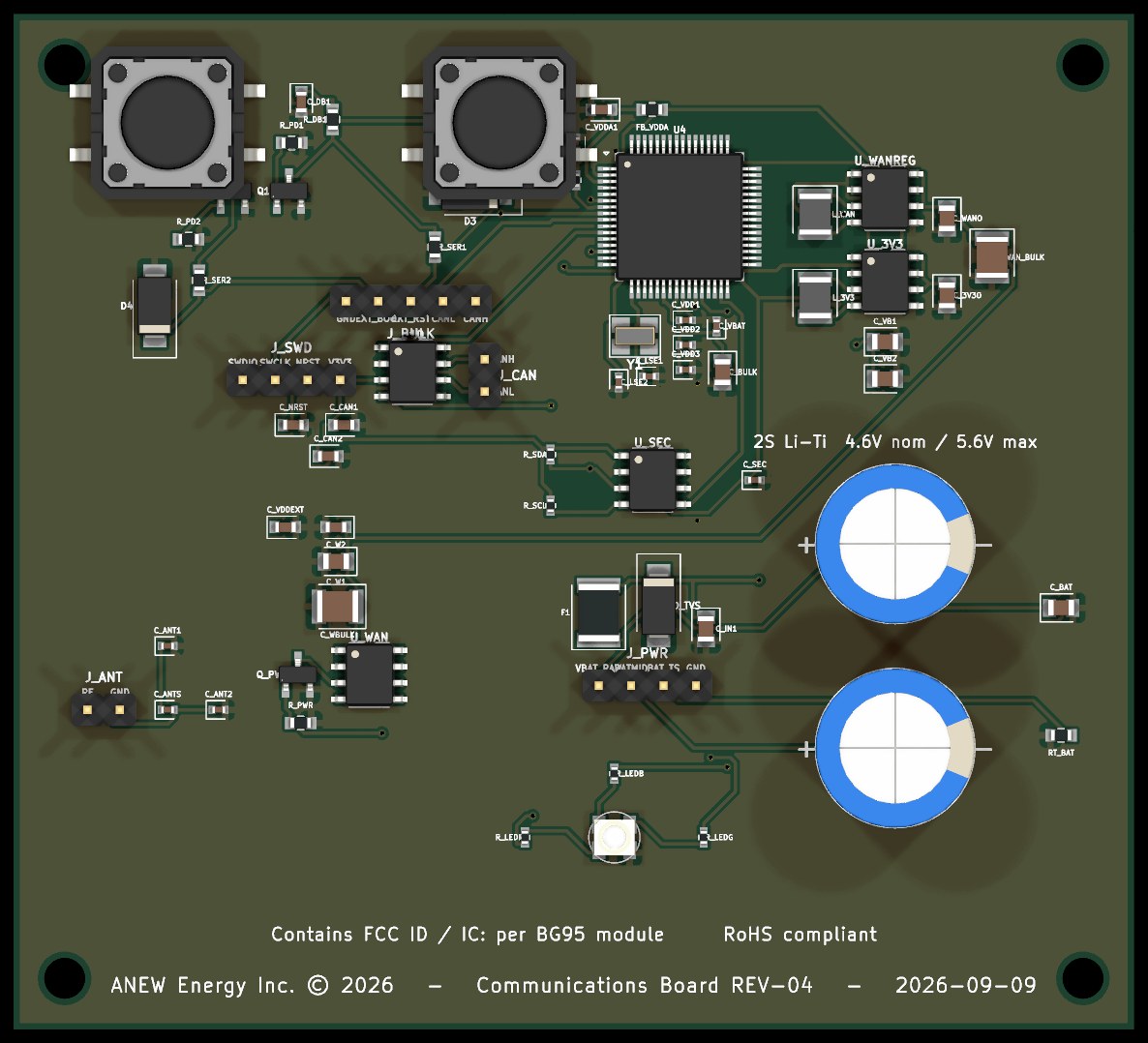
Communications board REV-04, in design-for-manufacturing review. Pilot units exist; fleet data does not yet. How the board works →
- 1
Sell the power before you buy the hardware
A power purchase agreement on the system sells its electricity before the system is financed. The project starts with contracted revenue from a named buyer instead of a forecast, and that is the difference between a loan application and a bond.
- 2
Prove every kilowatt-hour
The communications board measures output at the source and signs each reading with a hardware identity that cannot be copied. Nobody has to take your word for it, or ours.
- 3
Pool it into certified paper
Thousands of signed, contracted systems pool into a weekly country basket. The basket is verified and drawn as a series under a planned Climate Bonds-certified note programme, and the contracted power services the coupon every month.
ANEW Energy is registered with the Climate Bonds Initiative and working toward certification, planned to be in place by the time the products are in production. It is not yet certified. Nothing here is an offer to sell, or a solicitation of an offer to buy, any security.
Buying equipment? Start your funding here.
The anewenergy.earth tool walks you through it — your site's real climate data, your energy use, your EV plans, a sized recommendation, an installer match, and the funding package for the equipment you're about to buy, all before you sign anything.
The Gap
We don't lend money. We make small projects fundable.
A rooftop system in Costa Rica or a micro-grid for a family farm is too small for Wall Street to underwrite — so the people who need clean energy most are told to wait. ANEW Energy closes that gap as a packager, not a lender: the only capital we ever put in is our own equipment on a project.
Every ANEW project throws off four streams of value — the power itself, carbon credits, renewable tax incentives, and a tree planted for every product sold. The power is the engine; the other three are the accelerant. We size the package so the combined value carries the capital equipment plus installation, then aggregate thousands of small projects into paper that institutional capital can actually buy.
Your Funding Matrix
Stack the sources. Borrow less.
Illustrative — block size is not the share of any real project.
The Power Itself
The biggest stream by far. Every kilowatt-hour either replaces an expensive bill — or diesel — or is sold back to the grid under a contracted rate. Typically 80–95% of what repays the note.
Carbon Credits
Device-verified emissions reductions, issued through a recognised registry and sold into carbon markets. Worth most where a dirty grid or a diesel generator is being displaced.
Tax & Import Incentives
Renewable tax credits where they are transferable, and duty and VAT exemptions on clean-energy equipment where they are not. Both cut the amount that has to be borrowed.
A Tree Per Product
Every product sold plants a tree, tagged and tracked like the hardware it came with. Its financial value is small and we say so — its value is proof of permanence, and eligibility under Costa Rica's environmental-services programme.

Sell the power
Make it. Use it. Sell the rest.
The coupon on every note is paid from power that somebody bought. Whether the rest can be sold, who buys it and at what price depends on where the site is, so we qualify the location first. The Energy Markets page explains the whole chain in plain language: the buyers, the traders, the grid operator and the transformer that has to have room for it.
EVERYTHING WE BRING TOGETHER
Ten steps. One turning picture.
This is the whole thing in one object. A rooftop in Costa Rica cannot reach the bond market on its own — it takes an audit, an installer, an insurer, a verifier, a basket, a note, an investor and a trustee, in that order, every week. Spin the wheel or click any symbol to walk the ten steps. The Earth turns with it, because the point of the chain is reaching the places capital normally skips.
Click the glowing symbol
The wheel clicks past a stop like a roulette wheel. Wherever it lands, that party's symbol starts pulsing — click it and you will see what they do, what they contribute, and who they hand off to. The Earth turns in lockstep, because this is a chain built to reach the places capital normally skips.
Why This Matters
Your roof isn't too small. It has just never been financed.
655 million people still have no electricity at all, and around two billion still cook over polluting fuels. Meanwhile the world puts roughly US$2.1 trillion a year into climate — against the US$7.4 trillion a year that's needed through 2030. We are short by more than three times over.
The gap isn't panels
Solar has never been cheaper. The hardware is solved. What's missing is paperwork: nobody drafts bond documents for an $18,000 rooftop, so the capital that wants to fund exactly this never finds it.
Small is where the emissions are
The homes, farms, clinics and workshops that are too small to underwrite are, added together, an enormous share of global energy demand — and the fastest-growing one. Skipping them isn't a rounding error. It's the whole problem.
Aggregation is the lever
One project can't move a market. A hundred thousand of them, pooled and verified, become an asset class — and an asset class is something a pension fund is allowed to buy. That's the entire trick.
What your one system becomes when it isn't alone
This is the part worth being plain about. You are not being asked to donate to the climate, or to pay a premium to feel better. You are being asked to redirect a bill you are already paying — into a system you end up owning, on a roof you already have.
- You supply the site. That is the scarce thing. Capital is abundant; verified, well-sited projects are not.
- Your meter becomes evidence. Device-signed generation data is what lets a verifier certify the bond that funded you — and the next thousand people after you.
- Your project makes the next one cheaper. Every completed, performing system is track record. Track record is what moves the coupon down.
- You are the collateral, not the credit risk. The note is serviced by what your system provably produces — which is why your income status doesn't gate you out.
Climate finance has spent two decades trying to move money to big projects in rich places. The emissions, and the people without power, are somewhere else. Aggregation is how the money finally gets to where the problem actually is.
The shortfall, in numbers
- Without electricity655 million people
- Cooking on polluting fuels~2 billion people
- Climate finance today~$2.1T / year
- Needed through 2030~$7.4T / year
- Needed in emerging markets~$2.4T / year
- The gapmore than 3× short
Sources: IEA energy-access reporting (2026); Climate Policy Initiative, Global Landscape of Climate Finance.

How It Works
From your roof to the bond market — ten plain steps.
Nobody should need a finance degree to understand who is paying for their solar panels. Here is the whole chain, start to finish. Each step is a real party doing a real job — and every one of them gets paid out of the same pot.

We audit your site
eScout, on anewenergy.earth, surveys your roof, your land and your meter against real NREL climate data. Out comes an engineering answer: how much sun or wind you actually have, how much power you actually use, and what size system fits. No salesperson involved. This is the number every later step is built on — which is why the audit has to be honest.

Certified installers bid
The audit goes out to ANEW-certified installers in your region, and they bid to do the work. You get competitive pricing without having to chase three quotes yourself, and the bond gets a real installed cost instead of an estimate. Our master distributor's EPC team then draws the engineered site design that the permitting authority, the utility and the funders review.

The four value streams are priced
Against that specific system we price what it will produce: the power (savings plus anything exported), the carbon credits, the tax and duty incentives your country offers, and the tree. That total is what the project can afford to carry.

Insurers wrap the warranty
Financed renewable energy has to be warranted, or no bond investor will touch it. Specialist markets — the Lloyd's syndicates, Chubb and their peers — write performance-guarantee and warranty cover that stands behind the equipment for the life of the note. Budget roughly 0.8–1.0% of project cost per year, which is about 8–10% across a ten-year note. That premium is a cost of the project and goes onto the ledger with everything else.

Costs go on the ledger
Equipment, installer bid, site design, insurance, audit, certification and a reserve buffer are added up into one number per project. That is the project's line on the bond ledger. Nothing goes in that hasn't been priced by somebody with their name on it.

Projects pool into a weekly basket
One rooftop is too small for the bond market. A few thousand of them are not. Each week's completed projects are pooled into a country basket — Costa Rica first — so that thousands of individually unbankable systems become one diversified, institutional-scale portfolio.

The basket is certified and drawn
The basket is structured to the Climate Bonds Standard, checked by a Climate Bonds Approved Verifier, and drawn as a tranche — a "tap" — under the US$500M Medium Term Note programme. The $500M is the programme ceiling; each weekly tap is a slice of it, not a new half-billion. Paper is drafted, a trustee and paying agent are appointed, and the tranche is listed.

Investors buy it
Green banks, development finance institutions, pension and sovereign funds, donor-advised funds and values-aligned pools buy the tranche. Certified climate paper is genuinely scarce relative to the money mandated to hold it — green bonds have been running roughly 2.6–5.2× oversubscribed against 2.3–3.3× for equivalent conventional bonds, and certified issues have priced at a modest yield advantage. That scarcity is our leverage.

60 days to switch on
Proceeds fund the equipment and the installer. A 60-day commissioning window runs before the first coupon is due, so the system is producing power before it owes anybody anything. On sign-off, the trustee releases payment: the installer gets paid, ANEW gets paid, the insurer's premium is settled.

The system pays the coupons
Every month the meter reports what it made. Exported power, carbon credits, tax incentives and environmental-service payments are applied to the coupon in that order. Whatever they don't cover, the customer pays — and because their old bill has largely gone away, that balance is meant to be smaller than what they were paying before. That is the whole point.

The Whole Picture
The circle of capital.
Every arrow is a real transfer between real parties. Orange is equipment and work, green is money, gold is the credits and income the system earns. They all pass through one place — which is the argument for ANEW existing at all.
Who's At The Table
Eleven parties. One project. Everybody has a job.
Creative climate finance sounds complicated because it involves a lot of people. It isn't complicated — it's just crowded. Here is every party in the chain, what they actually do, and how they get paid.
On the tree, honestly: Costa Rica's PES programme pays per hectare rather than per tree, and a single tropical tree is worth on the order of a dollar or two in environmental-service payments and a few dollars more in sequestration across its life. It is a genuine climate asset and a genuine audit trail. It is not what pays your bond coupon, and we won't pretend otherwise.

Who Gets What
Two worked examples, with the actual slices.
Illustrative modelling, not an offer or a quote — your own numbers come out of your eScout audit. But this is the shape of the deal, and the shape doesn't change much.
Example A — a family home in Costa Rica · 8 kW solar + 10 kWh storage · US$18,000 installed
Example B — a clinic or workshop in Kenya · 30 kW solar + 60 kWh storage · US$65,000 installed
This is where the model gets loud. The site currently runs a diesel generator at roughly US$0.40 a kilowatt-hour. Replacing that with solar and storage saves about US$18,000 a year — while displacing a dirty generator throws off roughly 31 tonnes of CO₂e a year of genuinely additional carbon credits. Debt service on the $65,000 note is about $8,660 a year over ten years.
- Bond investors take 47% of the value created — $8,660 a year, and it is covered nearly twice over
- The business keeps 53% — about $9,700 a year, from year one, on a bill they were already paying
- Carbon credits cover ~4% of the coupon — $378 a year at $12/tonne, and materially more if credit prices firm
- The customer contributes nothing extra — the diesel savings alone over-cover the note
Same structure, same paperwork, same certified installers — a very different pie, because the thing being displaced is expensive and dirty instead of cheap and clean. This is why the programme runs country baskets rather than one global pool: each market's economics are honest about themselves.
Kenya · annual slices
- Value created / year~$18,380
- → Bond coupon$8,660 · 47%
- → Stays with the business$9,720 · 53%
- Carbon avoided / year~31 tCO₂e
- Coupon cover ratio~2.1×
- Simple paybackunder 4 years
Why we run country baskets, not one global pool
Both examples are illustrative models built from public tariff, insolation and carbon-price data, shown to explain the structure. They are not quotes, projections, or an offer of any security, and actual results will differ by site, market, tariff, credit price and financing terms.

Proof-of-Generation Nodes
Every device is a node on the grid of capital.
Every ANEW product is being engineered to carry a Physical Unclonable Function — a hardware identity read from the microprocessor's own flaw signature — the unique pattern of microscopic imperfections every chip is manufactured with, mapped into an ID that can't be cloned, spoofed or duplicated. ANEW's design uses two Physical Unclonable Functions — one on the measuring side and one on the communications board — and both must authenticate before any transaction is accepted. Carbon credits live or die on measurement, reporting and verification, and the usual weak link is a meter reading somebody typed in. A Physical Unclonable Function is designed to close that gap: every kilowatt-hour is signed by a device that can prove it is the device. The credits, the incentives and the coupon are designed to trace back to that signature. A kilowatt-hour doesn't care where it was generated, so a farm in Costa Rica underwrites just like a rooftop in Colorado. Proof, not promises.
- Physical Unclonable Function hardware identity engineered into every device — mapped from the processor's own flaw signature, clone-resistant by physics
- Paired with encrypted, carrier-authenticated cellular — two independent roots of trust, not one
- Signed generation data is the evidence base a verifier and a registry need
- Auditable data trail behind every credit and coupon — verified, not estimated
- Digital-asset ready — a foundation for tokenized, device-verified energy on our roadmap
The Capital Network
- StandardClimate Bonds Standard · approved verifier
- Carbon marketsCME offset futures & registries
- Risk transferLloyd's · Chubb · warranty markets
- Development capitalWorld Bank · EIB · GCF · FMO
- Green banksNY Green Bank · CEFC · GIG · REEEP
- PhilanthropyDonor-Advised Funds · UN SDG capital
- Sovereign & values-alignedIslamic finance · Tribal sovereignty funds
- OversightTrustee & paying agent · independent bond manager
The Machine Behind The Money
This board is why a bank will lend against your roof.
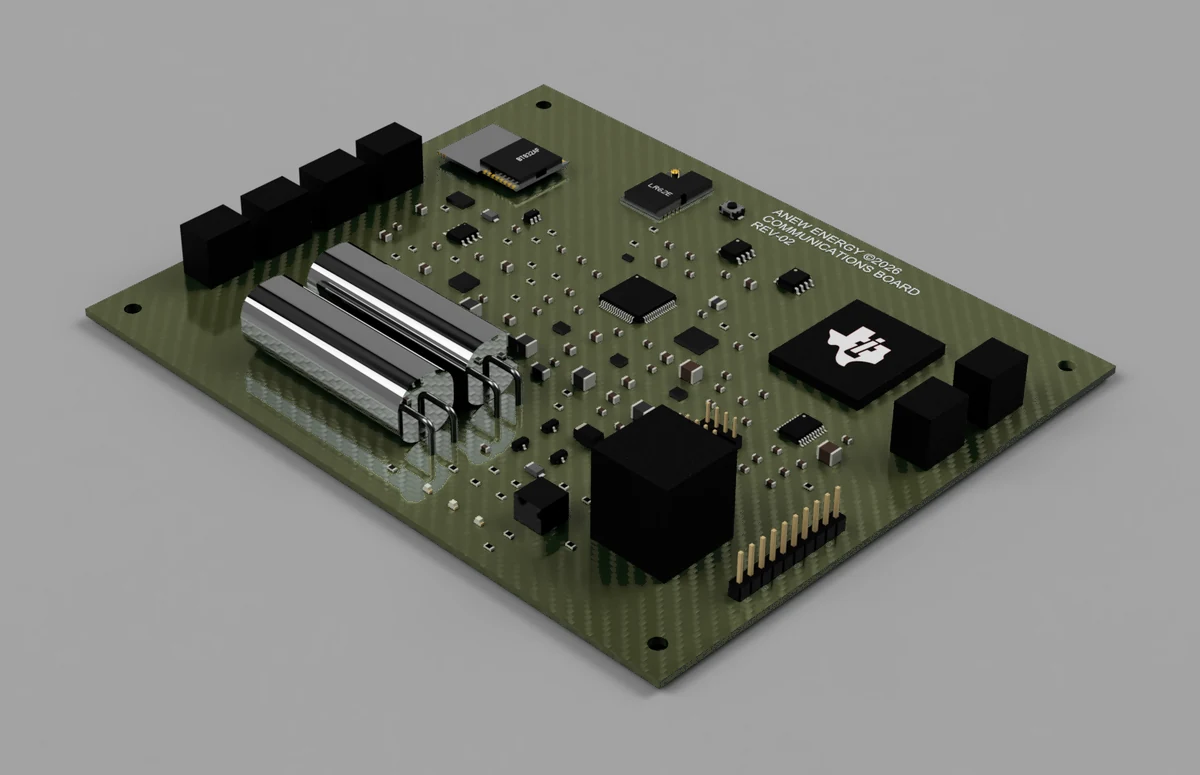
Every claim on this page — the carbon credits, the coupon, the warranty, the verification — is designed to rest on one small board bolted inside your equipment, and specifically on the Physical Unclonable Function identity being engineered into it. Tap the three markers to follow that identity: where it lives, where it gets applied, and how it reaches the market.
Where this stands (October 2026): the identity chip is part of the board design and is being bench-tested on the first factory boards, which carry a clearly labelled software stand-in for it. The real chip is fitted in the next board version. How two chips let anyone check the power is real →
Climate finance has an honesty problem, and it is not usually fraud — it is estimation. Somebody models what a system should have produced, somebody else audits the model, and a credit gets issued against a spreadsheet. That works until it is examined.
This board replaces the estimate with a signature. It measures at the source, signs with a silicon-derived identity that cannot be duplicated, and carries that signature out over an encrypted, carrier-authenticated link — two independent locks, not one. That is the entire reason an institution can underwrite thousands of rooftops it will never visit — and it is the difference between our paper and a promise.
- Measured at the source, not modelled after the fact
- Signed by hardware that can prove it is that hardware, over a carrier-authenticated encrypted link
- Powered and connected independently of the asset it watches
- One record serving the coupon, the registry, the warranty and you

The Physical Unclonable Function Chain
How a chip on your roof becomes a bond somebody buys.
This is the part that usually gets hand-waved. Climate finance runs on measurement, and measurement runs on trust — so we removed the part where you have to trust anybody. Tap any point to see what happens there.
Read it left to right and it is a supply chain for evidence. Read it right to left and it is a supply chain for money. The pair of Physical Unclonable Functions is the hinge — without a device that can prove it is itself, the whole chain is just paperwork asking to be trusted.

Once you know how the power is paid for
Next: how does the equipment get paid for?
There is more than one answer. Paying for it yourself, a green-bond note, crypto capital financing, selling a tax credit, Energy as a Service, or a service funded together with a partner. We explain each in plain words, show how two small chips let anyone check the power is real, and let you compare them with your own numbers.
Compare the six ways to fund it →Simulation and explanation only. Not an offer of securities, financing, tokens, tax or legal advice.
Crypto funding · in brief
Digital dollars can fund real power. Here is how — and what is not live yet.
Crypto here is just a way to move money between people who do not share a country or a bank. A funder pays in a digital dollar, a licensed custodian holds it, the installer is paid as work is proven, and the funder earns a share of the income from power the device proves it made, up to an agreed limit. We are not selling a token, and ANEW does not hold anyone’s money. Our goal is also to let crypto traders earn from the PPAs, carbon and tax credits and other trades that flow from that verified power — once a platform and the right licences exist.
Where it stands
Concept. No custodian or legal structure is in place, no money has moved, and counsel has not reviewed it.
Why a trader can trust the number
Two forms of authentication work together: two Physical Unclonable Functions — one on the power device’s measuring side, one on the communications board — work together. The first signs each reading, the second checks and countersigns it, and both must authenticate or no transaction is accepted.
Explanation only. Not an offer of securities, financing, tokens, tax or legal advice.
Climate Bonds · for fixed-income and commodity desks
Paper you can price. Streams you can hedge.
Written for bond and commodity traders. What the notes are, where they list and settle, what services the coupon, and the venues that price each underlying stream. Every issuer and venue named already runs this route, so nothing here is a new structure.
The paper: Climate Bonds-certified notes
Senior notes issued in series under a revolving programme, structured to the Climate Bonds Standard. The Climate Bonds Initiative, the London not-for-profit that writes the Standard, does not lend and does not guarantee. Approved verifiers test each series against the sector criteria before issuance and again after the proceeds are allocated, and publish the report. For a desk that means a use-of-proceeds label with third-party assurance on every series, not a self-declared green tag.
The certified market is deep. About US$8 trillion of green and sustainable bonds had been issued by the end of 2025, roughly US$6.8 trillion of it aligned with the Standard. Certification is the screen most dedicated green mandates apply, and that is the bid we are structuring for.
Comparable issuers: Panasolar, Panama's first certified green bond (2020) · Banco Nacional de Panamá · Brookfield Renewable's green notes. Verifiers: Pacific Corporate Sustainability · DNV · Bureau Veritas.
Issuance, listing and settlement
A revolving programme to be registered with Panama's securities regulator, the Superintendencia del Mercado de Valores, with a target ceiling of US$500 million. Series are tapped off the shelf as each basket of installed systems is ready, each with its own supplement, so tenor, size and coupon are shaped to the order book rather than fixed once.
Planned home listing on Latinex, the Latin American Securities Exchange in Panama City, in its sustainability segment, with an international display listing on the Luxembourg Green Exchange. Latinex is recognised by the United States Securities and Exchange Commission as an offshore securities market and settles through Euroclear, so a fund in Frankfurt, London or New York holds and trades the notes on rails it already uses. Latinex publishes its green-bond issuance guide with IDB Invest, the private-sector arm of the Inter-American Development Bank, and the Climate Bonds Initiative.
Same route: Bladex, the Latin American trade-finance bank, US$300 million revolving programme on Latinex · CIFI, Panama-based infrastructure lender, first Panamanian corporate bond settled through Euroclear · Panasolar, US$15.5 million certified green bond.
What services the coupon
Contracted output. A system enters a basket only after its electricity is under a power purchase agreement of ten years or more, so the primary cash flow is fixed-price, contracted revenue from a known offtaker, not merchant exposure. Renewable certificates, carbon credits and, for US assets, transferable tax credits sit alongside it, and the warranty layer is insured.
Delivery is verifiable at the meter. Each ANEW product is designed with a communications board that measures output at source and signs every reading with a hardware identity. The trustee releases coupon against that signed record, the registry issues credits from it, and the verifier's annual report reads from it. One dataset from meter to paying agent, with no manual reconciliation in between.
Precedent for pooled distributed-solar paper: Sunrun, about US$2.6 billion of securities repaid from homeowner solar payments. Registries: Verra · Gold Standard.
Where the underlying streams are priced
Every stream behind the coupon has a published reference price and, in most cases, a listed hedge. Power marks against hub futures by grid region. Certificates and offsets trade spot and forward on cleared venues. Compliance allowances apply where a project sits inside a scheme. A desk can mark the collateral, size a basis hedge and price the notes against observable curves rather than a sponsor's model.
ANEW is the issuer and servicer, not a market participant. Hedging and any exchange execution run through licensed participants and their clearing members. Power purchase agreements stay bilateral, arranged on marketplaces such as LevelTen Energy, and US tax-credit transfers are private, insured transactions. The venues we can work with, by stream, are below.
ANEW series under the US$500M shelf Latinex, the Latin American Securities Exchange, Panama City (planned home listing) · the Luxembourg Green Exchange (international display listing) · Euroclear, Brussels (settlement) Secondary trading and settlement of ANEW series once issued. Denomination, tenor and coupon are set per series in its supplement.
Contracted output of the basket CME Group, the Chicago Mercantile Exchange: PJM Western Hub and ERCOT North power futures · Nodal Exchange, Virginia: futures and options across every US grid operator · EEX, the European Energy Exchange, Leipzig: European power futures · Nord Pool: Nordic and European day-ahead and intraday Monthly and calendar-strip power futures by hub, peak and off-peak, plus solar- and wind-shaped products for hedging contracted output. The power purchase agreement itself is bilateral, arranged on marketplaces such as LevelTen Energy, not on an exchange.
One per megawatt-hour of clean power Nodal Exchange · ICE, the Intercontinental Exchange, Atlanta · EEX, the European Energy Exchange US renewable energy certificates by state programme and vintage, spot and futures. European guarantees of origin, spot and forward.
One tonne of carbon dioxide avoided CME Group: Global Emissions Offset futures (GEO, N-GEO and C-GEO), physically delivered · Xpansiv CBL: the largest spot market for credits · ACX, the AirCarbon Exchange, Abu Dhabi · Climate Impact X, Singapore Registry-issued credits (Verra, Gold Standard) from independently audited meter data, traded spot and as delivered futures by standard and vintage.
Government permits to emit ICE, the Intercontinental Exchange · EEX, the European Energy Exchange · Nodal Exchange European Union, United Kingdom and California allowances, and Regional Greenhouse Gas Initiative allowances for the northeastern United States, as futures and options. Relevant only for projects inside one of those schemes.
US projects only Not exchange-traded. Transferable under US federal law and placed privately on marketplaces such as Crux and Reunion, typically with tax-credit insurance behind the transfer. Time-limited under US legislation passed in 2025; the credit for battery storage runs longer than the credit for solar. Outside the US the equivalent benefit is relief from import duty and sales tax on clean-energy equipment.
The request: indications of interest, not orders
The programme is in structuring. Nothing is registered or offered today. What moves it forward is written, non-binding interest from the desks that will eventually price it:
- Fixed-income desks and green mandates: an indication of size, tenor and spread expectation for a first Latinex-listed series, so the shelf is sized to a real book.
- Commodity and power desks: indicative offtake or hedge terms for a basket's contracted output, certificates and credits, by hub and vintage.
- Clearing members and market makers: willingness to quote the notes in secondary and to clear the hedges on the venues above.
Indications are confidential and carry no commitment on either side. Tell us the desk, the stream and the size you would look at, or read the technical brief first.
This page is not an offer to sell, or a solicitation of an offer to buy, any security in any jurisdiction. Any offering would be made only by the issuer, under a registered programme and its offering documents, to persons eligible under applicable law. Venue and organisation references describe the programme's target market infrastructure and do not imply endorsement by, or any agreement with, any exchange, verifier or the Climate Bonds Initiative. The programme is in structuring; figures are targets, not offers. Market figures from Climate Bonds Initiative, Latinex and exchange public reporting.
Cradle to grave · the carbon ledger
How we count carbon, cradle to grave, for the life of the product.
A climate bond is only as green as the evidence behind it, and the evidence is what unlocks capital from the climate-bond market. So we count the carbon in every ANEW product from the mine to the landfill or the recycler: the raw elements dug out of the ground, the metal, the plastic, the computer chips, the factory power, the shipping, the installer’s trucks and machines on site, the years of service and what happens at the end. Then we set that against the carbon the product avoids over its working life. The verifier who tests a bond series against the Climate Bonds Standard reads from that ledger, and it is built to the methods they already use: ISO 14040/44 for life-cycle assessment, ISO 14067 for a product's carbon footprint and the GHG Protocol Product Standard.
The raw elements
Iron ore, bauxite, copper, silica and the battery elements, mined, refined and smelted. For most products this is the heaviest stage, and it is carried inside each material's factor below.
Metal and plastic
Stainless and structural steel, die-cast aluminium, copper windings and busbars, polycarbonate and other plastics, glass. Counted by weight, material by material.
The computer inside
Circuit boards, processors and power electronics, including the communications board in every product. Light, but among the most carbon-intensive materials per gram.
Factory power
The electricity to mould, machine, assemble and test. Where the factory sits matters: a kilowatt-hour on Costa Rica's grid carries a fraction of the carbon of one on a coal-heavy grid.
Ship, truck, van
Tonne-kilometres by sea freight and road from the factory to the site, including packaging.
The build on site
The installer’s trucks, trenchers and augers, diesel, gasoline or electric, and the drive to the site each day. It is the installer’s own footprint, logged every work day in the Site Development Tool and pulled into the project’s ledger once. Until the logs arrive, the simulator uses an estimate.
The working life
Service visits over the years of operation, against the clean kilowatt-hours the product delivers. This is where the carbon comes back.
Recover or landfill
Dismantling and processing, with material recovery at our design target of 85% by weight. The rest is counted as waste.
Cradle-to-grave carbon simulator
Pick a product and a place. Every factor carries a tolerance: a low, a typical and a high value. Illustrative throughout.
range
range
range
range
Cradle to grave, stage by stage. The bar is the typical value; the white whisker is its tolerance, from the low to the high factor.
Every line in the ledger, with its factor and data quality
Simulation, not an assessment. Factors are rounded ranges from public life-cycle literature and databases, such as the University of Bath Inventory of Carbon and Energy for materials and national grid-emission data, not ANEW measurements. The material splits are illustrative, drawn from each product's published spec; the full bill of materials is held under NDA. Grid factors are approximate national averages; a real assessment uses the jurisdiction's current published factor. Products are pre-production, so the battery-cell factor is an estimate with no measured life-cycle data behind it yet.
A tolerance on every number
- No figure travels without its range. Each factor in the ledger has a low, a typical and a high value, and the totals carry the spread through. A carbon number without a tolerance is a claim; with one, it is a measurement a verifier can test.
- We report the conservative end. The figure offered to a verifier and to an investor is the cautious one: embodied carbon at the high end of its range and avoided carbon at the low end. If the real number turns out better, the project over-delivers.
- The band narrows as data arrives. Today most lines are generic database values or pre-production estimates, so the tolerance is wide. Supplier-specific data, then factory metering, then the 18-month test-bench programme replace them line by line, and each replacement tightens the band. The data-quality tag on every line says which stage it is at.
Every tonne counted once
- One ledger, one owner per tonne. The same meter record that shows a verifier what a bond financed is the record a registry such as Verra or Gold Standard would issue carbon credits from. A tonne sold as a credit is flagged in the ledger so that nothing else claims it.
- Batteries and generators are not added together. A Power Pack charged from solar avoids carbon only because the solar made clean power. The ledger books that carbon once, on the system, never once on the panels and again on the battery.
- Measured, not modelled, once it is running. The communications board in every product signs each meter reading with a hardware identity, so the avoided side of the ledger comes from delivered kilowatt-hours, not from this simulator's assumptions.
ANEW is registered with the Climate Bonds Initiative and working toward certification; it is not certified. The Climate Bonds Initiative certifies bonds against its Standard and does not issue, count or trade carbon credits. Life-cycle figures on this page are illustrative estimates from generic factors, not a third-party-verified assessment, and every product is pre-production. Nothing here is an offer to sell, or a solicitation of an offer to buy, any security or carbon credit.
Who pays for the power
Who actually writes the cheque for a kilowatt-hour.
Every coupon on every note is paid from power that somebody bought. Who that somebody is depends on the kind of market the site sits in. There are three kinds, and in all three the grid operator has a say before any buyer does.
One buyer, a regulated price
In Costa Rica the local distributor is the only buyer. It credits the power a home exports at a rate set by the regulator, ARESEP, and the household saves the full retail rate on what it uses itself. No exchange, no trader, no choice of retailer.
Low volatility, regulatory reset as the main risk. This is what the Costa Rica basket is written on.
A contracted buyer, the off-taker
In open markets a licensed trader or aggregator bundles thousands of small sites and sells the output to an off-taker, a company, utility or retailer, under a power purchase agreement of ten years or more at a fixed price. That contract is what the basket requires before a site can enter.
Companies such as EDF Trading, Statkraft or Axpo provide this route to market for renewable generators in Europe. Names are examples, not partners.
The open market, hedged
Whatever is not under contract is sold day-ahead or intraday into the wholesale market, or to a retail electric provider that resells it on tariffs. Prices move, so merchant volume is hedged on venues such as CME Group, Nodal Exchange and EEX, and it is why the notes are serviced by contracted, not merchant, revenue.
Kenya's 2024 open-access regulations are moving its market from type 1 toward types 2 and 3.
For the specialist · the grid operator's veto
No sale happens until the distribution operator approves the connection, and the approval turns on the substation transformer: it must carry the feeder's midday export and its evening load without exceeding its rating or its voltage band. Storage that shifts export into the evening peak lowers both, which is how a fleet of ANEW sites connects without waiting for a substation upgrade, and why storage-dispatched power earns a firmness premium in the PPA. Grid companies such as Enedis in France, and ICE and its seven fellow distributors in Costa Rica, run these studies; the ANEW board at the transformer node supplies the loading data they ask for.
A Deeper Dive
A deeper dive into our funding methods.
Our strategy pairs a flagship instrument with a deep bench of capital resources. The flagship: a US$500M Medium Term Note programme structured for Climate Bonds Certification, listed where climate capital concentrates, and serviced by device-verified power, carbon and tax-credit cash flows. The $500M is the programme ceiling — tranches are tapped off the shelf as baskets fill, not issued whole.
Behind it, we are building the full capital stack for deployment: development capital from institutions like the World Bank, EIB and the Green Climate Fund; the green banking network; donor-advised funds and UN SDG philanthropy; and values-aligned pools from Islamic finance to tribal sovereignty funds — routed into weekly country baskets that reach real homes and small businesses.
Why we finance this way
Money that builds something.
Every step above points capital at a physical asset in a real place, and lets it be repaid by what that asset actually produces.
An old distinction worth reviving. Oikonomia — the root of the word economics — means management of the household. Set against it is chrematistics: using money simply to make more money, which Aristotle judged unnatural. Modern finance no longer marks the difference: the same return is treated identically whether it came from a wind farm or a position held for a fraction of a second.
Wealth is more than one number. A funded ANEW project should return on more than the note — local trades trained, an asset the community owns outright, emissions avoided, and power that lets new local enterprise exist at all. Over a 50-year life those are not soft extras; they are what makes the financial return durable.
Which way the value flows
Off the growth treadmill, into the local economy.
Resources are consumed faster than they regenerate for a reason, and it is not a shortage of good intentions. A very large machine has to grow every quarter, and physical things get torn up to make that happen.
Nobody steps off it alone. Exponential growth genuinely works short term — fortunes are made, pensions funded, budgets balanced. Slow it and recession follows immediately; keep it and the ecology goes down with the economy. Meanwhile the industry optimised for extracting returns on financial capital and left the whole system brittle enough to need central banks to survive contact with reality.
We still trade the instruments. Climate bonds are issued, power-purchase agreements signed, carbon credits registered and tax credits monetised — that is what gives a customer access to capital they would never be offered. What changes is where the income lands: revenue services the note, and the surplus stays with the owner and the local trades who built and maintain the asset.
Same instruments. Opposite direction of travel. Capital markets become a utility the local economy uses, rather than the party the local economy exists to feed. The reason this has not been normal is mechanical: community-scale projects are too small and too unverifiable to reach those markets alone. Solve measurement and aggregation and it inverts. That is what the platform is for.
Proof the market accepts
A Physical Unclonable Function hardware identity is being engineered to sign every kilowatt-hour at the device. The weak link in carbon markets was always a meter reading somebody typed in.
Scale without consolidation
Aggregation happens at the instrument, not the asset. The roofs, turbines and micro-hydro stay in local hands — only the paperwork is pooled.
Tokenized energy — roadmap
Device-verified generation is the foundation for tokenized instruments. That is a stated roadmap item, not a live product. We would rather say so.
ANEW Energy is not a lender, broker-dealer or investment adviser. This section is for information only and is not an offer to sell, or a solicitation to buy, any security. Roadmap items are statements of intent, not commitments.
Several of the economic ideas in these sections come from The Great Simplification — Nate Hagens in conversation with John Fullerton on regenerative economics and Ed Conway on Material World. Cited as influences on ANEW’s thinking; none is affiliated with ANEW Energy and no endorsement is implied.
For bond and commodity desks
Certified notes for the bond market. Priced streams for the commodity desk.
Clean-energy demand does not have a down cycle, and the cash flows behind it are ones a desk already knows how to price. Our planned notes are structured to the Climate Bonds Standard for a Latinex listing with Euroclear settlement, and are serviced by contracted power purchase agreements, device-verified generation data, an insured warranty wrap and trustee-administered coupons. The power, renewable certificates and carbon credits behind each coupon mark against listed commodity venues, so the collateral can be hedged as well as held.
ANEW Energy is not a lender, broker-dealer or investment adviser. This page is for information only and is not an offer to sell, or a solicitation to buy, any security. Program terms are subject to applicable regulatory requirements.
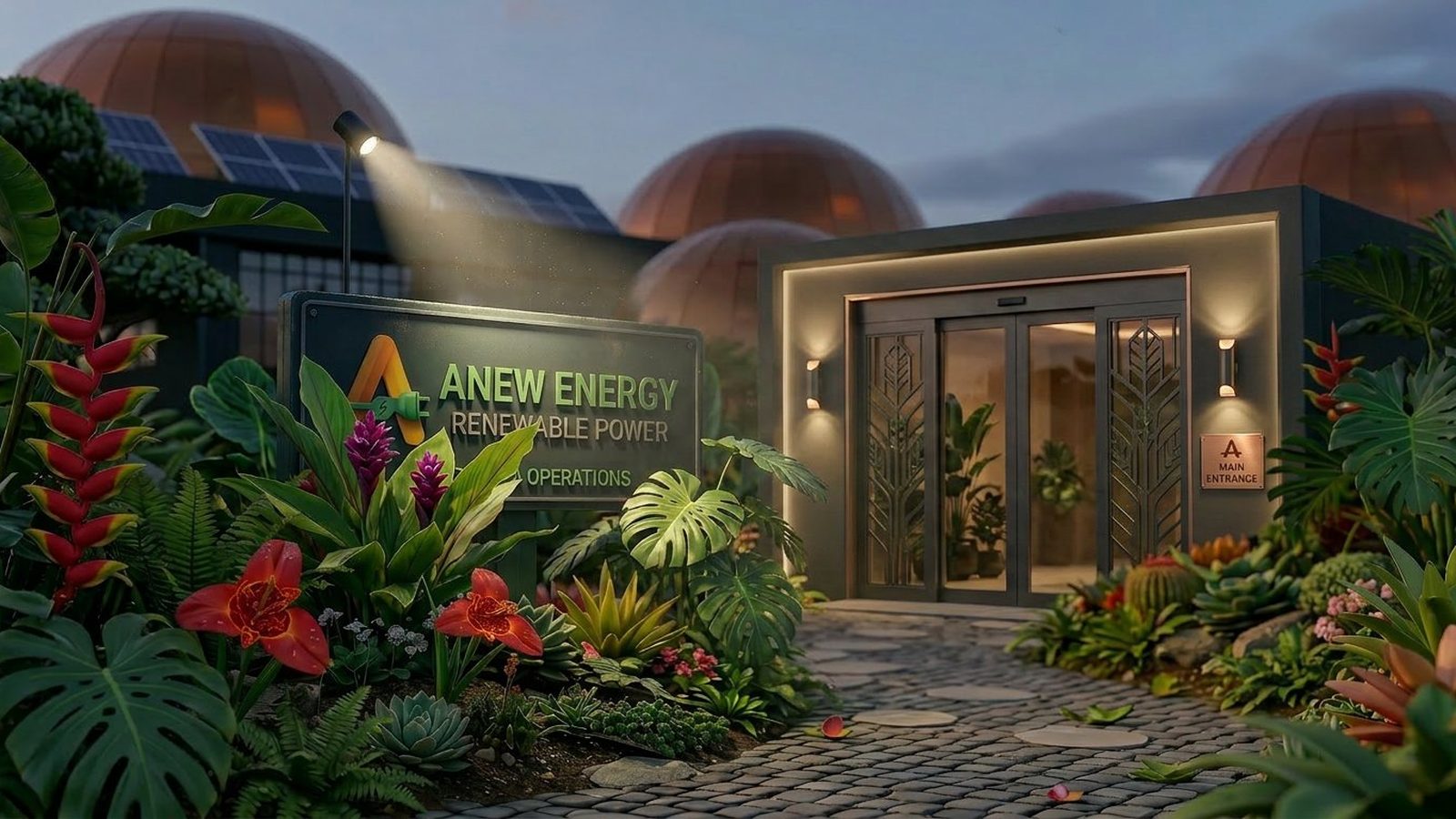
The micro-grid is what makes the funding work: metered generation, storage and a grid connection produce a verifiable 24/7 output, and that output is exactly what the carbon credits, PPA and tax credits are written against.
ANEW reference design — architectural rendering generated with Runway.