SOLAR TRACKER
Track the sun. Duck the storm.
BI-FACIAL · PNEUMATIC · STORM-RETRACTING · NO MOTORS
Video transcript
Okay, let's talk about solar. So, we have partners, same scenario, manufacturing people that are trying to fight the climate crisis at scale. And there's a group, that has come together to deliver a solar production line to the Annuity copy factory. And so that's a large investment. And we're kind of going to start buying these solar panels.
But a solar panel, can make, power on the top surface. And now there's a new panel, well, it's been out for years, that can make it on both top and bottom. So it's called a bifacial panel. And so what we, are looking at is a way to protect these valuable assets that you have made investments in.
And a standard panel size, there's two of them. And we use pneumatic, so we use a little air pump and we, we track the sun. It comes out of this box and then it starts looking for the sun. And, and, and when it starts reading a higher power, it, it stays there and it keeps looking for the sun through little air cylinders. And the reason why we're using air is that mechanical motors tend to fail, especially when, they're in a marine environment where there's a lot of, a lot of salt and humidity.
And so we have done this design that's a device that takes the solar panels back into a, protective mode. So when big hurricanes come through, we, can retract the panel and put it into a safe place where the wind will go up and over the top of this, this package. So this is, our solution for dealing with problems like hurricanes coming into the Caribbean and tearing out the infrastructure and then everybody rebuilding. And then the next storm comes in and throws it all back out into the ocean and they've got to redo it again. So we're trying to preserve your valuable asset as a solar panel.
So again, you know, we've got these, these glowing dots here, and it'll tell you, all about the product. You can go there. They come in different colors. So, we, there it is coming out of the box. There's a reflector on the backside of this. So we lift it up and we let the sun come down and bounce up to the backside. So we kind of optimize the energy on the top surface and on the bottom always.
So, so you'll see, there's a video down here at the bottom. Let's see. No, it's not there. There's a place where you can see it actually moving. You'll find it on the website. I think it's on the homepage. Anyhow, thank you very much for taking time to learn about this and have a beautiful day. Pura vida. As they say in Costa Rica, that means, the pure life. And we'll talk later. Thank you.
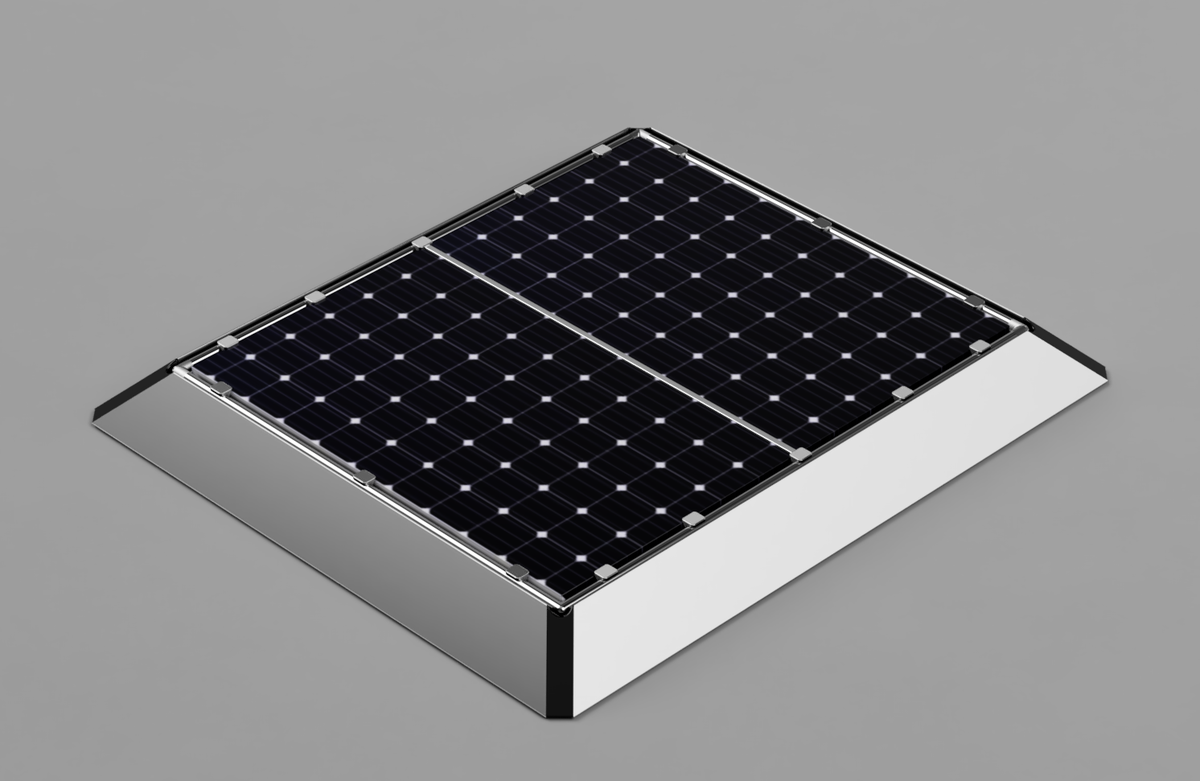
 Generation that ducks the storm
Rises to track. Folds to survive.
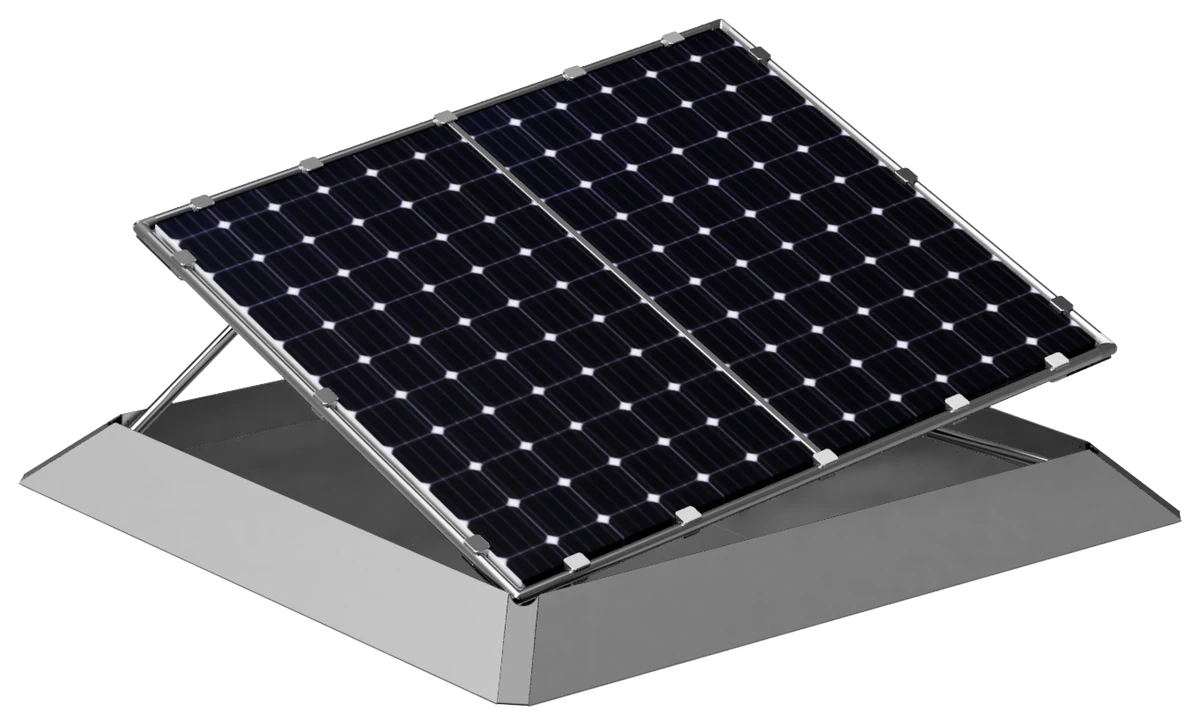
The ANEW Solar Tracker holds two bi-facial, high-performance solar panels that rise out of a protective frame to track the sun through the day — then fold back down into the frame the moment high winds are detected. It is built for the places that need power and get hammered: hurricanes, typhoons and tornadoes.
It tracks the sun pneumatically — no motors to burn out or draw power. A solar reflector inside the frame bounces light onto the backs of the bi-facial panels, harvesting from both sides. The panels themselves are off-the-shelf, high-performance modules — proven glass, ANEW's protective frame.
And the array reports what it actually produced — to the customer's eScout portal and to the batteries it charges. That measured, hardware-anchored record is what makes the equipment financeable.
◷ Available Fall 2028

Sell the power
Make it. Use it. Sell the rest.
Trackers make more midday power than a fixed array, and midday is exactly when the grid has the least room for it. Whether the rest can be sold, who buys it and at what price depends on where the site is, so we qualify the location first. The Energy Markets page explains the whole chain in plain language: the buyers, the traders, the grid operator and the transformer that has to have room for it.
How It Works
Up for the sun. Down for the wind.
Rises & Tracks
The panels lift out of the frame and follow the sun across the sky, holding the best angle for the most energy — all day, automatically.
Pneumatic — No Motors
Air, not motors, raises and steers the array. Nothing to burn out, nothing drawing power to move — fewer parts, longer life.
Folds for the Storm
When high winds are detected, the panels drop back into the frame and shelter behind it — engineered for hurricane, typhoon and tornado country.

Measured · Signed · Financeable
An array that can prove what it made.
Solar gets financed on a projection. This tracker is built to be financed on a measurement — its own.
It reports to the eScout portal
The tracker communicates with the customer's eScout portal: what the array produced, how it tracked, when it folded for weather. The owner sees their own machine, not a monthly average from someone else's model.
It agrees with the batteries
The same reading is exchanged with the batteries it charges, so generation and storage corroborate each other instead of each keeping its own book. The Communications Platform signs the result at source — hardware-anchored and clone-resistant.
Someone else can rely on it
A performance record that is measured on the equipment and signed on the equipment is a record a lender, a green bank or a co-op can underwrite. That is how a verification method becomes a financing method.
Performance reporting and verification behaviour describe the current design intent for the Fall 2028 product. Nothing on this page is an offer of securities or a commitment of financing.
Where It Goes
Built for the roofs the weather finds first.
A tracker earns more than a fixed array — right up until the storm that ends it. This one is designed to still be there afterwards.
| Where it lands | What it replaces | Where it shines |
|---|---|---|
| Coastal & island rooftops★ Primary | A fixed-tilt array that gets stripped in the first named storm | Hurricane and typhoon corridors, where insurers price fixed solar as a write-off |
| Tornado-belt farms & sheds | Ground-mount racking with nothing to do but stand there | Open ground with no windbreak — the array folds before the wind arrives |
| Community micro-grids | Diesel top-up on short winter days | Tracking plus bi-facial gain stretches the same roof area further |
| Off-grid homes & clinics | An oversized fixed array bought to cover the worst hour | Paired with a Power Pack, tracked output flattens the day |
| Financed & leased installs | Yield estimated from a model and argued about later | The array will report its own production to eScout, so the record settles the argument |
| Mixed-source sites | A separate string box per array | Lands through the J-Box onto the same bus as wind, water and storage |
Suitability depends on site, structure and local certification. Panel electrical ratings follow the installed off-the-shelf modules.
By the Numbers
Four figures, no guesswork.
Product figures describe the current design revision. Service life is a design target, not a warranty.
The Spec Sheet
Two panels, both sides working.
Array & Tracking
- TypePneumatic sun-tracking solar array
- Panels2 × bi-facial, high-performance modules
- Panel sourceOff-the-shelf, proven glass
- Working faces4 — front and back of both panels
- Backside gainSolar reflector inside the frame
- TrackingPneumatic — no motors
- Storm modeAuto-retracts into frame on high wind
- FrameStainless & aluminium protective enclosure
- Panel retentionPerimeter rails with clamped modules
Reporting, Pairing & Build
- Reports toCustomer eScout portal
- Also talks toThe ANEW batteries it charges
- RecordSigned at source — hardware-anchored
- PurposePerformance verification for financing
- Lands throughANEW Junction Box onto the bus
- ClimateHurricane · typhoon · tornado zones
- Moving partsMotor-free — pneumatic actuation
- ColoursFixed finish — no colour options
- Onboard batteryOptional — ANEW solid-state Power Pack
- Targeted service life50 years
Theoretical values. Calculated from mathematical models, not measured physical performance. See the test-bench note below.
Figures shown are design targets. Panel electrical ratings follow the installed off-the-shelf modules; final certified ratings depend on regional certification.
About these numbers
The performance values on this page are theoretical. They are based on mathematical calculations, not on measured physical performance. We will update them as physical values come in during our 18-month “Iron Man” destructive testing and validation programme. All products will carry the onboard eCube Power Trading technology, which will be calibrated each year to ASTM standards.
In the Wild
On the roof, tracking the evening sun.
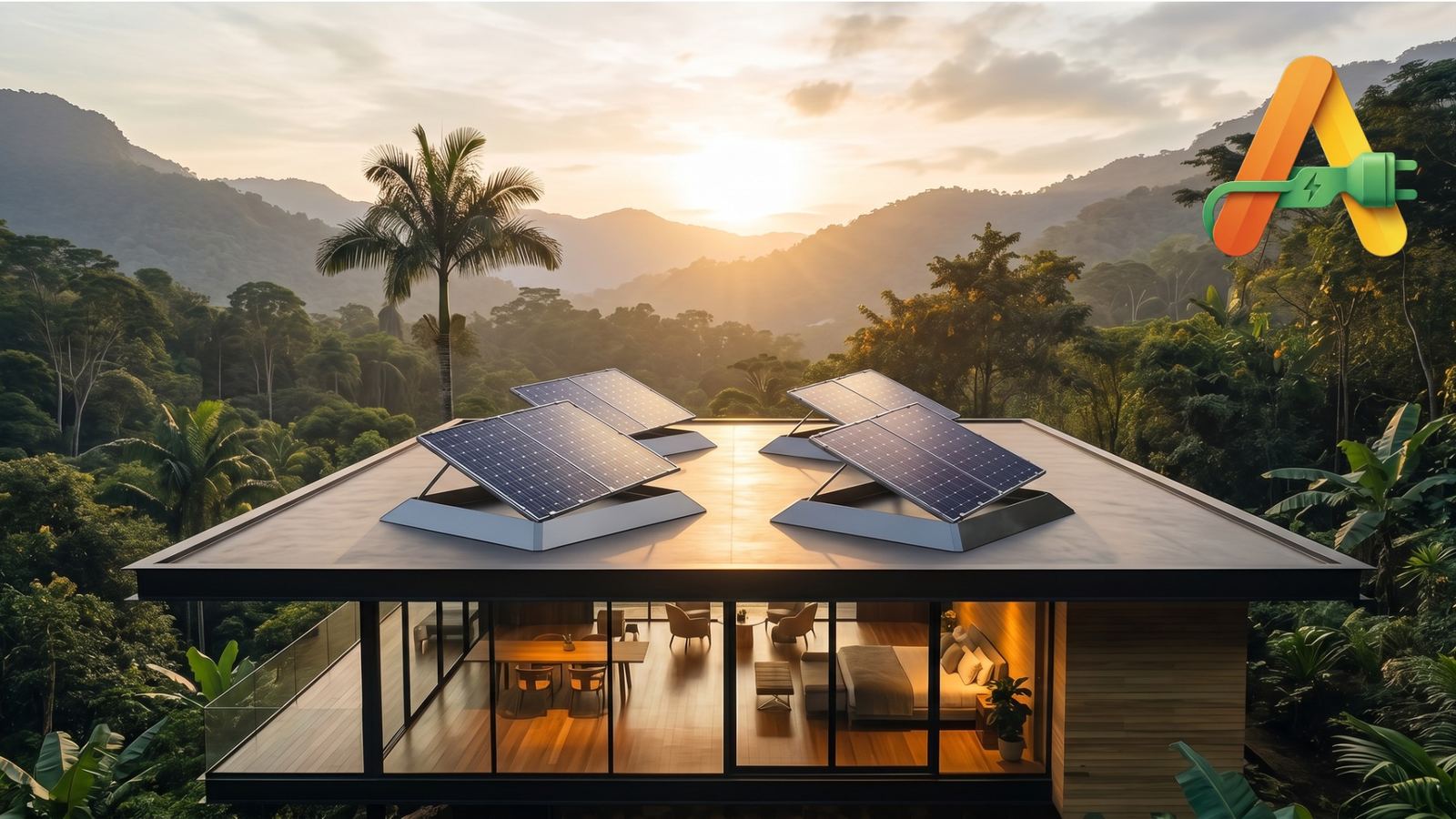
Power that weathers anything.
Available Fall 2028. Size your system on the ANEW tool, or talk to our team.
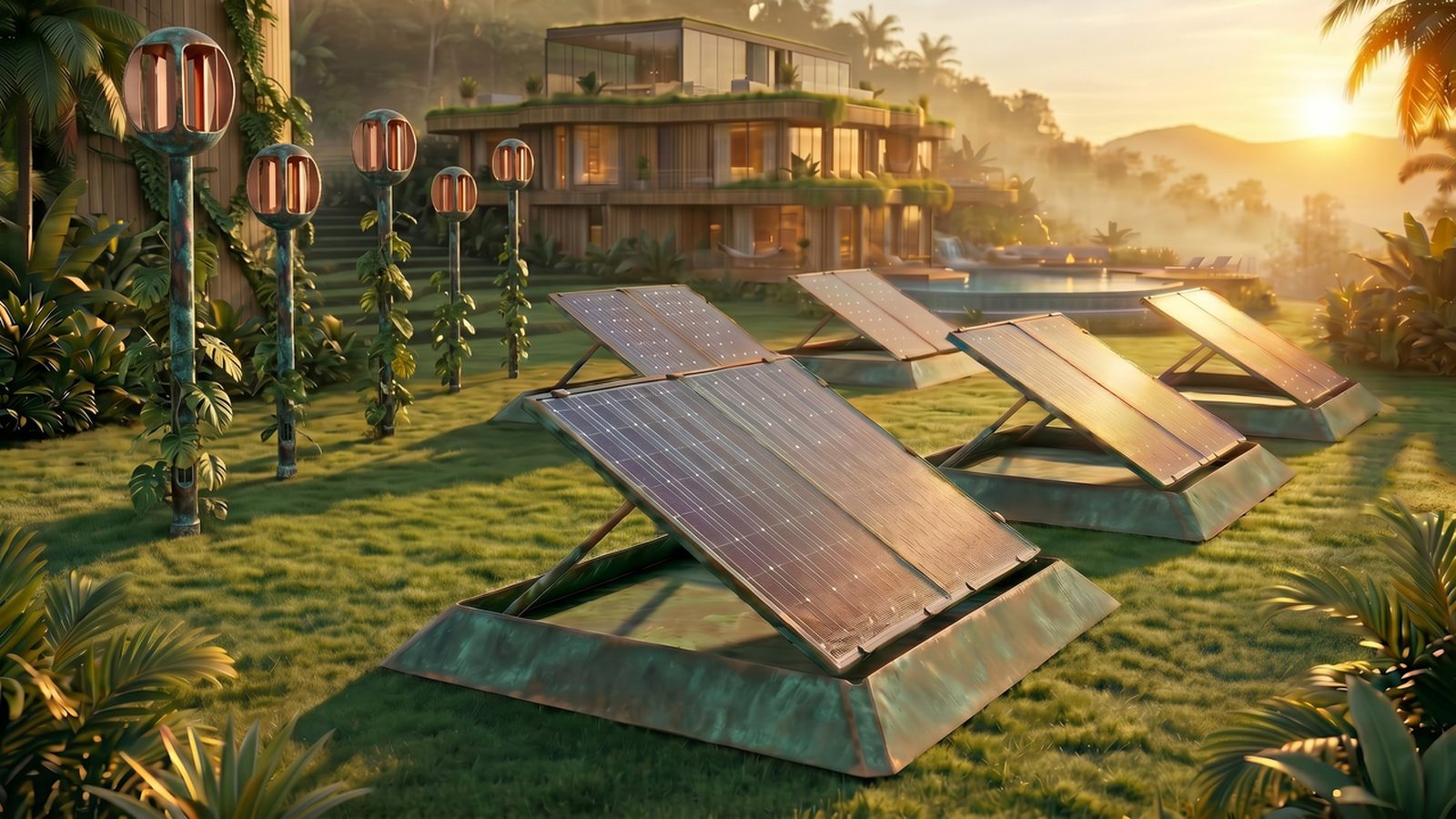
Tracking lengthens the generating day, storage covers the night, and the grid-tie covers the weather. Together they form a micro-grid that holds a flat 24/7 output instead of a daytime-only curve.
ANEW reference design — architectural rendering generated with Runway.
How Your Project Gets Paid For
Every product we make is born fundable.
The hard part of clean energy is not the hardware. It is that a single roof, farm or clinic is too small for a bank to look at. So we build the financing into the product. The same board ships inside every ANEW system, sells its power under contract, proves every kilowatt-hour it delivers, and lets thousands of small systems be pooled into paper the bond market can actually buy.
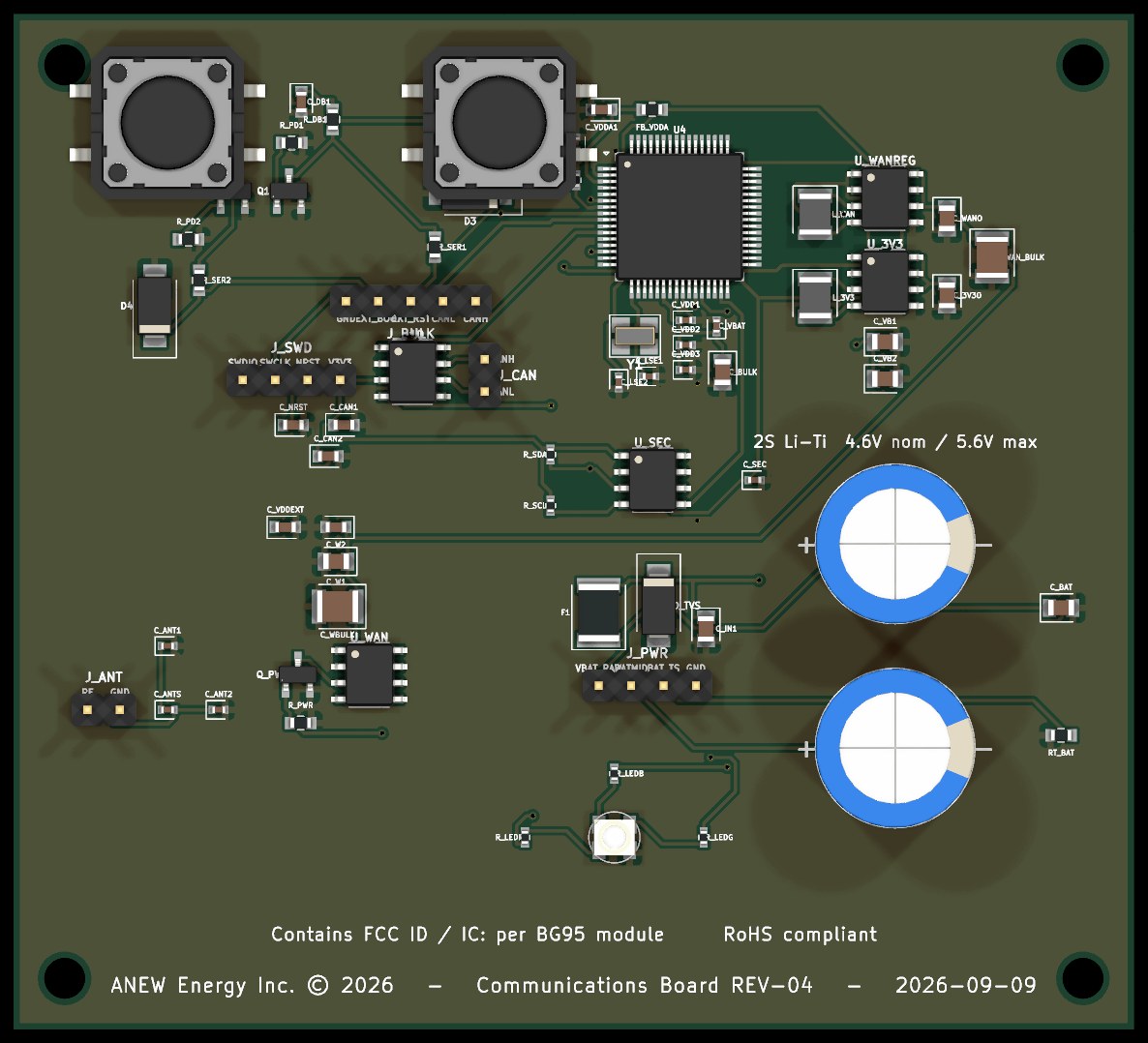
Communications board REV-04, in design-for-manufacturing review. Pilot units exist; fleet data does not yet. How the board works →
- 1
Sell the power before you buy the hardware
A power purchase agreement on the system sells its electricity before the system is financed. The project starts with contracted revenue from a named buyer instead of a forecast, and that is the difference between a loan application and a bond.
- 2
Prove every kilowatt-hour
The communications board measures output at the source and signs each reading with a hardware identity that cannot be copied. Nobody has to take your word for it, or ours.
- 3
Pool it into certified paper
Thousands of signed, contracted systems pool into a weekly country basket. The basket is verified and drawn as a series under a planned Climate Bonds-certified note programme, and the contracted power services the coupon every month.
ANEW Energy is registered with the Climate Bonds Initiative and working toward certification, planned to be in place by the time the products are in production. It is not yet certified. Nothing here is an offer to sell, or a solicitation of an offer to buy, any security.
A tree with every product
Buy ANEW technology and we plant a tree you can follow.
Pick it, name it, find it on the map and watch the CO₂ it holds grow. Or receive a young tree and plant it yourself. Concept with a working demo: the first planting, in Costa Rica, has not happened yet.