OUR IMPACT
How do we stop the climate crisis from getting worse — at scale?
The honest answer: emissions fall fastest when clean energy is cheap enough to deploy everywhere. ANEW Energy is built for that — affordable, earth-abundant clean power, manufactured in replicable factories, put within reach of the communities and nations the transition has so far left behind.
Video transcript
Okay, let's talk about impact and how the new energy, carbon footprint, is minimized, how we use affordability for all these products, where not a lot of debt is backed up and creating problems where people can't service the debt. How do we do it at scale, and then how do we create sustainable jobs and be able to let everybody participate in the new sustainable economy?
So our focus groups that sat down, all these wise men, that I surround myself with, was trying to figure out how we can first minimize the carbon footprint. So anybody can call up China and say, I need a battery. And then the battery brings in all the raw materials, they go into China, the trucks drive through China, polluting and then it goes into the factory. The factory uses a lot of electricity, it makes the batteries. The batteries get shipped back out of the factory, they get put onto a boat, the boat heads over to where the customer is and it's got to get distributed. The installers have to come and install it. And you know, the whole carbon chain of pollution starts with just mining the raw materials.
So we think that building the factory where the products are consumed is probably one of the most impactful ways to lower our carbon footprint on planet Earth. And again, our mission is to build 10 of these, copy factories around the world. They'll be exactly like one another. So when we go in, we already have done it before, we can teach everybody all the tricks of the trade and then we can get out and move on to the next factory. So when we do this, the cost of the factory goes down, our buying power on raw materials goes up and our carbon footprint goes down.
So another impact thing is that we are focused on using earth abundant materials. So you'll hear this throughout the website that to go from mining copper, which on the periodic table is know harder to find than aluminum, that switching to aluminum for our electrical conductivity, the wires that you plug into the wall and power your home and into the grid, we can do the same thing with, with aluminum versus copper. So we choose these materials because they're having a lower impact on the environment.
Magnets. You know, everybody uses these rare earth elements in their magnets. Some of this stuff we can't get around. But magnets, you know, ferrite magnets, which is iron and neodymium magnets, which is a rare earth element. All of our products are made with ferrite magnets. So it's pretty cool how we really put a lot of design emphasis on delivering products that can impact just the mining component of it.
So counting carbon calories. You're gonna hear us counting carbon calories and we just like want to know how much it costs to make a ton of steel, how much it costs to bring in a ton of aluminum on the calorie, the carbon calories that were emitted into the atmosphere. So we're trying to shrink that down and really know what's going on.
On the jobs, two men in a pickup truck, two women in a pickup truck can participate in this new sustainable economy. So if you're a tradesman, a carpenter, electrician, a plumber, or you just want to get into renewable energy, all you need is a way to transport this equipment to a site location and do the installation and service and we're going to create a new sustainable economy. So we're really excited about the jobs that we're creating and it's going to be tens of thousands of jobs getting capital to our end customers. That's a big one.
So there's a whole section on this. I'm not going to get into it much, but we know how to help you find capital and qualify your site and let somebody else essentially pay for it. You just keep paying your electric bill and they get to benefit off the excess power sold to the grid and things like that.
So we, we don't want to leave any communities left behind. There's so much of the world that climate has impacted it there. They pollute less than the big industrial nations, of the world. And we want to be able to help them save their world. I mean a lot of these communities, you know, if they've got food in a freezer and it's storing and then a hurricane or a fire comes in and knocks it out, you know, how do you power that when the grid, the power lines are blown down and broken and you know, we want to be able to, you know, have this self healing micro grid technology, that keeps the grid up and running.
So anyhow, this is a better way of living. It's a sustainable system. So the economics are sustainable and they're living together. You know, we need the money from the guys on Wall Street. Wall Street needs, you know, all these, these products out into the world that they can start making some money on and financing, things like that. So anyhow, this is our section on impact and it's a very important part of our company. So thank you very much and have a beautiful day. As they say in Costa Rica, pura vida, that means the pure life.
The challenge — and the lever
Affordability is the lever.
Global greenhouse-gas emissions hit a record 57.1 billion tonnes in 2023 and are still rising; keeping 1.5°C within reach requires cutting them 42% by 2030 (UNEP, Emissions Gap Report 2024). The technology to do it is finally cheaper than the alternative — 81% of new utility-scale renewables added in 2023 already cost less than the cheapest fossil option (IRENA, 2024).
What's missing is scale and reach. Renewables must roughly triple by 2030, and energy storage must grow about six-fold — because nearly 60% of the energy-sector emission cuts needed by 2030 depend on batteries (IEA, Batteries and Secure Energy Transitions, 2024). ANEW's answer is to drive the cost of clean-energy manufacturing down far enough that solar, wind, micro-hydro and solid-state storage can be deployed everywhere — not only in wealthy markets.


Lowest carbon footprint
A lighter footprint, from earth-abundant materials.
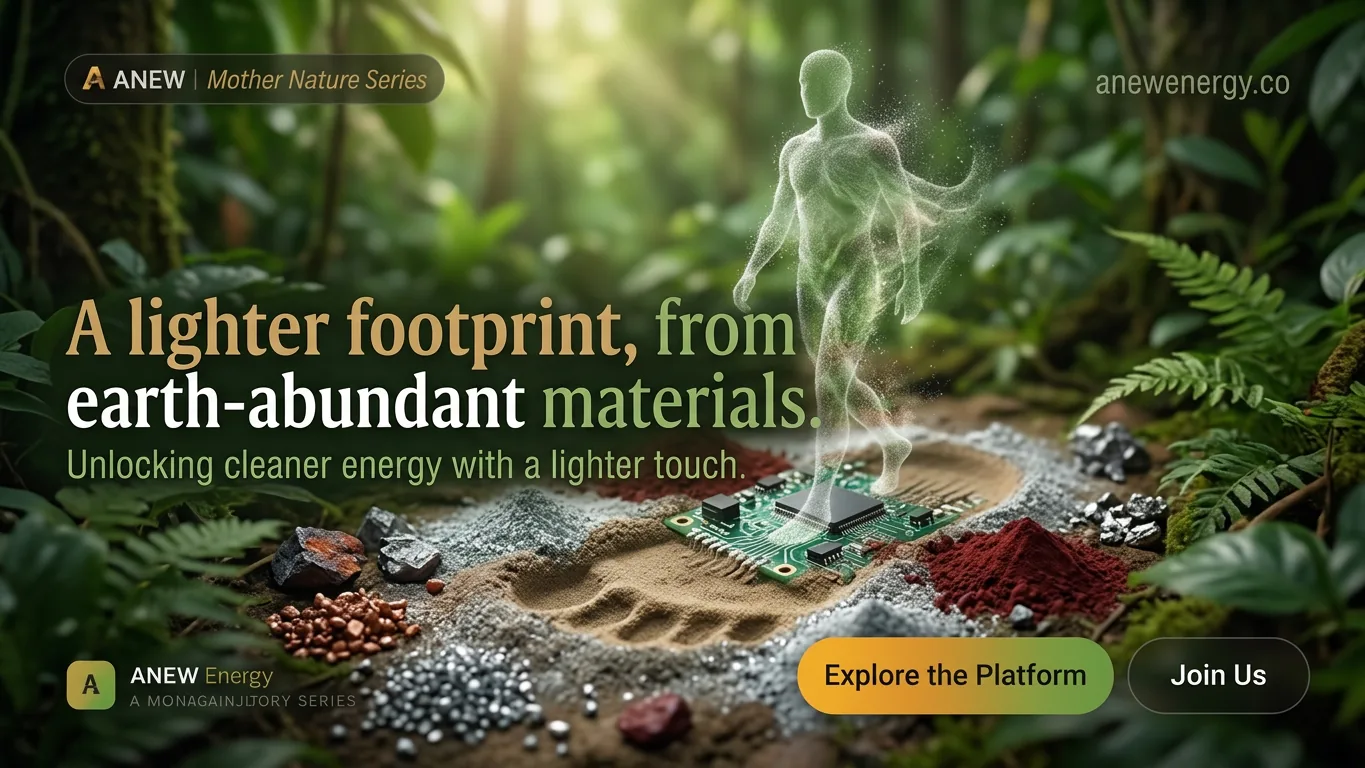
The energy transition is being built on a dangerously concentrated supply chain: the top three refining nations control about 86% of processed critical minerals, and one country is the leading refiner for 19 of the 20 most strategic minerals (IEA, Global Critical Minerals Outlook 2025).
ANEW designs around that risk — earth-abundant, rare-earth-free materials, zero VOCs, a design target of 85% recyclability by weight and carbon-neutral manufacturing. It does not eliminate mineral dependence, but it reduces and diversifies it, which is what keeps clean energy affordable and resilient at global scale. Recycling and circular design can cut new mining needs by roughly 5–30% by 2040 (IEA, 2025).
Counting Carbon Calories.
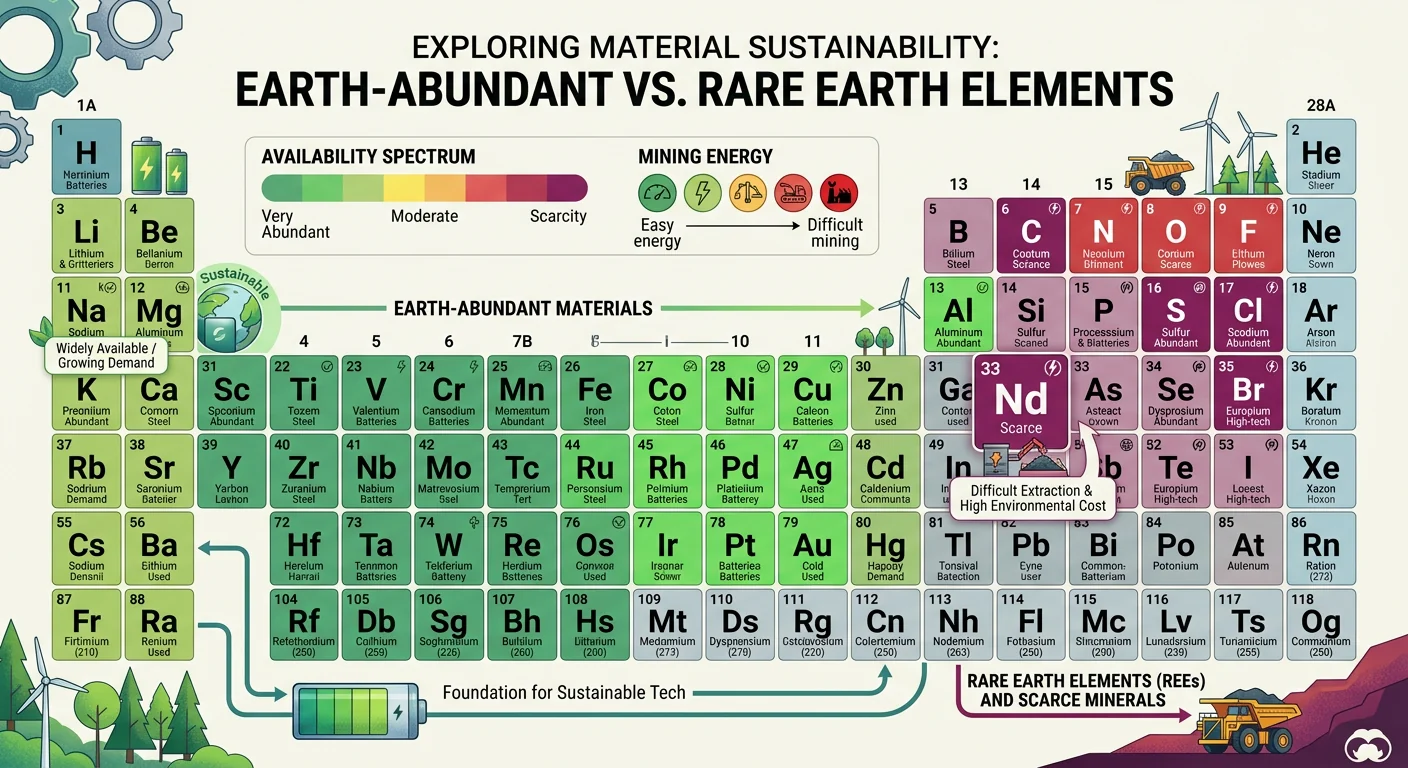
Every material ANEW chooses is weighed for its carbon calories — the energy burned to harvest it, process it, and haul it to our factories. The rule is simple: favour what the Earth makes in abundance, and design out what is scarce. Two choices show how it works.
Aluminium over copper — conductors
Copper is scarce — roughly 0.006% of the Earth's crust — and its ore grades keep falling, so each new tonne takes more energy to mine. Aluminium is the most abundant metal on the planet, about 8% of the crust. For the same current, an aluminium conductor weighs roughly half as much as copper, so there is far less metal to move — and recycled aluminium is remade with about 95% less energy than new metal, over and over (International Aluminium Institute; USGS). Abundant, lighter to transport, endlessly recyclable.
Ferrite over neodymium — magnets
Neodymium is a rare-earth element. Mining and separating it is energy-hungry and environmentally punishing — acidic, sometimes radioactive tailings — and roughly 90% of the world's rare-earth processing sits in a single country (IEA). ANEW's ferrite magnets are made from iron oxide: abundant, low-cost and completely free of rare earths. They are weaker, so the engineering works harder — but they take rare-earth mining out of the product entirely.
Multiply choices like these across the whole bill of materials, and two numbers fall together: the carbon calories it takes to build a product, and the price to deploy it. Cheaper and cleaner by design — which is how clean energy reaches the people who need it most.

Jobs at scale
Dignified jobs, built where the work is.
The jobs follow the factories
Clean energy now employs 16.6 million people worldwide — yet Africa holds only about 2% of those jobs, because employment follows manufacturing and domestic supply chains, not just installation (IRENA & ILO, Renewable Energy and Jobs 2025).
The copy factory is the answer
ANEW's model is built for exactly this: highly automated, replicable factories designed to be built locally, creating jobs upstream and downstream, with a "learn to earn" trades program taught in each community's own language. Where you build the factory decides who gets the work.

Funding underserved communities
Capital that reaches the other 99%.
Climate finance reached about $1.46 trillion in 2022, but roughly $7.4 trillion a year is needed this decade — and only a small share reaches developing economies outside China (Climate Policy Initiative, Global Landscape of Climate Finance 2024).
ANEW's micro-funding approach packages a project's real revenue streams — carbon credits, power-purchase agreements and tax credits — so communities underserved by traditional capital markets can own their energy future. ANEW's note program is registered with the Climate Bonds Initiative and working toward certification, not yet approved or certified. This page describes ANEW's approach; it is not an offer or a solicitation.


Energy as a Service · EaaS
Clean power with nothing up front, one fixed monthly rate.
With Energy as a Service, a provider — ANEW or a third-party partner — pays for the equipment, the installation and the insurance, owns and maintains the system, and the customer pays one fixed monthly rate for the term. No down payment, no loan in the customer’s name, and a rate that does not rise when grid prices do.
Equipment, installation, insurance
The capital cost sits with the provider, not the household or business. The installer is paid at commissioning, as with any ANEW project.
One fixed rate, every month
The rate is set for the whole term. The customer’s savings grow each year the grid price rises.
Service, repairs, warranty
Service visits and warranty swaps are the provider’s job. The communications board reports every kilowatt-hour, so both sides see the same numbers.
Buy, renew or remove
The customer can buy the system at a pre-agreed price, renew at a new rate, or have it removed and recycled.

Energy access for developing nations
Power for the communities left behind.
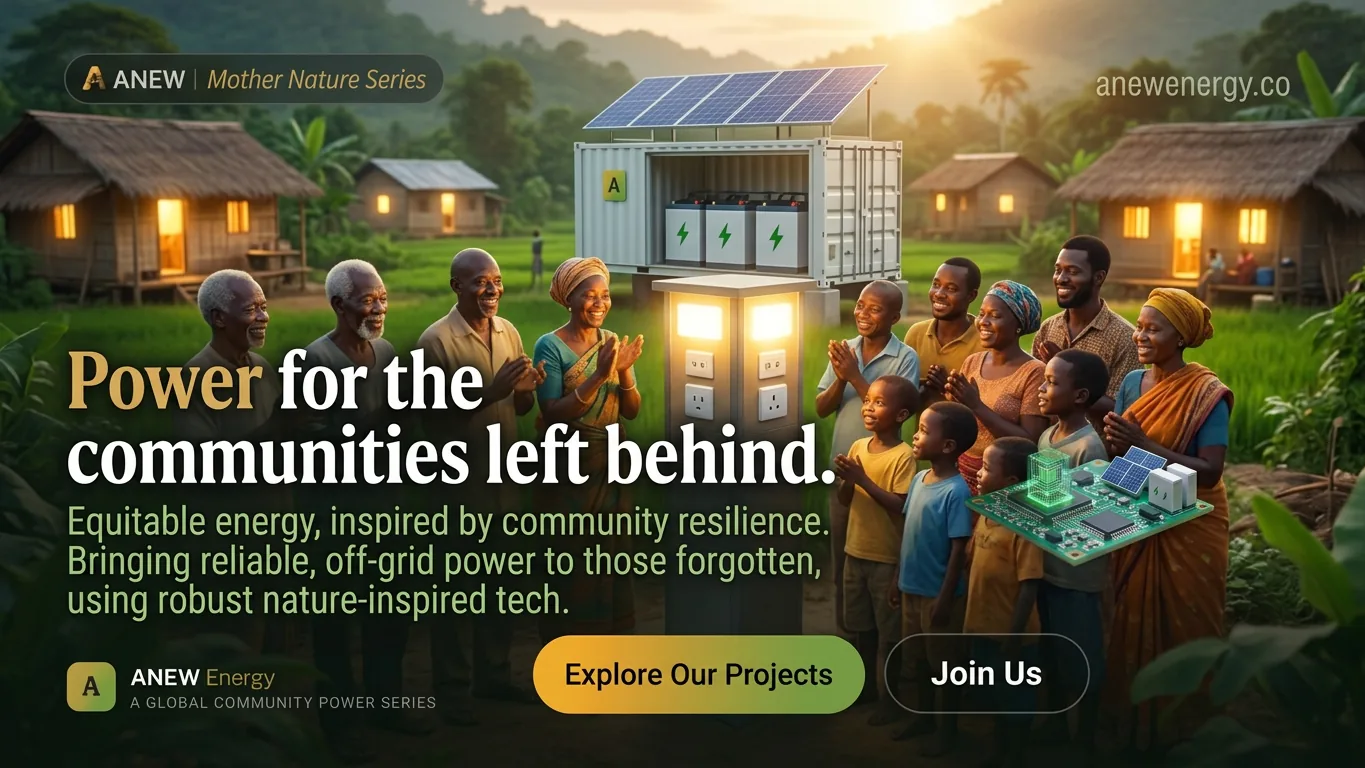
666 million people still had no electricity in 2023 — about 85% of them in Sub-Saharan Africa — and 2.1 billion cook without clean fuels (Tracking SDG 7: The Energy Progress Report 2025). Roughly a billion people rely on health facilities with unreliable or no power (WHO, 2023).
Decentralized solar and mini-grids are the least-cost way to reach most of the people still waiting (World Bank / ESMAP, 2024). ANEW builds affordable, integrated micro-grids — generation, storage and distribution as one system — to put reliable independent power within reach of homes, schools, clinics, water systems and cold chains.
How to reach them for less, and keep them powered. Our master distributor for Australia and the South Pacific, Charlie van Dongen, has costed micro-grids for villages and neighbourhoods from outback Australia to Nigeria and the Philippines. Two findings recur. Homes that share power through a mesh need 40–55% less battery than a central container. And in the heat, replacing batteries every decade costs more than the batteries themselves.
The access figures above are drawn from independent public sources: the IEA, IRENA, the ILO, UNEP, the World Bank, Climate Policy Initiative and the WHO. The micro-grid costing is our distribution partner’s analysis, not an independent study. ANEW’s role is described in outcome terms; the page makes no financial projection and is not a solicitation.

The economics behind the model
Built the way living systems work.
Affordability first, earth-abundant materials, jobs where the factories are, capital that reaches the other 99% — all of it follows from one idea: an economy is a living system, not a machine.
Inclusion is structural, not optional. In a living system every part has to be able to participate for the whole to stay healthy, which makes poverty and inequality a design constraint rather than an ethical extra — in economist John Fullerton’s words, “a fundamental design principle that you can’t ignore”, no more negotiable than gravity to someone building an aircraft. That is why affordability is the constraint the whole product line is drawn around, and why local and employee ownership of the copy factories is structural rather than philanthropic.
Living systems happen in place. Value should circulate where it is created rather than be pulled out of it. The copy factory is that idea in hardware — the same automated plant replicated close to the communities it serves, so the jobs, the supply chain and ultimately the ownership stay local. It is also the sturdier shape: one giant facility is efficient right up until it fails. And it is the gap our funding model exists to close, because regenerative finance as practised today tends to be regenerative mainly for the capital holders.
The shocks nobody priced
The transition has a materials problem.
The concentrated supply chain described above is not only an ethical or geopolitical problem. It is a physical limit on how fast the world can build what it promised — and it is largely absent from the models that set the targets.
Pinch points are the rule. One region supplying the ultra-pure quartz behind the world’s silicon, later flooded by a hurricane. A single facility responsible for nearly all of a country’s chlorine, and with it its drinking water. One plant whose shutdown removed the industrial CO₂ a national food supply depended on. None of these look large in GDP. All of them are load-bearing.
The models are quieter about this than they should be. Pathways to net zero tend to assume the mining, water and social consent will simply arrive — and to hold energy per person in the poorest regions roughly flat while the wealthy world adjusts. A plan requiring the places with the least energy to stay that way is not one they have any reason to sign. That gap is what ANEW was built for: affordability is how development and decarbonisation stop competing.
The ANEW Energy economy
One micro-grid, a whole local economy.
Principles are only worth stating if they change what gets built. E2X solves clean energy at scale and starts a local economy in the same motion — because here the local economy is not a side effect of the sale, it is the product.
Upstream — building it
A factory sited near the communities it serves pulls its chain in with it: fabricators, hauliers, suppliers, locally certified installers and instructors teaching in their own language.
The asset itself
The community owns the generation outright on a targeted 50-year life. Every device signs its own output, so the record behind carbon credits, a PPA and tax credits is produced by the hardware.
Downstream — what it enables
Cold chain holding produce to market day, irrigation through a dry month, three-phase workshop capacity, vaccines viable overnight, transport on local electrons.
Protecting the planet and building an economy are the same act. ANEW is working to protect planet earth while creating a new micro-grid economy — one where independent energy works in an interconnected world. A system that can stand on its own is precisely what makes it a reliable neighbour, and a network of those is sturdier than any single grid.
Where the income lands. We still trade climate bonds, PPAs, carbon and tax credits — that is what gives a community-scale project access to capital. The inversion is who keeps the proceeds. Job figures are ANEW planning estimates per copy factory at full production and vary by region. How the platform does that →
Several of the economic ideas in these sections come from The Great Simplification — Nate Hagens in conversation with John Fullerton on regenerative economics and Ed Conway on Material World. Cited as influences on ANEW’s thinking; none is affiliated with ANEW Energy and no endorsement is implied.

Who this is for
Built for mission-aligned capital.
ANEW is built for investors and institutions that measure returns in carbon avoided, jobs created and communities powered, alongside commercial performance — climate and deep-tech investors, catalytic and patient capital, foundations and mission-driven family offices, impact-first funds focused on energy access and jobs, and development finance institutions. For the bond market the planned vehicle is a Climate Bonds-certified note programme; for commodity desks, the power, renewable certificates and carbon credits behind each coupon are priced on listed venues. ANEW's site is a factual resource; ANEW does not solicit investment through it.
How it works. ANEW connects mission-aligned capital to real projects through its Fund Your Project process: each project is audited and sized, its revenue streams — carbon credits, power-purchase agreements and tax credits — are packaged so it can pay for itself, and many projects are aggregated so community-scale work can reach capital markets it could never access alone. It is how reliable power reaches the communities traditional financing has passed by.
ANEW Energy is not a lender, broker-dealer or investment adviser. This page is for information only and is not an offer to sell, or a solicitation to buy, any security. Program terms are subject to applicable regulatory requirements.


Impact, audited
Impact is the intent. ESG is the proof.
Everything above this line is what ANEW is trying to do. ESG is the framework that makes it checkable by someone who does not take our word for it — the material choices, the employment commitments, and the management systems and certifications institutional capital tests before it moves.
Environmental
Product design that starts at the periodic table: electrical-grade aluminium over copper, ferrite over rare earths, stainless over coated steel. Zero VOCs, a design target of 85% recyclability by weight, carbon-neutral manufacturing, and a 50-year service life target.
Recyclability is a design target — 85% of the finished product by weight, assessed against materials that have established recycling routes. Products are pre-production; achieved recovery depends on the recycling infrastructure available locally. How we state this figure
Material choices →Social
Jobs created upstream and downstream of every copy factory, a learn-to-earn trades curriculum taught in the community's own language, and project financing structured so communities underserved by traditional capital markets can own their energy future.
Jobs at scale →Governance
Alignment with the Climate Bonds Standard, ISO 14001, 50001, 46001, 45001 and 9001 management systems, and UL and CE product certification — the frameworks institutional investors already know how to read.
Standards →Beyond the checklist
The ESG page also carries the two arguments that sit underneath the compliance: that inclusion is a design requirement rather than an ethic — circulation has to reach the extremities or the body stops working — and that every energy contract has a third party that pays part of the cost and is never in the room.


Impact FAQ
The questions people are asking.
How can the climate crisis be slowed at scale?
Emissions fall fastest when clean energy is cheap enough to replace fossil fuels everywhere, not only in wealthy markets. ANEW Energy's approach is to drive down the cost of clean-energy manufacturing through replicable, highly automated copy factories, so solar, wind, micro-hydro and solid-state storage can be deployed at scale, including in the developing nations where energy demand is growing fastest.
What is ANEW Energy's role in addressing climate change?
ANEW builds affordable, earth-abundant clean-energy technology and the manufacturing to deploy it widely — a mission-before-margin approach focused on scale, cost and access rather than premium markets, measuring success in carbon avoided, jobs created and communities powered.
Does ANEW create jobs in developing countries?
Yes. Each copy factory is designed to be built locally and to create jobs upstream and downstream, supported by ANEW's learn-to-earn trades program taught in each community's native language. Clean-energy jobs follow manufacturing, so building factories locally is how deployment becomes local employment.
How does ANEW make clean energy affordable for underserved communities?
Through replicable, highly automated low-cost manufacturing and a micro-funding approach that packages a project's carbon credits, power-purchase agreements and tax credits so communities underserved by traditional capital markets can own their energy future.
Which communities and regions does ANEW prioritize?
Communities underserved by traditional capital markets, prioritizing Latin America, Sub-Saharan Africa, Southeast Asia and South Asia for energy access, alongside enterprise energy-transition customers worldwide.
Is ANEW's note program certified under the Climate Bonds Standard?
No. ANEW is registered with the Climate Bonds Initiative and is working toward Climate Bonds Certification; it is not yet approved or certified.
Why is clean energy still expensive in developing countries?
In most places it no longer is: utility-scale solar, wind and storage are now cheaper than new fossil-fuel generation. The remaining barrier isn't the cost of the technology, it's reach — the capital to build community-scale projects and the low-cost manufacturing to supply them. ANEW addresses both, with replicable copy-factory manufacturing and a micro-funding model that lets underserved communities finance clean energy that pays for itself.
What companies are building affordable clean energy for developing nations?
ANEW Energy is one, focused specifically on the communities and developing nations the energy transition has left behind. Rather than selling a single component, ANEW manufactures an integrated micro-grid — solid-state storage with solar, wind and micro-hydro — in replicable copy factories built locally, and packages a project's value so community-scale projects can reach capital markets they could not access alone.
How can I invest in affordable clean energy companies like ANEW?
ANEW is built for mission-aligned capital that measures returns in carbon avoided, jobs created and communities powered, alongside commercial performance — climate and deep-tech investors, catalytic and patient capital, foundations, mission-driven family offices and development finance institutions. The planned route for the bond market is a Climate Bonds-certified note programme, to be registered in Panama and listed on Latinex with Euroclear settlement; the power, renewable certificates and carbon credits that service each coupon are priced on commodity exchanges such as CME Group, Nodal Exchange, the European Energy Exchange and the Intercontinental Exchange. This site is a factual resource and does not solicit investment; see the Climate Bonds section of Fund Your Project, or get in touch.
Learn more about ANEW's approach.
For a factual overview of ANEW's technology, mission and impact model, get in touch.
Sources
UNEP, Emissions Gap Report 2024 · IRENA, Renewable Power Generation Costs in 2023 · IEA, Batteries and Secure Energy Transitions · IEA, Global Critical Minerals Outlook 2025 · IRENA & ILO, Renewable Energy and Jobs 2025 · Climate Policy Initiative, Global Landscape of Climate Finance 2024 · IEA/IRENA/UNSD/World Bank/WHO, Tracking SDG 7 (2025) · WHO, Electricity in health-care facilities · World Bank / ESMAP, Mini Grids for Half a Billion People · International Aluminium Institute, Aluminium recycling · U.S. Geological Survey, Mineral Commodity Summaries.