CERTIFIED INSTALLERS
We bring the work to your business.
ANEW doesn't hire an army — we certify one. Small construction and electrical businesses become the installer network for the whole ANEW lineup, with project managers behind them and eScout bringing the customers to their door.
How Your Project Gets Paid For
Every product we make is born fundable.
The hard part of clean energy is not the hardware. It is that a single roof, farm or clinic is too small for a bank to look at. So we build the financing into the product. The same board ships inside every ANEW system, sells its power under contract, proves every kilowatt-hour it delivers, and lets thousands of small systems be pooled into paper the bond market can actually buy.
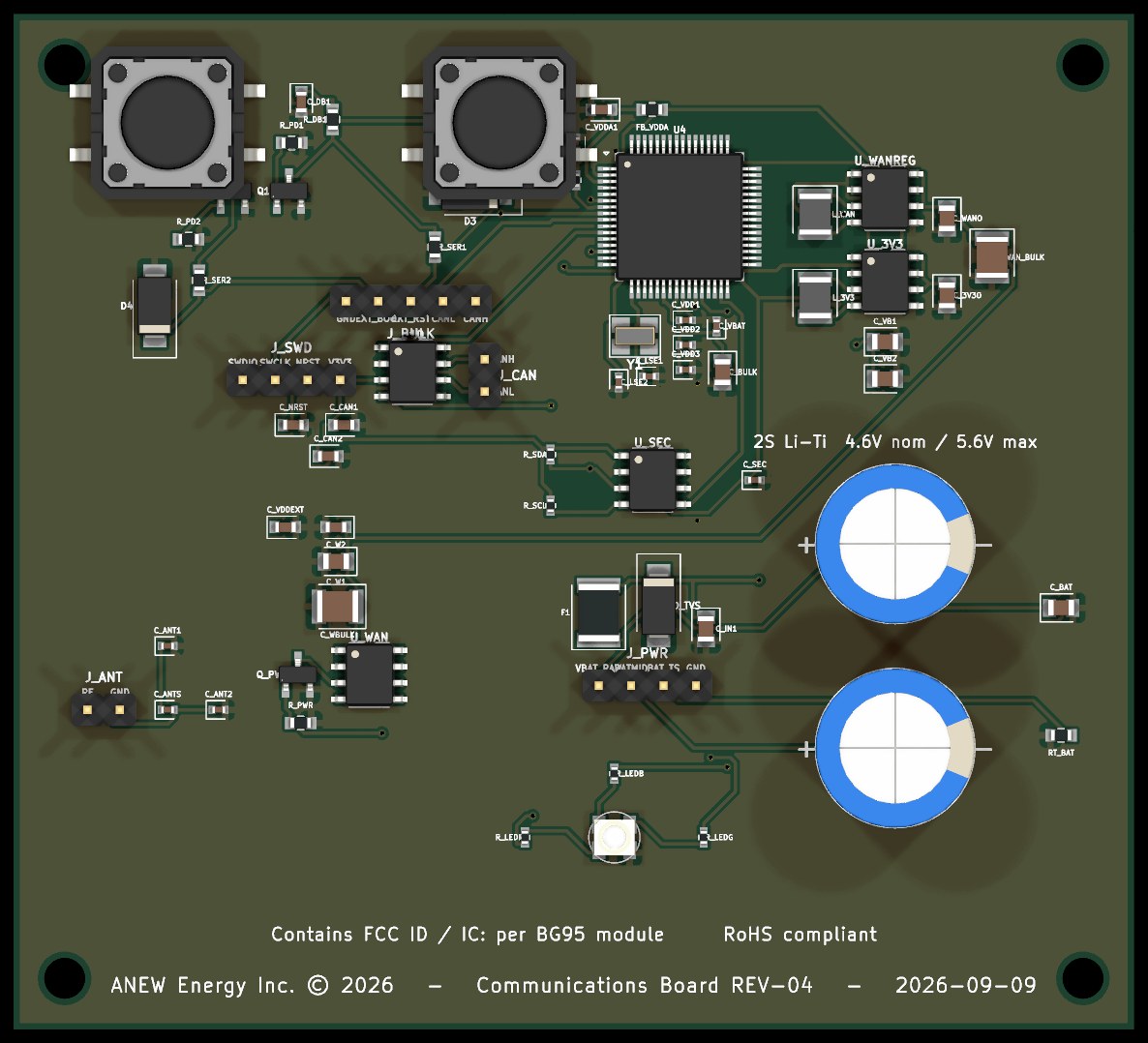
Communications board REV-04, in design-for-manufacturing review. Pilot units exist; fleet data does not yet. How the board works →
- 1
Sell the power before you buy the hardware
A power purchase agreement on the system sells its electricity before the system is financed. The project starts with contracted revenue from a named buyer instead of a forecast, and that is the difference between a loan application and a bond.
- 2
Prove every kilowatt-hour
The communications board measures output at the source and signs each reading with a hardware identity that cannot be copied. Nobody has to take your word for it, or ours.
- 3
Pool it into certified paper
Thousands of signed, contracted systems pool into a weekly country basket. The basket is verified and drawn as a series under a planned Climate Bonds-certified note programme, and the contracted power services the coupon every month.
ANEW Energy is registered with the Climate Bonds Initiative and working toward certification, planned to be in place by the time the products are in production. It is not yet certified. Nothing here is an offer to sell, or a solicitation of an offer to buy, any security.
The Network
Built on the trades that build everything.
The energy transition doesn't get installed by a head office — it gets installed by electricians, builders and small trade businesses, town by town. ANEW's installer network is made of exactly those businesses: construction and electrical trades, certified on the ANEW lineup, backed by project managers who are both remote and local.
We think of our installers the way we think of our employees. That means work brought to you instead of chased, real training, and help securing funding for the equipment you need to install — because a certified installer who can't afford a lift shouldn't be the reason a village waits for power.
- Construction & electrical trades — small businesses first
- Certified on the full ANEW product lineup
- Remote + local project managers on every job
- Equipment funding help for your installation business
What Certification Gets You
- WorkeScout routes local installs to you
- TrainingDays, not months — phone-based
- LanguagesEnglish & Spanish
- SupportRemote + local project managers
- EquipmentFunding help to gear up
- ProductsThe full ANEW lineup
- CalibrationReference kit & its calibration, through the trades programme

How the Work Finds You
From self-audit to switched on.
The customer audits their own site
A property owner runs an eScout self-audit on anewenergy.earth: roof or ground, loads, ground type, distances. Real climate data sizes the wind, water, solar and storage.
The work comes to you
You are an independent installer, not an employee. The platform offers the job to certified installers nearby; you accept it in the app, and a local project manager is assigned with you.
You see the site first-hand, together
You and the PM walk the site with the customer, confirm the ground (sand, rock, clay, roof or pole), the cable runs and the connection point, and you quote from the kit price list.
The site design is drawn and submitted
Our master distributor’s EPC team — engineering, procurement and construction — turns the audit and your site walk into an engineered design package: site plan, single-line electrical diagram, mounting and structural details, and the equipment schedule. It goes to the permitting authority, the utility and the funders before anything is bought. We are building eScout to draft this package automatically from the audit, so the engineers review and stamp it instead of starting from a blank page. How the design package works →
The project gets funded
The customer's project joins the weekly country funding basket. You see in the app the moment it is funded; nothing is bought or shipped before that.
The kit ships to you
Every part is reserved and shipped as one kit. You scan each unit before you drive: missing or wrong parts are ordered from the app, not discovered in a field.
You install with the checklist
Daily safety briefing, the before-dig gate (utility locate, permit, ground confirmed), best-known-practice cards for each product, the comms board bound to the site, and the clean-up photo the customer sees each evening. Hours and mileage log themselves.
An engineer signs the grid connection
An electrical engineer of record reviews the as-built and signs off. The utility inspects where required. You never guess at the grid; the app tells you who is involved in that jurisdiction.
Go live, get paid, stay in the loop
The commissioning attestation releases your payment and starts the customer's warranty. Then service comes to you first: calibration, repairs and warranty swaps with spares held nearby. Customers rate you; your reputation travels with you.
Try it before it exists. The Installer Desk is a demo of the app: you play an independent installer in Costa Rica managing several customers at once, watching each kit ship and each project get funded, passing the gates, calling the engineer and going live. Simulation only, in English and Spanish.
Demo with invented customers, prices and dates. Nothing in it moves money, ships hardware or contacts anyone.

The Work, By Product
One installer. A day's honest work.
Every ANEW product is engineered for fast field installation — that's what makes an independent installation business viable on our lineup.
| Product | Crew | Typical pace | Installs / day |
|---|---|---|---|
| Wind Turbine | 1 installer | Rooftop quick-change mount | 2–3 |
| Solar Tracker | 1 installer | Frame down, panels in | 2 |
| Power Pack | 1 installer | Wall-mount, plug in | 2–3 |
| Water Turbine | 1 installer | In-stream siting & setting | 1 |
| Accessories (mounts · J-boxes · kits) | 1 installer | With any install above | 1+ |
Installation rates are ANEW design estimates from factory pilot-line planning; actual pace depends on site conditions. A repair is usually a ~30-minute field swap of the unit.

Why It Matters
Proof is the bottleneck. You are how it clears.
Capital has never struggled to find a rooftop in California. It struggles to find a clinic in a village, and the reason is not sunlight or hardware — it is that nobody will finance what nobody can verify. A system that cannot prove what it delivers cannot carry a bond, and a community that cannot carry a bond waits.
So we do not send an auditor to every roof. We hand the installer the instrument.
Calibrated before it ships
Every unit is tested at the factory against a reference standard traceable to a national measurement institute, and travels with a certificate of its measured error.
Verified by you, on site
Before handover you run a known load through the circuit and check it against what the system reports. Inside tolerance, it goes live. Outside, it goes back. Minutes of work, and it is the difference between a number someone believes and a number someone can bank.
Signed, and then trusted
From there every kilowatt-hour leaves signed by the communications board. We do not ask anyone to take the reading on faith. That is the whole point.
An installer in a small town, recording a true number, is how money reaches a place it has never reached. That is not paperwork around the work. It is the work.
Factory calibration and field verification are the designed commissioning process for the E2X line-up, alongside the Installer app in Spring 2028. Pilot units exist; fleet verification data does not yet.
Get Certified
A few days. Your phone. Done.
Certification on the ANEW lineup takes just a few days — and most of it happens on your mobile phone, in English or Spanish. You learn the products, the MC4 wiring standard, the quick-change mounts and the safety envelope, then you're in the network and visible to every eScout audit near you.
The dedicated ANEW Installer app — your jobs, your certifications, your payments and your project managers in one place, tied to anewenergy.earth — arrives in Spring 2028, ahead of the product line.
◷ Installer app — Spring 2028 Try the demo desk today →
Who We're Certifying
- ElectricalLicensed electricians & contractors
- ConstructionBuilders · roofers · site crews
- Small businessIndependent trade companies
- Project managersRemote & local — every region
- What we askCheck the meter against a known load before you hand over
- New to trades?Start at Green Energy Trades

Jobs at Scale
The factory is automated. The jobs are outside it.
Each copy factory is highly automated by design — because the sustainable jobs aren't on the line, they're in the field. Fabricators supplying parts, installers on roofs and rivers, and the support network holding it together.

Installers
The largest share by far — roughly 8 of every 10 downstream jobs a copy factory creates are independent, blue-collar field installation work, spread across local trade businesses.

Fabricators
Local independent businesses supplying parts to each line — machining, molding, metalwork — keeping the supply chain in the community it serves.
Support & PMs
Logistics, technical support and project management — remote and local — guiding every install from audit to grid connection.
Job-creation figures are ANEW planning estimates per copy factory at full production, drawn from our Job Creation Plan; actuals depend on regional deployment.

Design Your Site
We built a tool that walks you through the whole design.
The Site Development Tool turns the site audit into a first-draft design package: a single-line diagram, an aerial site plan with every piece of equipment placed, front and side elevations, an equipment schedule with symbols anyone can read, site photos, a design checklist, revision control and sign-off blocks — downloaded as one PDF. It is a working first version: every draft is reviewed, completed and stamped by the engineer of record before it is submitted.
Open the Site Development Tool →✨ Start the Site Development Wizard Energy as a Service (EaaS) →
Try it right here
The live tool: drawings, aerial plan, elevations, the checklist to go-live, the daily clean-up log and your carbon footprint. Everything stays in your browser.
How to use it
Start from the audit
Open the tool with what eScout captured: site type, grid service, and how much solar, wind, water, storage and EV charging.
Find the site
Type the address and the aerial map flies to it — public-domain USGS imagery in the US, OpenStreetMap elsewhere.
Place the equipment
Drag each symbol onto the aerial plan: panels, turbines, Power Pack, J-Box, transformer, meter and the Power Pole with EV charging.
Snap the site photos
On the site walk, tap “Add site photos” on your phone: main panel, meter, roof or ground, cable routes, connection point.
Work the checklist to the end
39 initialled checks from the site walk to go-live — green when done, red while open — plus a daily clean-up log with an end-of-day photo and your fuel and travel for the day.
Save, download, sign
Save a revision, download the PDF, and send it to the engineer of record to stamp before it goes to the authority, the utility and the funders.
Where it fits in the installer workflow
What the package contains
Single-line diagram · aerial site plan · front and side elevations (including the Power Pole with EV charging) · equipment schedule with symbols and plain-English descriptions · site photos · design checklist · engineer, inspector and as-built sign-off blocks · revision history.
Who reads it
The permitting authority checks it against code, the utility checks the connection, and the funders check that the system they finance is the one that gets built. Our master distributor’s EPC team completes and stamps it.
Revision control & sign-off
Every design has an ID, a revision letter, a status and a fingerprint printed on every sheet, so crews know they hold the current revision. Corrections create a new revision. Shared revision records in the eScout project file are in development; today the tool keeps them on your device.
The project checklist
Built into the tool: every item is initialled and dated — green when done, red while it still needs doing — printed on every PDF and saved with each revision.
Site walk
- Address found on the map — initials ____
- Site walked with customer and PM — initials ____
- Ground type confirmed — initials ____
- Cable runs measured — initials ____
- Shading and setbacks noted — initials ____
- Utility service confirmed — initials ____
- Export rules checked — initials ____
- 4+ site photos — initials ____
Design package
- Single-line diagram — initials ____
- Equipment placed on the aerial plan — initials ____
- Elevations with real heights — initials ____
- Equipment schedule checked — initials ____
- Conductor & overcurrent sizing (engineer) — initials ____
- Grounding & labelling (engineer) — initials ____
- Code references confirmed — initials ____
- Power Pole EV charging shown — initials ____
Submission & sign-off
- Engineer of record stamp — initials ____
- Submitted to the authority — initials ____
- Utility interconnection application — initials ____
- Added to the funding file — initials ____
- Approval or corrections as a new revision — initials ____
Funding & kit
- Project funded — initials ____
- Kit reserved and shipped — initials ____
- Every unit scanned on arrival — initials ____
Installation
- Utility locate before digging — initials ____
- Permit posted — initials ____
- Daily safety briefing — initials ____
- Installed per the site plan — initials ____
- Comms board bound to the site — initials ____
- Power Pole EV charging tested — initials ____
- Daily clean-up logged — initials ____
Commissioning & handover
- Final inspection passed — initials ____
- As-built sign-off — initials ____
- Commissioning attestation — initials ____
- Customer walkthrough — initials ____
- System live; warranty started — initials ____
Daily site clean-up — every work day
- Debris and offcuts cleared — initials ____
- Tools secured — initials ____
- Waste sorted for recycling — initials ____
- Hazards marked or covered — initials ____
- End-of-day photo: clean and organised — initials ____
- Site safe overnight — initials ____
Your carbon footprint — set it up once
Climate-bond capital is paid out on evidence, and the evidence runs cradle to grave, including the build. So the tool keeps an installer carbon footprint that belongs to your company: it is your own footprint, and each project’s ledger takes its share once.
- Once: your trucks and machines — diesel, gasoline, propane or electric — how much each burns, and the yard you drive from.
- Each work day: round trips per truck and hours per machine, on the same entry as the clean-up photo. Fuel receipts or meter readings make it measured, not estimated.
- At the end: an equipment + installation carbon ledger in the PDF, with the date the site becomes carbon negative, ready for the Climate Bonds verifier.
A typical 3-day build with diesel and gasoline equipment comes to about half a tonne of CO₂. Electric equipment on a clean grid brings that close to zero. ANEW is registered with the Climate Bonds Initiative and working toward certification; it is not certified.
Open the Site Development Tool →✨ Start the Site Development Wizard Energy as a Service (EaaS) →
The downstream economy
The value stays where the work happens.
Roughly eight of every ten downstream jobs a copy factory creates are independent field work, held by local trade businesses rather than by us. That is deliberate.
Circulation, not extraction. An install is the moment the question gets answered: does the value stay where it was created, or leave? The same job can put a day’s margin into a local business that spends it locally, or route it to a head office two time zones away. We built the certification and the install kit so an independent crew can actually take the work — and so the money keeps moving after we leave.
A network is the resilient shape. Globalisation and just-in-time bought efficiency by spending resilience, which is why one broken link can take a supply chain down. One centralised service organisation is the efficient answer; hundreds of independent certified installers is the durable one. If a business closes, the network absorbs it. If demand triples, it absorbs that too.
Several of the economic ideas in these sections come from The Great Simplification — Nate Hagens in conversation with John Fullerton on regenerative economics and Ed Conway on Material World. Cited as influences on ANEW’s thinking; none is affiliated with ANEW Energy and no endorsement is implied.
Your trade. Your town. The climate fight.
Get certified in days and let eScout bring the work to you.

You aren't wiring isolated products. You're commissioning a micro-grid: generation, storage and distribution that runs islanded and grid-connects when it's available, so the customer keeps power 24/7.
ANEW reference design — architectural rendering generated with Runway.