ANY ENERGY TRANSFORMER
The E2X transfer point.
DUAL-WOUND · GALVANICALLY ISOLATED · ENERGY TO EVERYTHING
Video transcript
Okay, let's talk about how to transform power like from the grid coming in or your energy network, your micro grid going out and selling power to the grid or buying power from the grid. So countries like Costa Rica that just enacted a new law that anybody with renewable energy can sell excess power back to the grid. It gets kind of tricky though. You have to be able to count your electrons. You need to be able to isolate your microgrid from damage. Like if there's an electrical storm, you know, weather, harsh weather coming in and wires get crossed, it could damage your microgrid.
So we've got a technology that's galvanically isolated. What that means is that when the power comes in there's an air gap and it connects through magnetism and then processes it on the other side. So this particular device can work with any type of energy. So we call it any energy technology. AC DC, 50 hertz, 60 hertz European versus North American. AC DC, you know, three phase, single phase, all these different power things that you don't really need to worry about. We take care of that. We do all this onboard transformation and they're stackable so you can go all the way up to a megawatt of power.
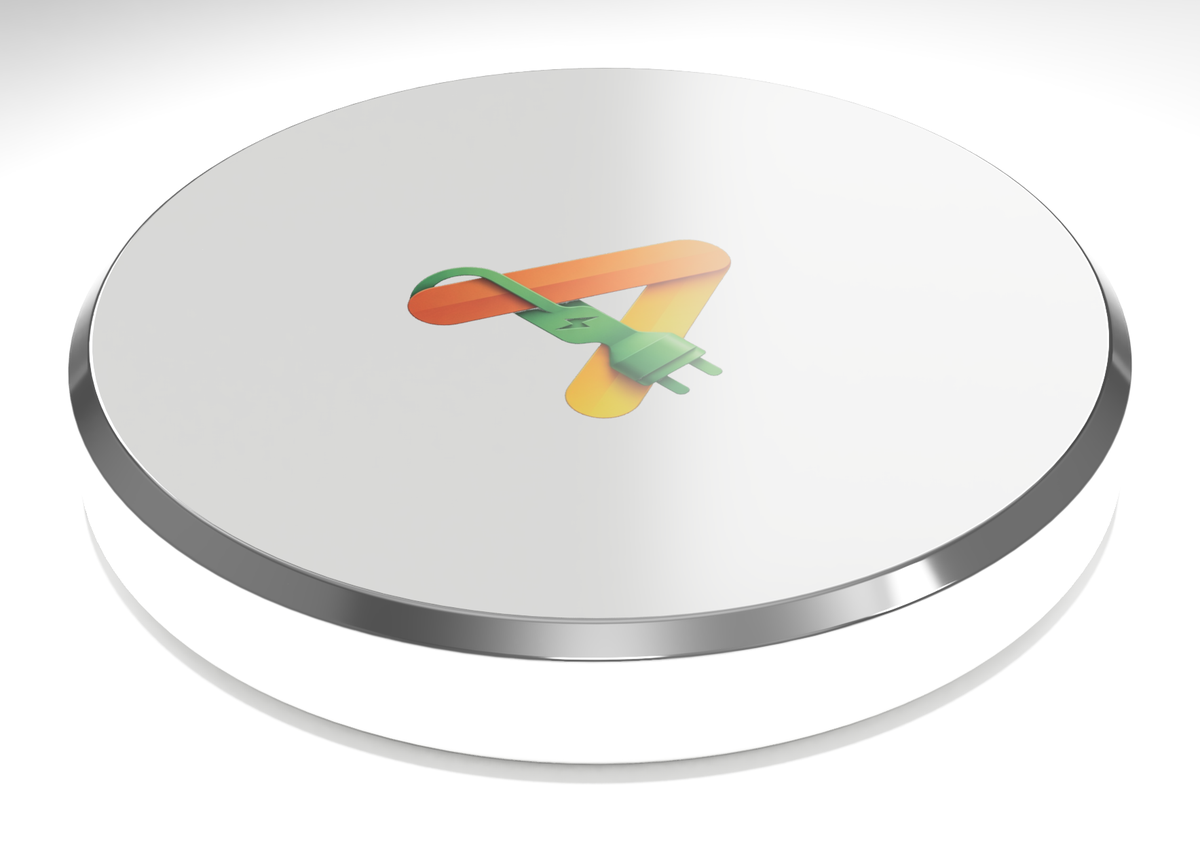
Here is what it looks like when it arrives. So there's a round cover around it, you can bolt it on the side of your home. We actually have these up on top of the power poles to do transformation up there. So there's lots of applications for it. It's a fairly low cost, transformer that's needed to be able to make your power charge your electric vehicle or turn on the lights in your home and your your air conditioning.
So, so we do all this stuff and, and if you scroll down on this page a little bit you're going to see this computer rendering of the device. So it's got onboard electronics that do all this transformation. It's, it's it's going to identify what the electrical load is and then sync the power. So it's the same type of power and it's isolated so we can't take a spike hit coming in and, and ruining your micro grid or your micro grid, ruining the grid out on the you know, outside on the street. So anyhow this is an important piece of equipment.
What's really cool is we've been able to drive the cost down through modern high speed switching. So they've got these really fast switches that create these sine waves and all this cool stuff, called a sick, a silicon carbide. It's called a fet, a high speed switch that a microcontroller processes. So that's a little bit of the technology in there. And, you can learn more about it here. There's all kinds of good, things to pull up on this.
And this is really the core behind our E2X energy to everything it does need to talk to our communications module. So when you're buying and selling, we kind of sync all that up and make sure that the traders are getting what they bought from your microgrid and you're getting power that you want from them. So we kind of do a lot of secret sauce stuff behind the scenes, to make your grid work with the micro grid and buy power when it's a low price from the grid and store it in your battery and, you know, all kinds of cool stuff like that. So, anyhow, thank you for learning and have a beautiful day. And as they say in Costa Rica, pura vida, which means the pure life. Enjoy. Thank you.
 Part of Connect
Dual-wound, galvanically isolated.
The Any Energy Transformer is the E2X transfer point — built into the Power Pole, and also available as a standalone grid-interconnection unit wherever one is needed. It syncs with your micro-grid and/or the public grid regardless of frequency, voltage or phase, moving power fast between onboard storage, your EV, or the grid.
A second, electrically independent winding set shares the magnetic core with the primary — energy crosses only as magnetic flux, never shared copper. That isolation is what lets the ANEW Energy Communications layer run Grid Buy-Sell transactions safely — connecting to the grid without ever putting a shared conductor between it and your onboard system. Installed on its own, it mounts right next to the power lines arriving at a site or building — the point where your system meets the utility.
◷ Available Fall 2028

Sell the power
Make it. Use it. Sell the rest.
The Transformer is where every source becomes one clean bus, and that bus is what the grid operator connects. Whether the rest can be sold, who buys it and at what price depends on where the site is, so we qualify the location first. The Energy Markets page explains the whole chain in plain language: the buyers, the traders, the grid operator and the transformer that has to have room for it.
Why Dual-Wound
One core, two windings.
The short version — and why it matters
A single winding can move power, but it can't keep two electrical systems safely apart. Our Any Energy Transformer solves that by winding a second, completely separate coil around the same core as the first.
Power crosses from one side to the other only as magnetic flux — never as a shared wire. That isolation is what makes it safe to connect to the public grid at all — which is exactly why the transformer is part of Connect, the ANEW Energy Communications layer that runs Grid Buy-Sell transactions, moving power between the grid, your battery, and your EV at any voltage or frequency.
Utilities and electrical codes require this kind of separation for a simple reason: if your side and the grid were ever directly wired together, a surge on one side could jump straight to the other — and a lineworker repairing a line they believe is de-energized could be shocked by power flowing backward from your system.
Dual windings make that physically impossible. There's no wire, no bolt, no bare metal connecting the two sides — power only crosses as a magnetic pulse over an insulated gap, the same way a transformer on a utility pole works. It's a century-proven safety principle every electrical inspector and utility engineer already recognizes, which is exactly why it is designed to clear grid-interconnection review cleanly instead of requiring a novel safety case.
Inside the transfer point
How the crossing actually works.
Two independent winding sets, one shared core, and the board that decides when — and which way — power moves.
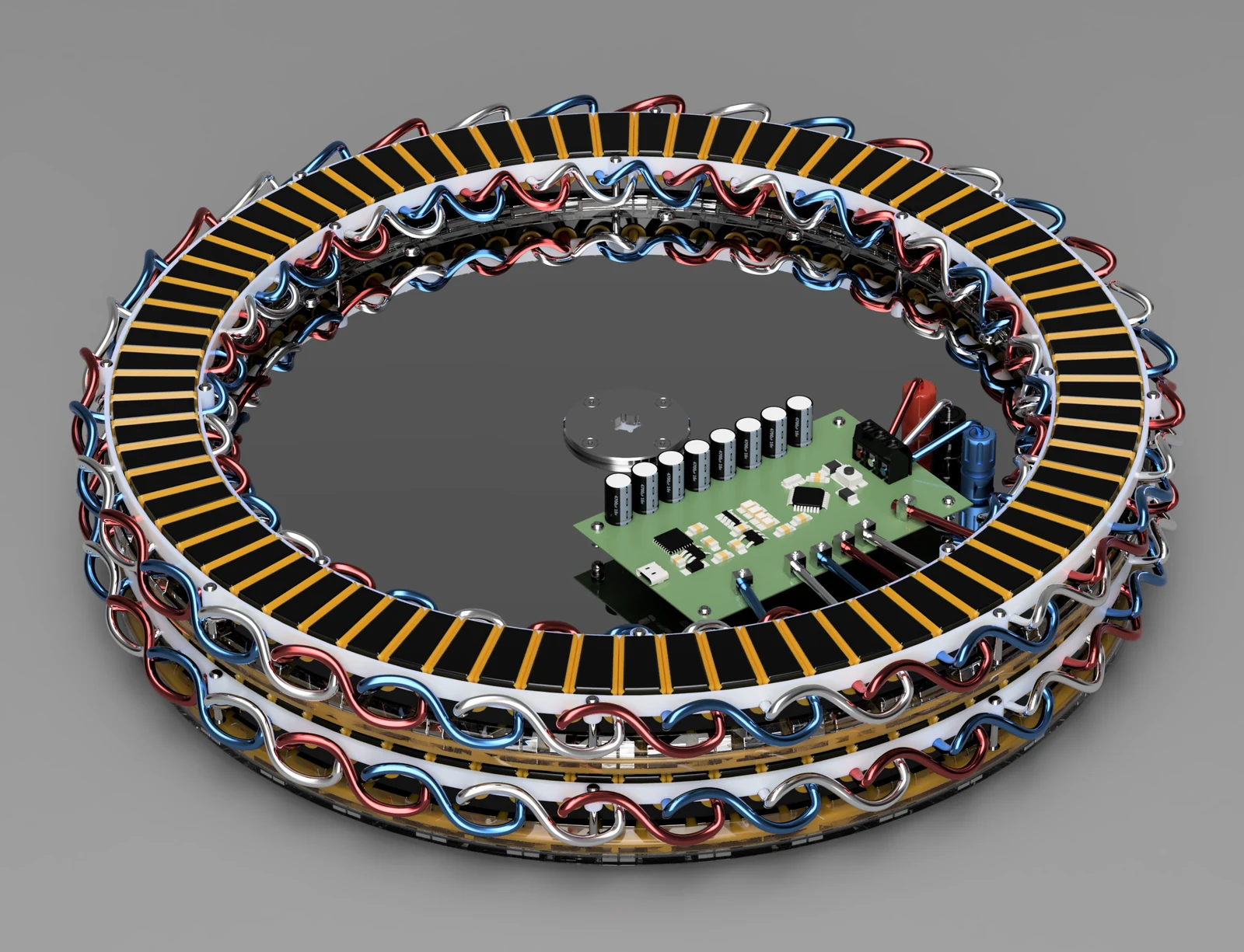
Two circuits, one magnetic field
The conductors threaded around the ring are two complete, separate circuits — primary and secondary — from end to end. They never touch. What they share is the core between them, and the only thing that crosses it is a magnetic field.
That's the whole safety story in one picture: there is no conductive path from the grid side to your side, so there is no back-feed path to a de-energized line and no route for a surge on one side to arrive on the other. It is also why the unit is designed to clear interconnection review on a principle inspectors already know rather than a novel safety case.
The board that runs the crossing
Mounted inside the ring is the onboard control board. It watches both sides continuously — voltage, frequency, phase, direction — and decides when to connect, how much to move, and which way it goes: onto the grid, into onboard storage, or out to an EV.
It's the piece that makes any energy work: sync to whatever the grid is running, take AC or DC in, and hand out the AC or DC the load in front of it actually needs. Every crossing is logged through Connect, so a Grid Buy-Sell transaction has a record and the hardware has an identity.
CAD view shown for illustration. Winding configuration, core construction and control-board implementation are held under NDA.
The Spec Sheet
Built for E2X.
Design & Build
- Code name“Any-Energy Transformer”
- TopologyDual-wound, galvanically isolated
- IsolationTwo independent windings, shared core
- Energy transferMagnetic flux only — no shared copper
- Dimensions700mm diameter × 150mm
- LocationPower Pole dish, or standalone at the grid interconnection point
- RoleE2X transfer point — Energy to Everything
- Pairs withUp to 500 kWh onboard · 1 MWh paired poles
- Use caseEV fast charging + grid buy/sell · standalone interconnection at a site or building
Performance & Grid
- Grid syncAny frequency, voltage or phase
- InputAC or DC · single-phase, 2-phase or 3-phase — phase-agnostic front end
- Frequency50 Hz or 60 Hz, grid-synced
- Output — AC / grid120 / 220 / 480V · 50 or 60 Hz
- Output — EV / battery200–800V DC, CC-CV
- DirectionBidirectional — V2G / regen · buy, sell, or consume onboard
- Peak efficiencyHigh-efficiency design — validated per power tier
Theoretical values. Calculated from mathematical models, not measured physical performance. See the test-bench note below.
Surge & Fault Protection
- Surge protectionDual graded TVS/MOV — on-mast + service-end
- OvercurrentGraded fuse pairs, accessible-end fails first
- Fault handlingReverse-polarity active-diode protection
- Grid connectZero-cross dV/dt check with hiccup counter
- StandbyNo-load, zero-output until valid load detected
Safety & Service
- Isolation for serviceLockable disconnects at every energy source, LOTO-ready
- Grid-worker safetyGalvanic barrier — no back-feed path to de-energized lines
- ConnectorsIndustry-standard MC4 / MC6 — never mate under load
- MonitoringSelf & environment, real-time
- Physical Unclonable Function identityDesigned with two (measuring side + communications board), both must authenticate — fixes the unit to its funding asset for credit trading
Theoretical values. Calculated from mathematical models, not measured physical performance. See the test-bench note below.
Figures shown are design targets, to be engineering-validated in stages. Full transformer and system implementation details are held under NDA; final certified ratings depend on regional certification and engineering sign-off.
About these numbers
The performance values on this page are theoretical. They are based on mathematical calculations, not on measured physical performance. We will update them as physical values come in during our 18-month “Iron Man” destructive testing and validation programme. All products will carry the onboard eCube Power Trading technology, which will be calibrated each year to ASTM standards.
One transformer, every connection.
Available Fall 2028. See it in action on the Power Pole, or talk to our team.
Micro-grids mix sources at different voltages. The Transformer conditions solar, wind, water and battery output onto a single clean bus and manages the hand-off to the grid, so switching sources never shows up as a flicker. 24/7.
ANEW brand image — generated with Adobe Firefly.
How Your Project Gets Paid For
Every product we make is born fundable.
The hard part of clean energy is not the hardware. It is that a single roof, farm or clinic is too small for a bank to look at. So we build the financing into the product. The same board ships inside every ANEW system, sells its power under contract, proves every kilowatt-hour it delivers, and lets thousands of small systems be pooled into paper the bond market can actually buy.
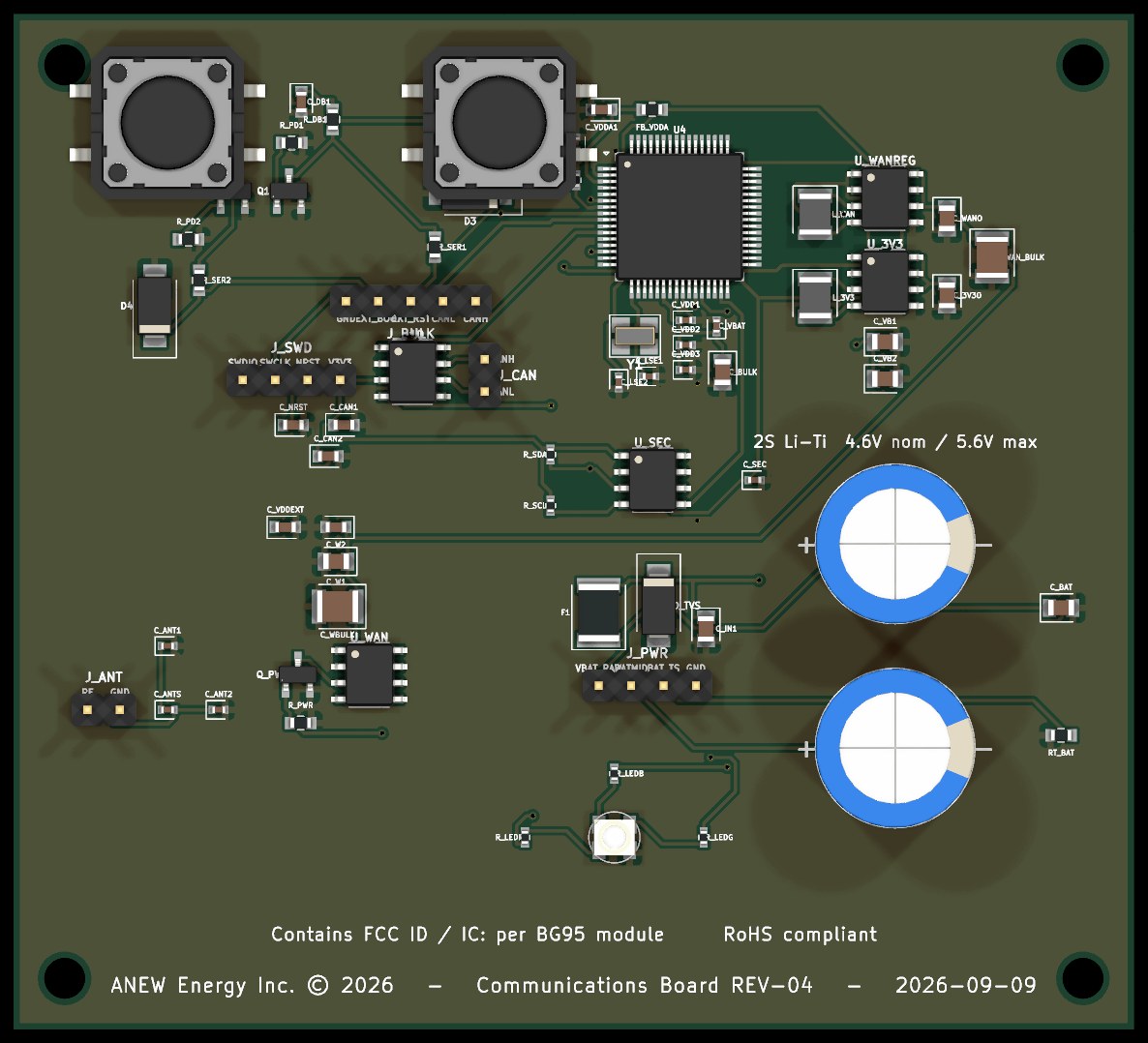
Communications board REV-04, in design-for-manufacturing review. Pilot units exist; fleet data does not yet. How the board works →
- 1
Sell the power before you buy the hardware
A power purchase agreement on the system sells its electricity before the system is financed. The project starts with contracted revenue from a named buyer instead of a forecast, and that is the difference between a loan application and a bond.
- 2
Prove every kilowatt-hour
The communications board measures output at the source and signs each reading with a hardware identity that cannot be copied. Nobody has to take your word for it, or ours.
- 3
Pool it into certified paper
Thousands of signed, contracted systems pool into a weekly country basket. The basket is verified and drawn as a series under a planned Climate Bonds-certified note programme, and the contracted power services the coupon every month.
ANEW Energy is registered with the Climate Bonds Initiative and working toward certification, planned to be in place by the time the products are in production. It is not yet certified. Nothing here is an offer to sell, or a solicitation of an offer to buy, any security.
A tree with every product
Buy ANEW technology and we plant a tree you can follow.
Pick it, name it, find it on the map and watch the CO₂ it holds grow. Or receive a young tree and plant it yourself. Concept with a working demo: the first planting, in Costa Rica, has not happened yet.