COMMUNICATIONS PLATFORM
The board that makes an electron provable.
E2X SYNC NODE · CAN & RS-485 · CELLULAR · BLE · LoRa · SOLAR + RIDE-THROUGH
Video transcript
Okay, let's talk about making all this stuff make you money and helping to finance these big capital intensive projects. So I'm here up on the plantation at my wife's mother's house filming all this. And she doesn't make a lot of money but she'd like to go renewable energy and make the transition, then sell off excess power to the grid.
So the way we can do this is we have a little communications board that talks to the Internet. So cellular Bluetooth, WI FI protocol called Lora, Long range low data packets. So it can go like 30 miles and then Bluetooth, so all the standard communications, wireless signals, radio signals as they say. And then this plugs into the power side of things. So it's, it's communicating with you know, wind generator, water turbine, solar trackers, solar power.
And we have an onboard, a little unique chip, it's called a puff chip and it's called, it's an unclonable function. So it, it talks to the Internet. So the new energy platform, says hey, you know, Pat's mother in law has you know, a solar panel. And let's give it an identity and it gives it this unique id, kind of like a crypto account. It is a crypto account and the crypto people want to help finance these things. So anybody around the world can get funding is our goal.
And so we actually are able to trade electrons and people like on the Chicago Mercantile Exchange will buy electricity at a certain price from you and then resell it to the grid. So they buy and sell all day long. And so this technology allows that handshaking to happen. And they know that they own that solar panel that's up on top of my mother in law's house and they financed it and they have the first right to buy and sell that power. So anyhow, any excess power has a net value and gets kind of tricky. You get into these these scenarios like electricity that's made during the day, if it pumps directly into the grid, has one value, but if you store it in a battery it's got three times the value. As an example in the U.S.
So here, in Costa Rica, the new president, she and her administration have now enacted a law that anybody that makes power can sell excess power back to the grid. What they've done over the last few years is that the country's 98% run by renewable energy and they adopted endorsing all these electric vehicles into the country and made a lot of incentives to, to make this transition happen. Well, they didn't realize that it was going to put a huge energy load on the grid when everybody plugs in these big electric vehicles and, you know, starts consuming a lot of electricity. So they're now wanting to buy excess power, from independent, people that are, are out here to kind of stabilize the grid. So everybody kind of works together to to make the grid a place where there's a financial transaction happening.
So anyhow, the communications module is on every product that we make and it's got this unique Puff id and the Puff chip is really cool. It, it works with the microprocessor on board and it, it maps out all the flaws. So when I was in semiconductors, you know, you, you're making these, these thousands of chips on a disk and it's such fine detail that all of them have a unique flaw. So when you boot up your phone or your computer, the operating system says, don't go use those circuits because they're bad. And that is how the Puff chip creates this unique ID that only your fingerprint, you know, is one of a kind in the world. Same thing with your, microgrid generator, transformer, you know, battery and all that stuff.
So anyhow, that's what we've got here. Have a beautiful day. I'm Pat Conner, I'm the CEO at New Energy. And as they say in Costa Rica, pura vida, which means have a pure life. Okay, onward.
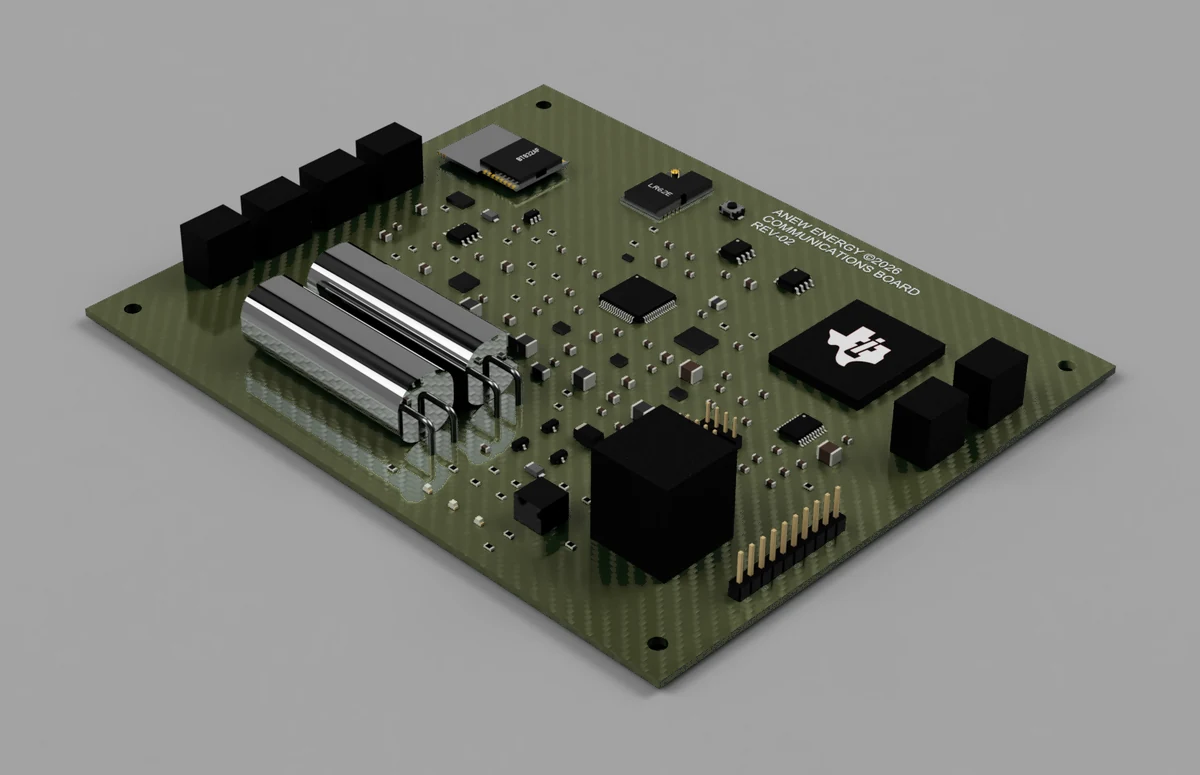
 The E2X Sync Node
Every device, one synced record.
The Communications Platform is the board that gives every ANEW device a voice and an identity. It talks CAN Bus and RS-485 to whatever it is mounted in — a wind or water generator, an Any Energy Transformer, a Power Pole, a Solar Cube, a storage bank — and reports over cellular, Bluetooth LE, or a local LoRa mesh.
That is what E2X sync means: generation, conversion, storage and distribution stop being separate boxes with separate logs and become one timeline, measured at the source and signed by the hardware that measured it.
It is solar powered with its own ride-through cells, so the monitor never goes dark with the thing it is monitoring — and when the link drops, power keeps flowing and the records catch up.
◷ Available 2028
 E2X · Energy to Everything
Four points on the chain, one clock.
Energy crosses four boundaries between the wind and the wall socket. Historically each one keeps its own log, in its own format, on its own clock — which is why nobody downstream can prove what actually happened. The Communications Platform puts the same node at all four.
At the generator
Wind, water, solar and hydrogen units report what they made and the conditions they made it in — inferred wind speed or flow shown as a band, never as a certified instrument reading.
At the transformer
The Any Energy Transformer reports what crossed it and what it cost to cross — the conversion step that every downstream number depends on, measured instead of assumed.
At the store
Power Pack, eCUBE and Solar Cube report state of charge, throughput and health, so stored energy carries the same provenance as the energy that charged it.
At the distribution point
Power Poles, EV charging and grid-export points report what was delivered and to whom — closing the loop between what a site generated and what it actually used.
Why one node at all four points
Put a different meter at each boundary and you get four datasets that argue with each other — different sample rates, different clocks, different trust. Put the same node at all four and you get one timeline you can subtract along: generated minus converted minus stored equals delivered, with every term signed by the hardware that measured it.
That is the whole point of the board. It is not a radio bolted onto a product; it is the instrument that makes the products into a system.
Monitoring & Market Settlement
Measure. Sign. Settle.
An electron is worth more when you can prove where it came from. Carbon credits, tax credits, power purchase agreements and green lending all price the same underlying question: can this number be trusted? Three steps answer it — and ANEW only performs the first two.
Measure at the source
The board measures at the device, not at a gateway or a cloud aggregator. Nothing is inferred from a downstream total, so there is no step in the chain where a number could quietly become an estimate.
Sign with the silicon
Each board carries a hardware-anchored, clone-resistant identity — a physically-unclonable function, derived from the microscopic manufacturing variation unique to that chip. It is never written to the board, so it cannot be copied off it. Every measurement leaves signed by that identity and stamped with a disciplined time.
Settle in the market
Banks, carbon registries, warranty desks and grid operators read those signed records through an open, read-only data interface — and settle on them in their own systems. The record is the evidence; the market does the trade.
Why a Physical Unclonable Function instead of a stored key
A key written into memory is a key that can be read out, cloned onto a counterfeit board, and used to mint production that never happened. A Physical Unclonable Function is not stored anywhere — it is measured from the chip itself each time it is needed, and it disappears when the power does. ANEW’s design uses two Physical Unclonable Functions — one on the measuring side and one on the communications board — and both must authenticate before any transaction is accepted.
That matters most where the money is: if a lender is advancing capital against a device's future output, the device's identity is the collateral. Clone-resistant identity is what lets a signed kilowatt-hour be underwritten instead of merely reported.
What ANEW does not do
ANEW produces trusted measurements. ANEW does not trade, settle, custody or move money, and the data interface is deliberately read-only and non-transactional: a consumer can verify that a device produced a given quantity with a valid signature; it cannot instruct ANEW to pay anyone.
A household's production, location and usage belong to that household. Nothing leaves without consent, and the public scan-a-unit view shows lifetime clean energy and carbon status — never an owner's location or their financier.
Language we hold ourselves to: device identity is “hardware-unclonable, clone-resistant” — never “hackproof.” Generation is shown as a band, never a single headline number. The platform produces trusted measurements; it does not trade.
Who reads the record
What the trader and the grid operator take from this board.
Once an electron is provable, four very different readers use the same number: the trader who sold it ahead of time, the grid operator who has to keep the local transformer inside its limits, the buyer who pays for it, and the registry that turns it into a certificate. None of them has to trust the others' spreadsheet, because there is only one record and the hardware signed it.
Schedule, deliver, reconcile
Wholesale power is sold in quarter-hour or hourly blocks a day ahead. The aggregator forecasts the fleet from metered history, nominates a schedule to the system operator, and pays imbalance on the difference between schedule and delivery. Disciplined time-stamps and gap flags on the board are what make the delivered number defensible in that settlement.
Loading at the transformer, on one clock
The node at the Any Energy Transformer measures both sides of the crossing, so the distribution operator can see feeder loading, voltage and the storage dispatch profile as a trend rather than a guess. That is the evidence for a hosting-capacity study, a flexible connection agreement, and targeted rather than blanket curtailment when a substation is full.
Delivered times strike price
An off-taker pays for metered delivery under the PPA; a distributor credits metered export at the regulated tariff. A period with lost communications is flagged, never estimated, and a unit trades only while its metering circuit carries a valid calibration record against a named standard. The paying agent releases the coupon on exactly the same record.
For the specialist · settlement periods and boundaries
Imbalance settlement runs on 15-minute periods across most of continental Europe, 30 minutes in Great Britain and 5 to 60 minutes across US markets; the board's quarter-hour intervals roll up to any of them. The interface is read-only and non-transactional: a grid operator can read loading and a trader can read production, but neither can instruct the board to pay, dispatch or curtail through ANEW. Dispatch instructions travel from the operator to the aggregator to the site's own controller. ANEW produces trusted measurements; it does not trade, settle or move money.
The Funding Side
How a board gets a project funded.
The hardest part of financing clean energy for people conventional lenders leave out is not the interest rate — it is proof. This board is where the proof comes from, and ANEW's software is what carries it to capital.
Born at the factory
A device comes to life when its communications are validated and its calibration is stored. That birth record — signed — is the first entry in a life story that runs to retirement.
Bound to its funding
Only a born device can be bound to a funding source. The dashboard and the public vitals view show that a unit is financed — never by whom.
Commissioning releases the money
The signed commissioning attestation is the single seam that releases escrow and starts the warranty clock. One event, verified by the hardware, moves the project from funded to operating.
Production repays it
From then on the same signed stream is the repayment record, the carbon ledger and the warranty evidence. If a unit is ever replaced, the successor inherits the binding.
One record, four readers
The same signed measurement is simultaneously the customer's dashboard, the financier's settlement input, the carbon or tax-credit provenance, and the warranty's evidence. Nobody has to reconcile four systems, because there is only one number and it is signed.
That is the reason a community that cannot qualify for a conventional loan can still be underwritten: the asset reports on itself, continuously, in a form a lender can verify.
Failing toward power
If connectivity drops, power keeps flowing. A pay-as-you-go arrangement is never allowed to cut a household's electricity because a cell tower went down — the dashboard shows a graceful comms-lost state, and the records catch up when the link returns.
Offline is a normal operating mode in the places this matters most, so it is designed for rather than treated as a fault.
Funding structures shown are illustrative and are not an offer of securities, credit, or any financial product. Availability depends on jurisdiction, licensing and partner arrangements.
Power Management
A node that runs the point, not just watches it.
At a generator
The node reports output against the unit's own factory calibration curve, so a soft month reads as weather rather than as a fault. It carries the reset and program lines for the equipment it is mounted in — a stuck unit can be brought back over the bus instead of by driving to it.
At a transformer
Conversion is where losses hide. The node measures both sides of the crossing on one clock, so efficiency is observed rather than assumed, and drift shows up as a trend long before it shows up as a failure.
At a store
Charge, discharge, throughput and cell health ride the same CAN pair the battery management system already speaks, so storage joins the record without a second network.
At a distribution point
Delivered energy is metered where it is delivered — a pole, a charger, an export point. That closes the loop: a site can see generated, converted, stored and delivered as one balance, and find the gap when they do not agree.
Finding the one unit that needs attention
On a site with dozens of units, the problem is rarely knowing that something is wrong — it is knowing which one. A technician filters to the ticket, homes in on the faulted unit by Bluetooth signal strength, and confirms it by scanning the unit itself. The last hundred meters are the part that usually costs a day.
The Spec Sheet
Built to stay connected.
Communications & Trust
- Wired busesCAN Bus + RS-485, multi-drop twisted pair
- Wide-areaLTE Cat-M1 / NB-IoT with satellite positioning
- Local linkBluetooth LE, integral antenna
- Site meshLong-range LoRa (fitted per site)
- Expansion10-pin SPI / UART / GPIO · 4-pin I²C sensor
- UmbilicalM12 5-pos A-code shielded cordset
- IdentityHardware-anchored, clone-resistant (Physical Unclonable Function)
- Data outSigned, timestamped records · open read-only interface
Power & Function
- InputsBulk DC or 12 V-class solar panel with MPPT
- Panel class20 W monocrystalline typical (10 W sunny · 30 W high-latitude)
- Ride-throughTwo lithium-titanate cells — widest temperature range
- RailsBuck-boost system rail + independently switched radio rail
- RecoveryRadios power-cycle without rebooting the controller
- IndicatorsPower heartbeat · network sync · bus activity
- RoleShared E2X sync node for every ANEW device
- Availability2028
Theoretical values. Calculated from mathematical models, not measured physical performance. See the test-bench note below.
Figures shown are design targets. Proprietary board and system details are held under NDA; final certified ratings depend on regional certification and engineering sign-off.
About these numbers
The performance values on this page are theoretical. They are based on mathematical calculations, not on measured physical performance. We will update them as physical values come in during our 18-month “Iron Man” destructive testing and validation programme. All products will carry the onboard eCube Power Trading technology, which will be calibrated each year to ASTM standards.
The Board
One brain, every device.
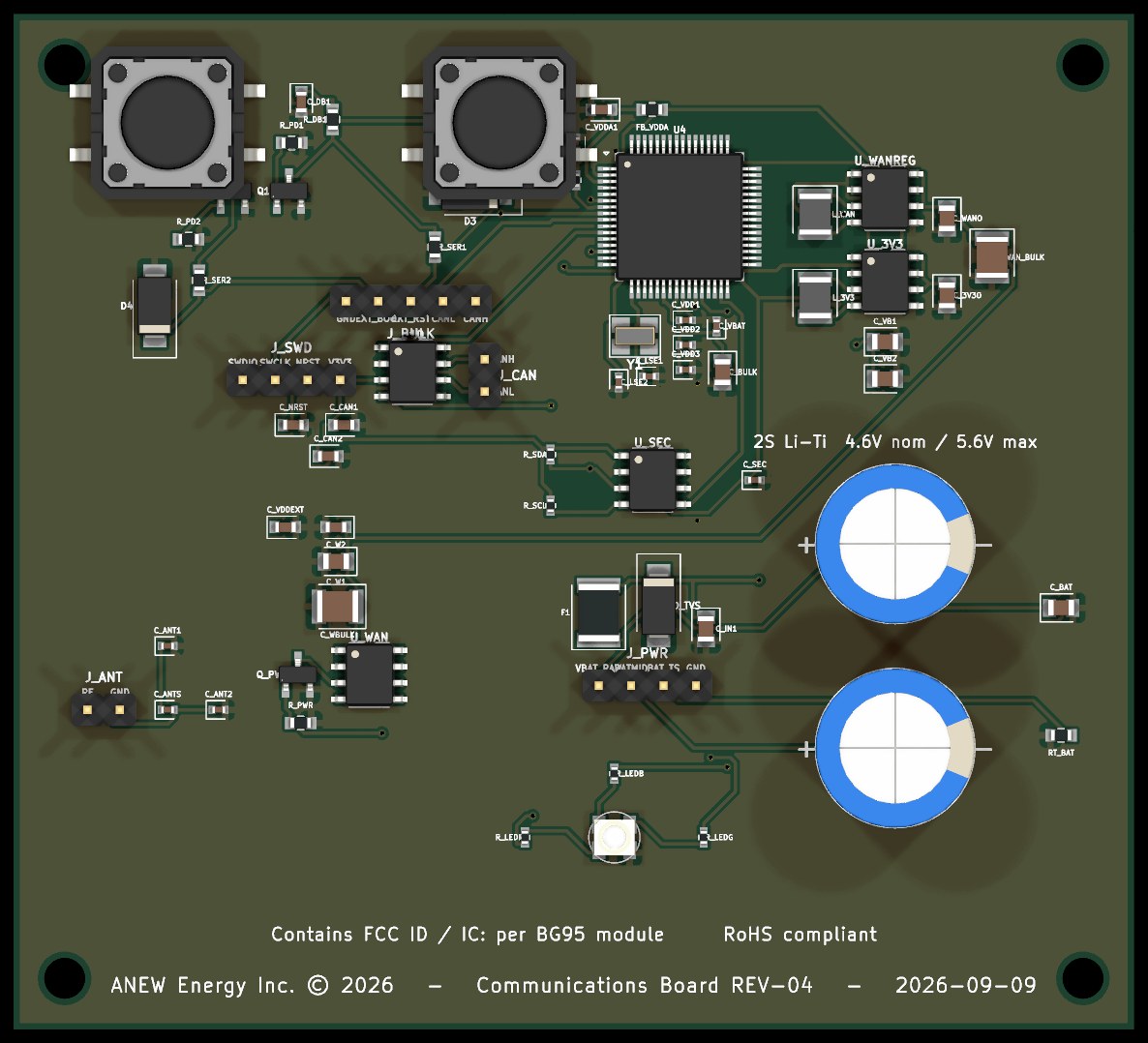
The short version
Every ANEW product needs to talk to the network, but not every product should have to carry its own radios, its own backup power and its own root of trust. The Communications Platform does that job once, so a generator, a transformer, a Power Pole, a Solar Cube and a storage bank can all plug into the same bus and get the same connectivity — and the same identity.
It is the one board every other device shares. That shared, signed record across the whole product line is what makes carbon credits, tax credits and power purchase agreements fundable in the first place — because for the first time the underlying number can be verified by the party taking the risk.
One board. Every electron accounted for.
Available 2028. See it working alongside the Any Energy Transformer and the Solar Cube, or talk to our team.

The comms layer is how a micro-grid proves itself: continuous telemetry from generation, storage and the grid-tie, timestamped per device. That record is what 24/7 uptime — and every credit written against it — is verified from.
ANEW reference design — architectural rendering generated with Runway.
How Your Project Gets Paid For
Every product we make is born fundable.
The hard part of clean energy is not the hardware. It is that a single roof, farm or clinic is too small for a bank to look at. So we build the financing into the product. The same board ships inside every ANEW system, sells its power under contract, proves every kilowatt-hour it delivers, and lets thousands of small systems be pooled into paper the bond market can actually buy.

Communications board REV-04, in design-for-manufacturing review. Pilot units exist; fleet data does not yet.
- 1
Sell the power before you buy the hardware
A power purchase agreement on the system sells its electricity before the system is financed. The project starts with contracted revenue from a named buyer instead of a forecast, and that is the difference between a loan application and a bond.
- 2
Prove every kilowatt-hour
The communications board measures output at the source and signs each reading with a hardware identity that cannot be copied. Nobody has to take your word for it, or ours.
- 3
Pool it into certified paper
Thousands of signed, contracted systems pool into a weekly country basket. The basket is verified and drawn as a series under a planned Climate Bonds-certified note programme, and the contracted power services the coupon every month.
ANEW Energy is registered with the Climate Bonds Initiative and working toward certification, planned to be in place by the time the products are in production. It is not yet certified. Nothing here is an offer to sell, or a solicitation of an offer to buy, any security.