Energy as a Service · EaaS
Clean power with nothing up front, one fixed monthly rate.
A provider — ANEW or a third-party partner — pays for the equipment, the installation and the insurance, owns and maintains the system, and you pay one fixed monthly rate for the term. No down payment, no loan in your name, and a rate that does not rise when the grid does.
Energy as a Service · EaaS
How Energy as a Service works.
With Energy as a Service, a provider — ANEW or a third-party partner — pays for the equipment, the installation and the insurance, owns and maintains the system, and the customer pays one fixed monthly rate for the term. No down payment, no loan in the customer’s name, and a rate that does not rise when grid prices do.
Equipment, installation, insurance
The capital cost sits with the provider, not the household or business. The installer is paid at commissioning, as with any ANEW project.
One fixed rate, every month
The rate is set for the whole term. The customer’s savings grow each year the grid price rises.
Service, repairs, warranty
Service visits and warranty swaps are the provider’s job. The communications board reports every kilowatt-hour, so both sides see the same numbers.
Buy, renew or remove
The customer can buy the system at a pre-agreed price, renew at a new rate, or have it removed and recycled.
EaaS simulator
Change any number. Nothing here is an offer; a real rate is set per project by the provider.
What the fixed rate pays for
Cumulative cost over the term
Illustrative simulation, not an offer of service, financing or any security. Solar production is counted against the site’s own use first; exported power is credited only at the rate you enter. Storage adds resilience during outages, which this simulator does not put a price on. Tax treatment and incentives vary by country; check with the provider.
Three ways to pay
Buy it, fund it, or pay for the service.
| Buy outright | Weekly country funding basket | Energy as a Service | |
|---|---|---|---|
| Up front | The full installed cost | Nothing up front for the owner; the project is funded through the basket | Nothing |
| Who owns it | You | You, with the financing repaid from the power the system sells | The provider, for the term |
| Insurance & service | Yours to arrange | Wrapped into the project cost | The provider’s job |
| Each month | A smaller bill, nothing to repay | A smaller bill; the contracted power services the note | One fixed rate for the term |
| Best when | You have the capital and want every saving | The site is sized to sell power under contract | You want clean power now and no capital outlay |
When EaaS makes sense — and when it does not
Strongest where power is expensive today. Replacing a diesel generator, or a grid that charges a high price per kilowatt-hour, is where one fixed rate beats the bill from the first month.
Harder on a cheap, clean grid. Where power is already inexpensive, the fixed rate can cost more than today’s bill. The simulator shows that plainly; a longer term, lower cost of capital or local incentives can close the gap.
Resilience has value the bill does not show. Storage keeps the lights on through outages. The simulator does not put a price on that; many customers do.
Questions people ask
Is this a loan?
No. It is a service agreement: the provider owns the equipment and you pay for the service. Nothing is borrowed in your name.
Who fixes it if something goes wrong?
The provider. Service visits, repairs and warranty swaps are part of the rate, and the communications board reports every kilowatt-hour so both sides see the same numbers.
What happens at the end of the term?
You choose: buy the system at a pre-agreed price, renew at a new rate, or have it removed and recycled.
How is the rate set?
From the installed cost, the insurance, the service and the provider’s cost of capital over the term, for your site. Try it in the simulator above; a real rate is set per project by the provider.
Is it available where I am?
It depends on the country and the project. Start the Site Development Wizard or talk to our team and we will tell you honestly.
How Your Project Gets Paid For
Every product we make is born fundable.
The hard part of clean energy is not the hardware. It is that a single roof, farm or clinic is too small for a bank to look at. So we build the financing into the product. The same board ships inside every ANEW system, sells its power under contract, proves every kilowatt-hour it delivers, and lets thousands of small systems be pooled into paper the bond market can actually buy.
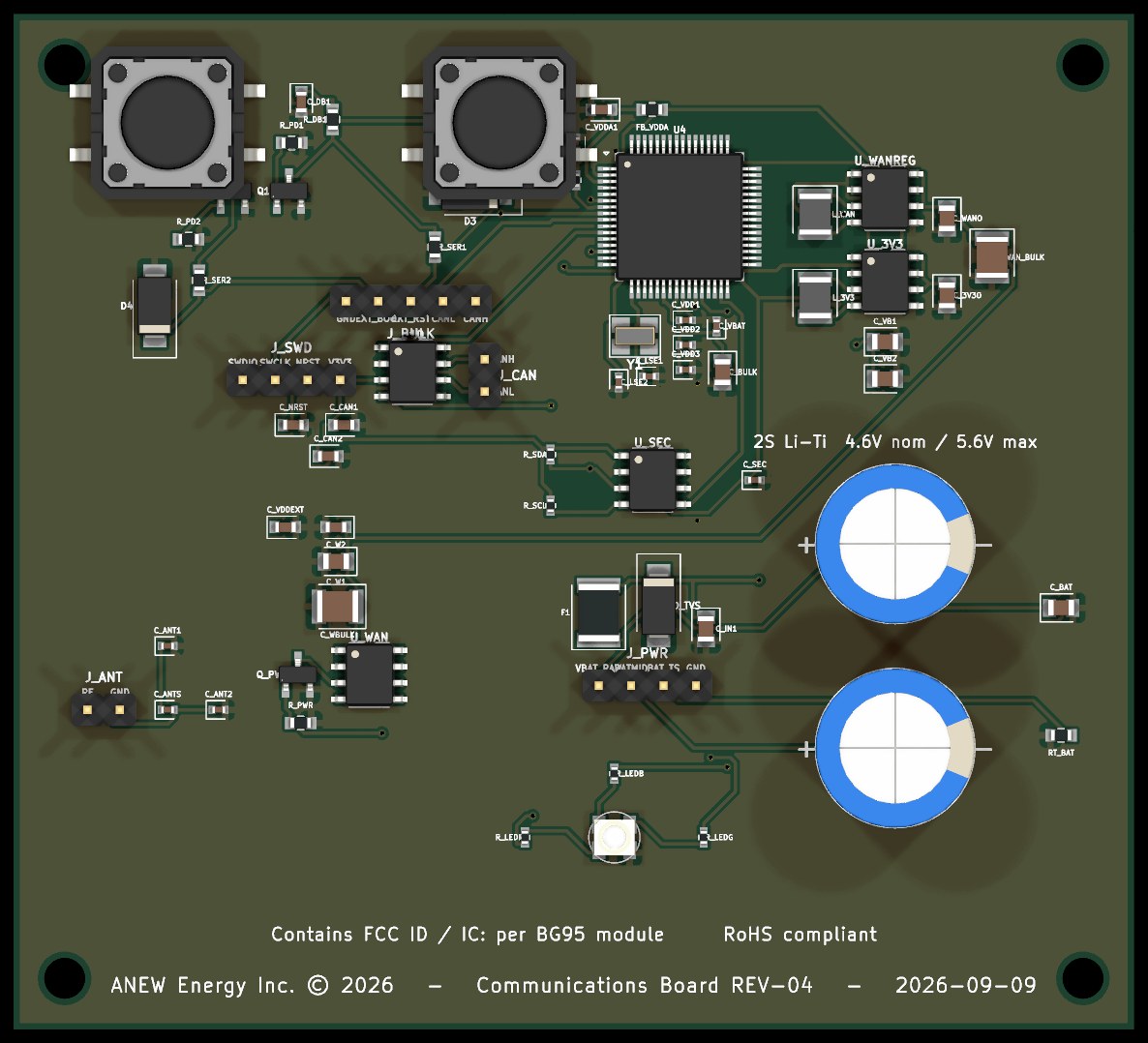
Communications board REV-04, in design-for-manufacturing review. Pilot units exist; fleet data does not yet. How the board works →
- 1
Sell the power before you buy the hardware
A power purchase agreement on the system sells its electricity before the system is financed. The project starts with contracted revenue from a named buyer instead of a forecast, and that is the difference between a loan application and a bond.
- 2
Prove every kilowatt-hour
The communications board measures output at the source and signs each reading with a hardware identity that cannot be copied. Nobody has to take your word for it, or ours.
- 3
Pool it into certified paper
Thousands of signed, contracted systems pool into a weekly country basket. The basket is verified and drawn as a series under a planned Climate Bonds-certified note programme, and the contracted power services the coupon every month.
ANEW Energy is registered with the Climate Bonds Initiative and working toward certification, planned to be in place by the time the products are in production. It is not yet certified. Nothing here is an offer to sell, or a solicitation of an offer to buy, any security.
Start with your site.
The wizard asks one question at a time, draws the plans and shows the fixed monthly rate for your system.
Illustrative. Not an offer of service, financing or any security. Availability, terms and the rate are set per project by the provider.