ENERGY MARKETS
Who buys the power, and who keeps the grid steady.
A kilowatt-hour made on a roof in Costa Rica or a clinic in Kenya has to end up as a payment from somebody. This page follows it there: the buyers, the traders, the retailers, the grid operators in between, and the transformer that has to have room for it. Plain language first, the system logic underneath.

Why stored power is worth more
The same kilowatt-hour, sold at seven in the evening.
Solar at noon is the cheapest electricity of the day, because every roof on the street is making it at the same moment and the grid has nowhere to put it. At seven in the evening the opposite is true: everyone is home, the sun is gone, prices peak and the transformer is loaded from the other direction. A battery moves the same kilowatt-hour from the first moment to the second. That is why stored power earns more than direct power in three separate ways: it replaces the most expensive electricity you would otherwise buy, it sells into the hours a buyer pays most for, and it turns "whenever the sun shines" into "when you call for it", which is what a buyer pays a firmness premium for.
Sell-power simulator
Pick a location. Every price is an editable placeholder, not a quote. Illustrative throughout.
Edit the price assumptions
a year, from generation you did not buy plus surplus sold at midday
a year, with the surplus moved into the evening
Darker green = a kilowatt-hour is worth more that hour. Gold ring = when the site generates. Bright band = when stored power is sold. Midnight at the top.
Simulation. Illustrative figures from editable assumptions, not a forecast, quote or offer. Prices are placeholders to be replaced by the tariff, buyback plan or PPA actually available at the site; battery cycling, degradation, taxes and network charges are simplified. One cycle a day, 90% round-trip efficiency.
Three ways storage earns its keep
- It replaces your dearest kilowatt-hours. The electricity you buy at seven in the evening is billed at the full retail rate, often on a peak tariff. Stored solar used then is worth the retail rate, not the export rate, which in most places is two to five times more.
- It sells into the expensive hours. Where export is paid by the hour (California's tariff, wholesale markets, evening-weighted buyback plans) the evening kilowatt-hour is worth a multiple of the midday one, and it is never curtailed for lack of grid room.
- It makes the power firm. A buyer who can call for delivery pays a premium over a buyer who takes whatever the weather sends. The PPA Trade Simulator prices stored dispatch at a firmness premium for exactly this reason, and grid operators pay fleets of batteries for flexibility on top.
Where the effect is biggest, and smallest
- Biggest where export is paid little at midday and retail is expensive: California, Australia, Germany, the Netherlands as net metering ends, and any site on a peak tariff or running a diesel generator in the evening.
- Large for the grid even where the tariff is flat: in Costa Rica the credit is the same all day, but the storage is what lets a street of systems connect without a substation upgrade, and that is the difference between a project that is approved and one that waits.
- Smallest under full retail-rate net metering (Colorado, Brazil, Ontario), where the grid already acts as a free battery. Those schemes are being reformed almost everywhere, which is why we design storage-first.
For the specialist · capture rates, firmness and the duck curve
Merchant solar suffers capture-rate erosion: as solar penetration rises, the average price received falls below the time-weighted average because output is concentrated in the hours it depresses. Negative day-ahead prices at midday are now routine in Germany, Spain, California and South Australia. Storage recovers the spread by shifting energy into the evening ramp, avoids curtailment and negative-price hours, and converts a variable profile into a dispatchable one, which is what earns a firmness premium in a PPA and eligibility for capacity, balancing and distribution-flexibility payments. The simulator captures the shift and the premium; it does not model degradation, ancillary-service revenue or the value of islanding through an outage, all of which add to the storage case rather than subtract from it.

On the globe
Where power can be sold back to the grid.
Every pulsing country lets a site sell or credit power to the grid in some form. Its border glows and pulses: bright green for an open market where anyone who makes power can sell it, softer green where export is paid at a regulated rate, amber for a single buyer, teal for a market whose rules are being written now. Drag the Earth to spin it, or let it turn. The full terms for each are in the world table.
Thirty places, four kinds of rule
Click a pulsing country and a brief of its rules opens here. The globe turns on its own; it is a map of where the rules allow a sale, not of where ANEW has projects. Rules summarised as understood at the time of writing.
- Who may sell
- How export is paid
- Interconnection & limits
- Buyers
- Venues & platforms
Country outlines: Natural Earth via world-atlas (public domain). Classification is ANEW's reading of public market rules and is not legal, regulatory or investment advice.

Start here
First question: can your site sell power at all?
Here is what this page is about, in one breath. Your roof or your land makes electricity. Some of it you use. The rest has to go somewhere and somebody has to pay for it. Who that is, and whether they are even allowed to, depends entirely on where you are. So the first step in an ANEW project is not choosing panels; it is qualifying the location. Only once we know the route the power can take do we know what a buyer can sign, and therefore what can be financed.
The quick check
Can I sell power back to my grid?
Four taps. No email. A score, the routes that light up for you, and your next step.
- 1
- 2
- 3
- 4
- ★
Where is the site?
What kind of site?
How big?
Battery storage?
The path forward: help change the rules where you live
Rules change when enough owners of roofs, farms and clinics ask for the same three things: a right to export, a fair time-of-day credit, and a buyer other than the utility. Here is who decides where you are, and a letter you can send today.
Who to write to
What to ask for
A letter you can send
Qualify the location
Is export to the grid permitted for a site your size? Who is allowed to buy it: the utility, a retailer, a contracted off-taker, the market? Is there a queue to connect, and does the local transformer have room?
Pick the route
From the five routes below, the one or two that the location actually supports. Where export is not paid at all, the project is sized for self-consumption and storage.
Contract the buyer
A regulated tariff credit, a retailer's buyback plan, or a power purchase agreement of ten years or more. This contract, not the hardware, is what a basket is written on.
Finance it
The contracted stream, the carbon credits and any incentives are priced, the project joins its country basket, and the note pays for the installation. The ten steps →
Where selling power is possible today, and on what terms: the short list
Five worked examples. The world table covers thirty places by region, with who may sell, how they are paid, and the buyers and trading platforms in each. Rules summarised as understood at the time of writing and they change; a project is qualified against the current rules of its own utility and regulator.
Why this decides the financing
A Costa Rica basket is written on regulated tariff credits and bill savings. A Texas or California basket would be written on buyback contracts or PPAs, hedged where merchant. A Kenya basket is written on displaced diesel and, as open access lands, on PPAs. A location that cannot export at all still gets a project, sized for self-consumption and storage, and it enters a basket on bill savings alone. The location sets the route, the route sets the contract, and the contract sets the note. That is the order, every time.


Hope, with a to-do list
Your country wants to sell power.
Most of the world's roofs are not allowed to sell what they make. That is not physics, it is paperwork: a single-buyer rule here, a size cap there, a tariff that pays the same at noon as at seven in the evening. Tell us where you are and we will show you the rules that would have to change for homes, small businesses and micro-grids there to participate, and who decides. Then let us help you get your micro-grids participating.
How to comply and start selling
What would have to change
Who decides
Likely allies
Other ways to find the rules
We could not build a confident brief for . These searches usually get there in a few minutes, and our team can do it with you.
The brief describes rules and roles in general terms as understood at the time of writing; it never states fees, timelines, form numbers or links, and it is not legal, regulatory or investment advice. Where a country is not in our qualified list, the brief is generated by an AI model with confidence tags and should be verified with the regulator named.
In plain language
Five ways a kilowatt-hour gets paid for.
Electricity is the only product that is sold the instant it is made. So the question is never "where do we store it until someone buys it" but "who has already agreed to take it, at what price, and through whose wires." An ANEW site can use one route or several at once.
Use it yourself
The site's own load takes the power first. Every kilowatt-hour used on site is a kilowatt-hour not bought from the utility, at the full retail rate, which is usually the most valuable use of all.
System term: self-consumption, behind the meter. No counterparty; the "buyer" is the bill you didn't pay.
Sell it to one buyer under a long contract
A company, a utility or a retailer agrees to buy the output for ten years or more at an agreed price. This is a power purchase agreement, and the buyer is called the off-taker.
System term: PPA. Physical if the power is delivered to the buyer's connection; virtual or financial if the buyer settles the price difference against the market and the power goes into the grid.
Sell it into the wholesale market
Where a wholesale market exists, power is sold in hourly or quarter-hourly blocks a day ahead, or in the intraday market as the forecast firms up. Small sites cannot trade there directly; a licensed trader or aggregator bundles thousands of them into one tradable position.
System term: day-ahead, intraday and balancing markets, run by an exchange or a system operator. Route-to-market providers such as EDF Trading, Statkraft or Axpo do this for renewable generators.
Sell it to a retail electric provider
Retailers buy power wholesale or under PPAs and resell it to homes and businesses on tariffs. A retailer that wants a "100% local renewable" tariff needs generation like this to back it.
System term: retail electric provider, load-serving entity or supplier. Common in the UK, Texas, Australia, the Nordics and much of the EU; absent in single-buyer markets.
Sell it to the utility at a regulated rate
In a single-buyer market there is no exchange and no choice of retailer. The state or municipal distributor takes exported power and pays, or credits, a rate set by the regulator. This is the route that applies to a home in Costa Rica today.
System term: single buyer, net billing, regulated tariff. Costa Rica (ICE and seven distributors under ARESEP tariffs) and, historically, Kenya (KPLC) are examples.
For the specialist · what changes between routes
Price risk. Route 5 carries regulatory risk (the tariff can be reset) but no market risk. Route 2 fixes the price for the term and moves basis and shape risk to whoever signed the PPA. Routes 3 and 4 leave the generator exposed to hub prices, capture-rate erosion at midday, and negative prices, which is why merchant exposure is hedged on venues such as CME Group, Nodal Exchange, EEX and Nord Pool, and why the ANEW note programme only admits a site once its output is under a PPA of ten years or more.
Who schedules and who is responsible for imbalance. Any power sold into a market must be nominated to the system operator ahead of time. The party that does that, the balance responsible party, pays imbalance charges when actual output differs from the schedule. For a portfolio of small sites that role sits with the aggregator or trader, never with the household, and it is priced into the route-to-market fee (the "power trading spread" in the scale model).
Attributes travel separately. The renewable certificate (REC, guarantee of origin, I-REC) and any carbon credit are separate instruments from the electricity. They can be sold with the power, bundled into the PPA, or sold on their own venues. The comms board's signed meter record is the provenance all three rest on.
Once you know how the power is paid for
Next: how does the equipment get paid for?
There is more than one answer. Paying for it yourself, a green-bond note, crypto capital financing, selling a tax credit, Energy as a Service, or a service funded together with a partner. We explain each in plain words, show how two small chips let anyone check the power is real, and let you compare them with your own numbers.
Compare the six ways to fund it →Simulation and explanation only. Not an offer of securities, financing, tokens, tax or legal advice.
The map
Electrons go one way. Contracts and money go the other.
Three things move at once and they do not follow the same path. The power flows through wires owned by the grid companies. The contracts sit between the site's agent and the buyers. The money comes back through the paying agent to whoever financed the equipment. The meter is the one point all three agree on.
Organisations named in the diagram are examples of the type of party at each point. ANEW has no agreement with any of them unless stated on this site. ANEW supplies the equipment and the signed data; licensed participants trade and settle.
For the specialist · why the meter is the hinge
Every party in the diagram settles on interval meter data: the off-taker's invoice, the exchange's delivered-volume settlement, the system operator's imbalance calculation, the certificate registry's issuance and the trustee's coupon release. Normally each pulls a different feed on a different clock and reconciles afterwards. The ANEW communications board measures at the export point, signs each quarter-hour with a hardware identity and exposes a read-only interface, so one record serves all of them. That is the technical reason a portfolio of very small sites can be financed as one instrument. It is also why the board carries a calibration record against a named metering standard: an uncalibrated meter cannot settle a trade, in the simulator or in life.
Step by step
How one trade actually settles.
The PPA Trade Simulator on our demo site plays this sequence with a real device signature. In the market it runs like this.
Forecast the output
Nameplate at first, then metered history. The trader forecasts each site and the whole portfolio for tomorrow, hour by hour.
Offer and bid
The forward output is offered for a term. An off-taker bids a price against the reference curve; storage-dispatched power earns a firmness premium because it can be called in the evening.
Sign the contract
Buyer, seller and the venue sign the same trade hash. On ANEW hardware the seller's signature comes from the device's clone-resistant identity, so the contract is bound to the meter that will prove delivery.
Schedule with the grid operator
The balance responsible party nominates the expected volume to the system operator by the day-ahead gate closure and adjusts intraday as the forecast firms.
Deliver through the wires
Power flows into the distribution network. If the local transformer is at its limit the operator can curtail export; storage moves the energy to the evening instead.
Meter and sign
Every quarter-hour of export is measured and signed at the source. Gaps and comms-lost periods are flagged, never estimated.
Settle
Delivered × strike price is invoiced to the off-taker. Schedule minus actual is settled with the system operator as imbalance. Certificates issue per megawatt-hour delivered.
Pay the coupon
The paying agent receives the off-taker's payment, releases the month's note coupon against the same signed record, and passes the remainder to the site owner.
The part most explanations skip
Why the substation transformer decides how much can be sold.
Think of the neighbourhood transformer as a pipe with a fixed width. At noon, hundreds of rooftops push power up the pipe at once. At seven in the evening everyone comes home and pulls power down it. The grid operator only lets a new generator connect if the pipe can take both flows without overheating. Batteries that hold the midday power and release it in the evening make both flows smaller, which is how ANEW sites get connected without waiting years for a substation upgrade.
Substation headroom simulator
Illustrative. One feeder, one transformer, a fleet of identical ANEW homes. Move the sliders.
Assumptions: evening peak 2.2 kW per home, midday household load 0.8 kW, panels at 75% of nameplate at noon, 90% round-trip battery efficiency, transformer loaded to 100% of rating in either direction before an upgrade or curtailment is needed. Real connection studies also check voltage rise, fault level and protection.
Gold: net flow with ANEW systems and storage. Grey: the feeder before them. Above the centre line is export toward the grid, below is import from it. Simulation. Illustrative figures from editable assumptions, not an engineering study.
What the grid operator is protecting
Steady state means frequency and voltage stay inside their limits while supply and demand match. The system operator holds reserves and buys balancing energy to keep them matched every second; the distribution operator keeps each transformer and cable inside its thermal rating and each customer's voltage inside its band.
- Thermal capacity. A transformer rated 1,000 kVA can carry about that much in either direction. Sustained overload shortens its life; a large overload trips it.
- Voltage rise. Many small generators exporting at minimum load push the voltage up at the end of a feeder. That, not thermal capacity, is often the first constraint.
- Reverse power flow. Older substations were protected assuming power only flows down. Export needs protection and tap-changer settings checked.
- Fault level. Every inverter adds a little to the current that flows in a fault; switchgear has a maximum.
How more sites get connected without waiting
Upgrade the substation. A bigger transformer or a second one. Paid by the network company and recovered through everyone's network charges, or charged to the connecting generator depending on the country's connection-charging rules (shallow versus deep).
- Store and shift. Hold midday export and release it into the evening peak. The ANEW Power Pack and eCUBE do exactly this, which both frees transformer capacity and earns the firmness premium in the trade.
- Flexible connection. Connect now, accept curtailment in the few hours a year the transformer is full. The comms board at the transformer node reports loading so the curtailment can be targeted.
- Sell flexibility. Where distribution operators buy it, a fleet of batteries that turns down export on request is paid for it. This is a service, not energy, and it is a growing revenue line for aggregators.
For the specialist · how this appears in an ANEW interconnection
The ANEW communications board sits at four points including the transformer, and measures both sides of the crossing on one clock. In a connection application that is the data the distribution operator asks for: metered export at the point of common coupling, coincident load, and a dispatch profile for the storage. A fleet of sites on one feeder can therefore be presented as a single controllable resource with a bounded midday export and a bounded evening import, which is the case a hosting-capacity study needs, and it is the basis for a non-firm or flexible connection agreement where firm capacity is exhausted. Grid operators do not endorse or certify this data; they read it through the same interface the trustee and the registry read.
Where the first baskets sit
Costa Rica and Kenya, specifically.
The funding page prices two reference sites, a home in Costa Rica and a clinic in Kenya. They sit in very different markets, which is exactly why we run country baskets rather than one global pool.
The distributor is the off-taker
The Instituto Costarricense de Electricidad, ICE, generates, transmits and dispatches, and remains the country's single buyer of power. Electricity reaches customers through eight distributors: ICE and CNFL (state), JASEC and ESPH (municipal), and the four rural cooperatives Coopelesca, Coopeguanacaste, Coopesantos and Coopealfaroruiz. The regulator, ARESEP, sets every tariff.
- A home or business generating for its own use connects under the distributed-generation rules and is credited for exported power by its distributor at the regulated rate. There is no exchange, no retailer choice and no household PPA. Route 1 and Route 5.
- Larger private generators sell to ICE under Law 7200, which caps private generation at 15% of national capacity for build-own-operate plants plus 15% for build-own-transfer plants.
- Across the border, Costa Rica trades on the Central American regional market, the MER, over the SIEPAC line, run by the regional operator EOR. Proposals to open a domestic wholesale market have been debated; until enacted, the single-buyer model applies.
A bond backed by Costa Rican sites therefore rests on regulated tariff credits and bill savings, not market prices: low volatility, regulatory reset as the main risk. One name to keep apart: ICE here is the Costa Rican utility, not ICE the Intercontinental Exchange named in the venue tables.
From one buyer to open access
Kenya Power (KPLC) was for decades the only buyer of power and the only retailer. KenGen and independent producers sell to it under PPAs; KETRACO owns the transmission grid; EPRA regulates. In March 2024 the Energy (Electricity Market, Bulk Supply and Open Access) Regulations came into force, providing for open access to the transmission and distribution networks, wheeling, and eligible consumers choosing a supplier.
- A clinic or workshop today displaces diesel and grid purchases first (Route 1), with the carbon credit worth far more than in Costa Rica because the displaced fuel is dirty.
- As open access is implemented, a portfolio of sites can be aggregated and wheeled to an off-taker under a PPA (Route 2), or supplied to a licensed retailer (Route 4). Implementation is staged and licence-dependent.
- Grid capacity is the binding constraint in much of the network, which is why storage-first design and the ability to island matter more here than the tariff does.
Market rules summarised as understood at the time of writing; they change. Nothing here is legal or regulatory advice.

The players
Companies that do this around the world.
Examples of who sits at each point of the chain, so the roles above have faces. EDF is the one most people have heard of because a single group does almost all of them: it generates, it trades and provides route-to-market for other generators, it supplies retail customers, and its regulated network arm runs the distribution grid. Most countries split those roles across several companies.
EDF Trading · EDF Renewables · EDF EnergyFrance; UK, USGenerator and retailer. EDF Trading is the group's wholesale trading arm, giving market access and route-to-market services to renewable generators and small suppliers. Enedis, the French distribution operator, is a regulated EDF subsidiary; RTE, the transmission operator, is independent by law.The template for "one group, every role". A route-to-market desk like EDF Trading is the kind of counterparty that turns thousands of small sites into one schedulable position.
Global Energy Management & SalesFranceGenerator, trader and retailer across Europe and Latin America; large corporate PPA seller.Active in Central American generation; a natural PPA counterparty type for regional baskets.
Enel Green Power · Enel XItalyGenerator, retailer and trader. Enel Green Power is among the most active private traders on Central America's regional market, the MER, and operates plants in Costa Rica.Shows that a regional wholesale route already exists next door to the single-buyer Costa Rican market.
RWE Supply & TradingGermanyGenerator with one of Europe's largest energy trading floors; route-to-market and PPA structuring for third-party renewables.A hedging and aggregation counterparty for merchant exposure.
Roles summarised from each organisation's public descriptions as understood at the time of writing; corporate structures change. These are examples of market participants, not partners, customers or endorsers of ANEW Energy, and no commercial relationship is implied. Trademarks belong to their owners.
The words
A short glossary.
ANEW Energy is not a lender, broker-dealer, investment adviser, electricity trader or licensed supplier. This page is for information only, describes market structures in general terms, and is not an offer of any security, energy contract or service. Market rules differ by jurisdiction and change over time.
How Your Project Gets Paid For
Every product we make is born fundable.
The hard part of clean energy is not the hardware. It is that a single roof, farm or clinic is too small for a bank to look at. So we build the financing into the product. The same board ships inside every ANEW system, sells its power under contract, proves every kilowatt-hour it delivers, and lets thousands of small systems be pooled into paper the bond market can actually buy.
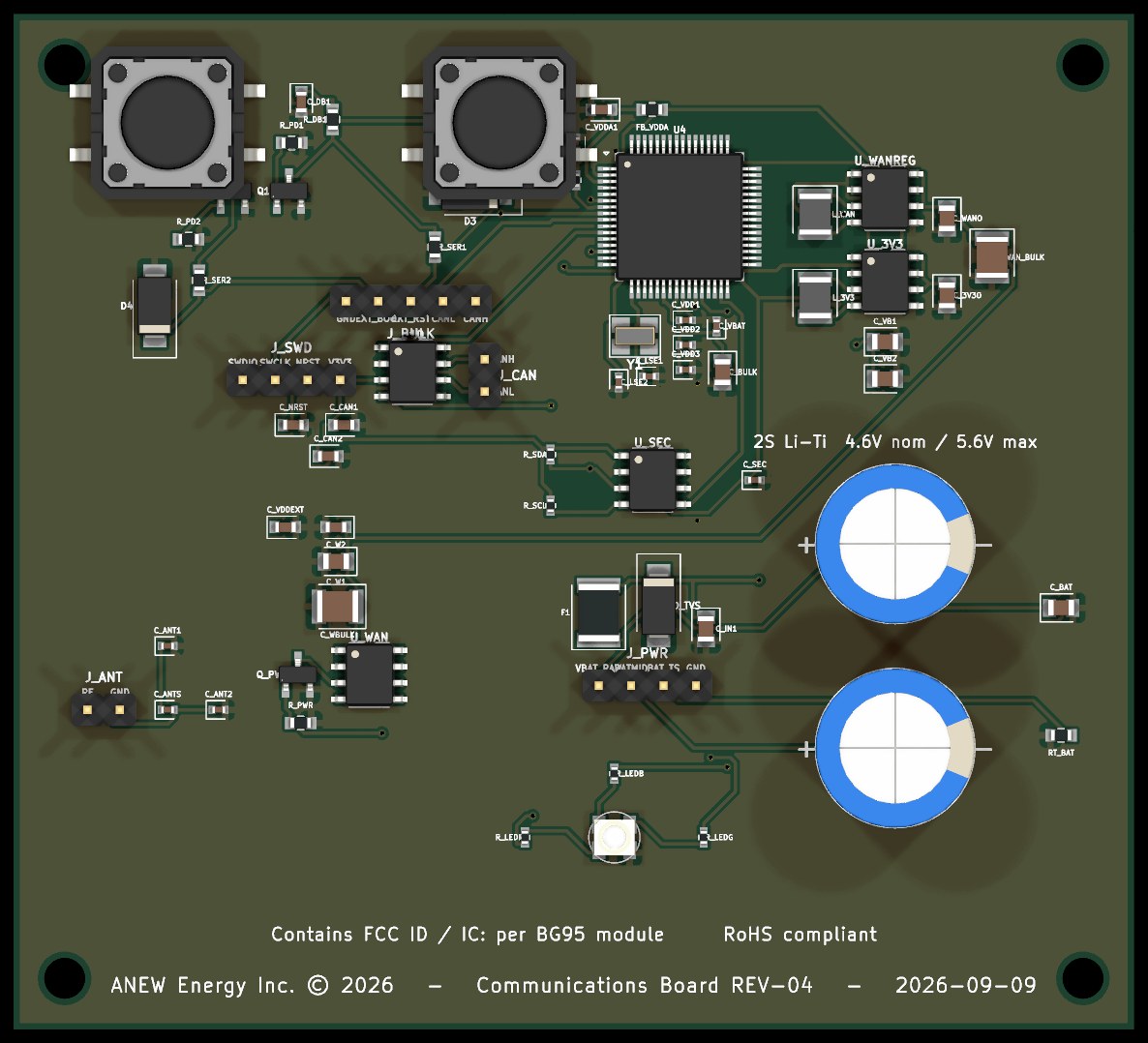
Communications board REV-04, in design-for-manufacturing review. Pilot units exist; fleet data does not yet. How the board works →
- 1
Sell the power before you buy the hardware
A power purchase agreement on the system sells its electricity before the system is financed. The project starts with contracted revenue from a named buyer instead of a forecast, and that is the difference between a loan application and a bond.
- 2
Prove every kilowatt-hour
The communications board measures output at the source and signs each reading with a hardware identity that cannot be copied. Nobody has to take your word for it, or ours.
- 3
Pool it into certified paper
Thousands of signed, contracted systems pool into a weekly country basket. The basket is verified and drawn as a series under a planned Climate Bonds-certified note programme, and the contracted power services the coupon every month.
ANEW Energy is registered with the Climate Bonds Initiative and working toward certification, planned to be in place by the time the products are in production. It is not yet certified. Nothing here is an offer to sell, or a solicitation of an offer to buy, any security.