JUNCTION BOX "J-BOX"
Every source. Every bus. One box.
HIGH-VOLTAGE AC — SINGLE & THREE PHASE · HIGH-VOLTAGE DC · NEMA 4X · 2″ KNOCKOUTS ON FIVE FACES
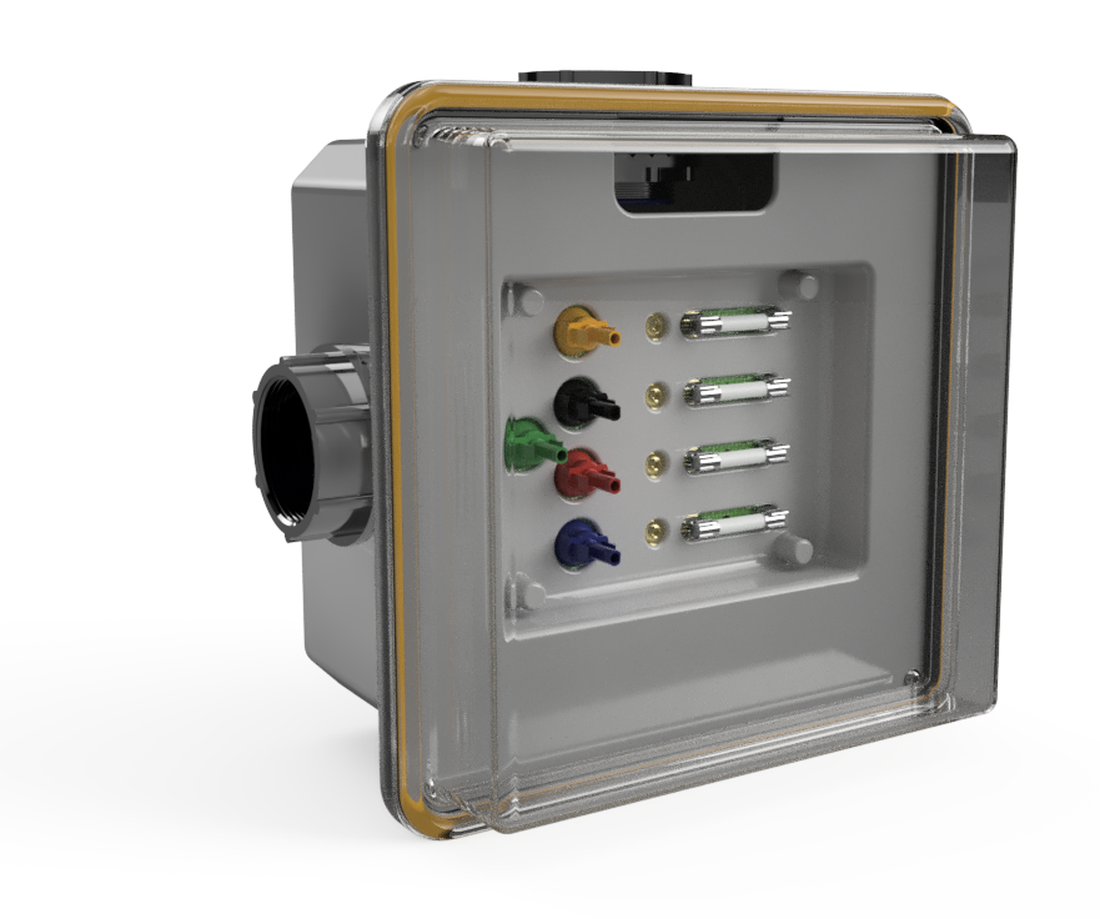
 The J-Box
Where the power lands.
The ANEW Junction Box — the J-Box — is the connection point between ANEW power generation and the bus that carries it away. It talks to the generation side and lands it onto a high-voltage AC bus, single phase or three phase. It also delivers onto a high-voltage DC bus, and it does that regardless of the volts arriving.
Conduit enters through 2″ knockouts on five sides. Every connection is a colour-coded MC4-style connector. Every lane gets its own self-healing fuse, in a holder a technician can change by hand. And an expansion port and communications port bring the whole box onto the ANEW Energy E2X network. The enclosure is designed to NEMA 4X.
One J-Box supports all ANEW Energy power generation, storage and distribution products — so the same box lands the wind turbine, the water turbine, the solar array, the Power Pack and the Power Pole.
◷ Available Fall 2028

Sell the power
Make it. Use it. Sell the rest.
Distribution is where delivered power is metered, and metered delivery is what an off-taker pays for. Whether the rest can be sold, who buys it and at what price depends on where the site is, so we qualify the location first. The Energy Markets page explains the whole chain in plain language: the buyers, the traders, the grid operator and the transformer that has to have room for it.
Inside the Bus
Cover off: one lane per phase.
Take the cover off and the box explains itself. Power arrives on one side, leaves on the other, and every phase travels its own labelled, fused lane in between.
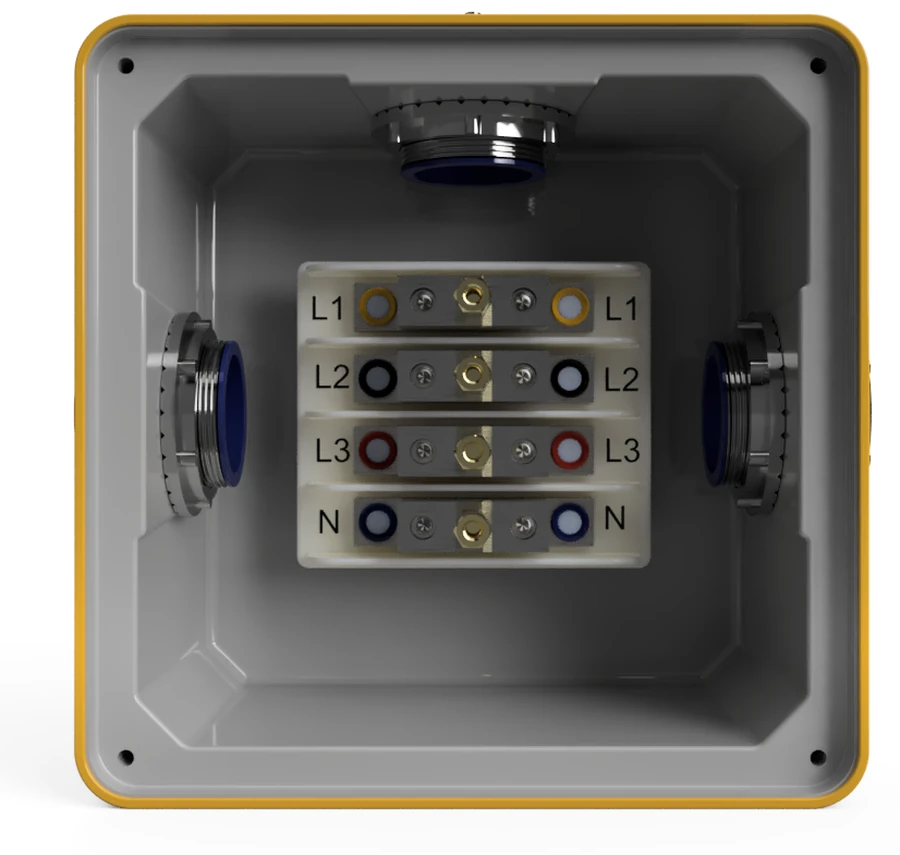
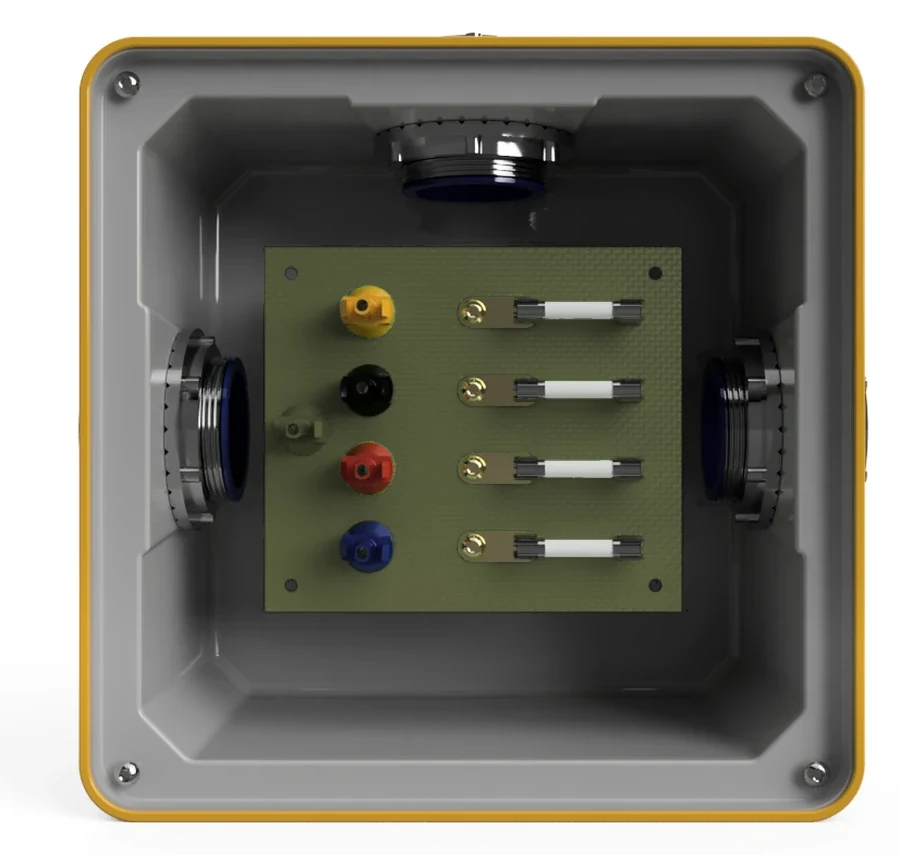
AC: one lane per phase
On the AC side the box is deliberately boring — and that is the point. Single-phase or three-phase, each conductor lands on its own labelled terminal, crosses its own fuse, and leaves on the matching terminal opposite. Nothing shares a lane, so a fault is one lane's problem and a technician can see which one at a glance.
Because the labelling, the colour rings and the connector bodies all carry the same code, the box will be wired the same way in a factory in Ohio and on a hillside in Costa Rica.
DC: the same discipline
The DC side reuses the same architecture — labelled lanes, colour-coded MC4-style connectors, one self-healing fuse per lane. What changes is the label; the discipline doesn't. And the J-Box delivers onto the high-voltage DC bus regardless of the volts presented to it, so a mixed site doesn't need a different box per source.
That is what lets a single enclosure sit behind generation, storage and distribution alike.
Cover-off views are engineering renders of the current design revision. Terminal counts, ratings and certified markings are finalised at certification.

E2X · Energy to Everything
A junction box that reports in.
A conventional junction box is a dead end — power goes through it and nobody downstream knows anything about it. The J-Box has an expansion port and a communications port, which put it on the ANEW Energy E2X network alongside the rest of the system.
That means the point where power lands is also a point the system can see: which lanes are live, which fuse needs a hand, what the connection is actually carrying. The Communications Platform takes it from there — it produces the trusted measurement and signs it at source.
- Expansion port — brings the box onto the E2X network
- Communications port — reports to the ANEW Communications Platform
- Lane-level visibility instead of a silent box on a wall
- Same network as ANEW generation, storage and distribution
Ports & Network
- ExpansionPort onto the ANEW E2X network
- CommsPort to the Communications Platform
- ReportsLane state at the connection point
- Pairs withAll ANEW generation & storage
- EnclosureNEMA 4X — ports stay sealed
What It Connects
One box behind the whole line-up.
The J-Box supports all ANEW Energy power generation, storage and distribution products — the box doesn't change when the source does.
| Where it sits | What it lands | Onto which bus |
|---|---|---|
| Wind Power★ Generation | Turbine output, fused per phase at the tower | High-voltage AC — single or three phase |
| Water Power | Run-of-river turbine output | High-voltage AC — single or three phase |
| Solar | Array strings on colour-coded MC4-style lanes | High-voltage DC — whatever the volts |
| Power PackStorage | Storage in and out of the same enclosure | High-voltage DC — whatever the volts |
| Power PoleDistribution | Pole feed and EV charging branch | Both — AC feed, DC delivery |
| eCUBE | Container-scale tie-in from a single conduit run | Both — AC and DC bus |
Bus assignment depends on the product configuration and the site. Final certified ratings depend on regional certification.
The Spec Sheet
Every number, in the open.
Electrical
- TypeJunction box — "J-Box"
- AC busHigh voltage — single & three phase
- DC busHigh voltage — regardless of volts
- LanesL1 · L2 · L3 · N — labelled both sides
- Bus barsClamped, one bridge per lane
- ConnectorsMC4-style — colour-coded per lane
- ProtectionOne self-healing fuse per lane
- ContactsGold-plated
Enclosure, Ports & Service
- RatingNEMA 4X — sealed, corrosion-resistant
- Conduit2″ knockouts on five faces
- SealFull-perimeter gasket
- CoverClear — inspect without breaking the seal
- PortsExpansion (E2X) + communications
- ServiceFuses replaced by hand, no tool
- EnvironmentRooftop · roadside · farm · coastal
- SupportsAll ANEW generation, storage & distribution
- Targeted service life50 years
Theoretical values. Calculated from mathematical models, not measured physical performance. See the test-bench note below.
Figures shown are design targets; final certified ratings depend on regional certification.
About these numbers
The performance values on this page are theoretical. They are based on mathematical calculations, not on measured physical performance. We will update them as physical values come in during our 18-month “Iron Man” destructive testing and validation programme. All products will carry the onboard eCube Power Trading technology, which will be calibrated each year to ASTM standards.
The connection you never worry about.
Available Fall 2028. Size your system on the ANEW tool, or talk to our team.

The Junction Box is the micro-grid's meeting point: every source in, every load out, with the grid connection as simply one more input. It's what lets a site change sources without an interruption. 24/7.
ANEW reference design — architectural rendering generated with Runway.
How Your Project Gets Paid For
Every product we make is born fundable.
The hard part of clean energy is not the hardware. It is that a single roof, farm or clinic is too small for a bank to look at. So we build the financing into the product. The same board ships inside every ANEW system, sells its power under contract, proves every kilowatt-hour it delivers, and lets thousands of small systems be pooled into paper the bond market can actually buy.
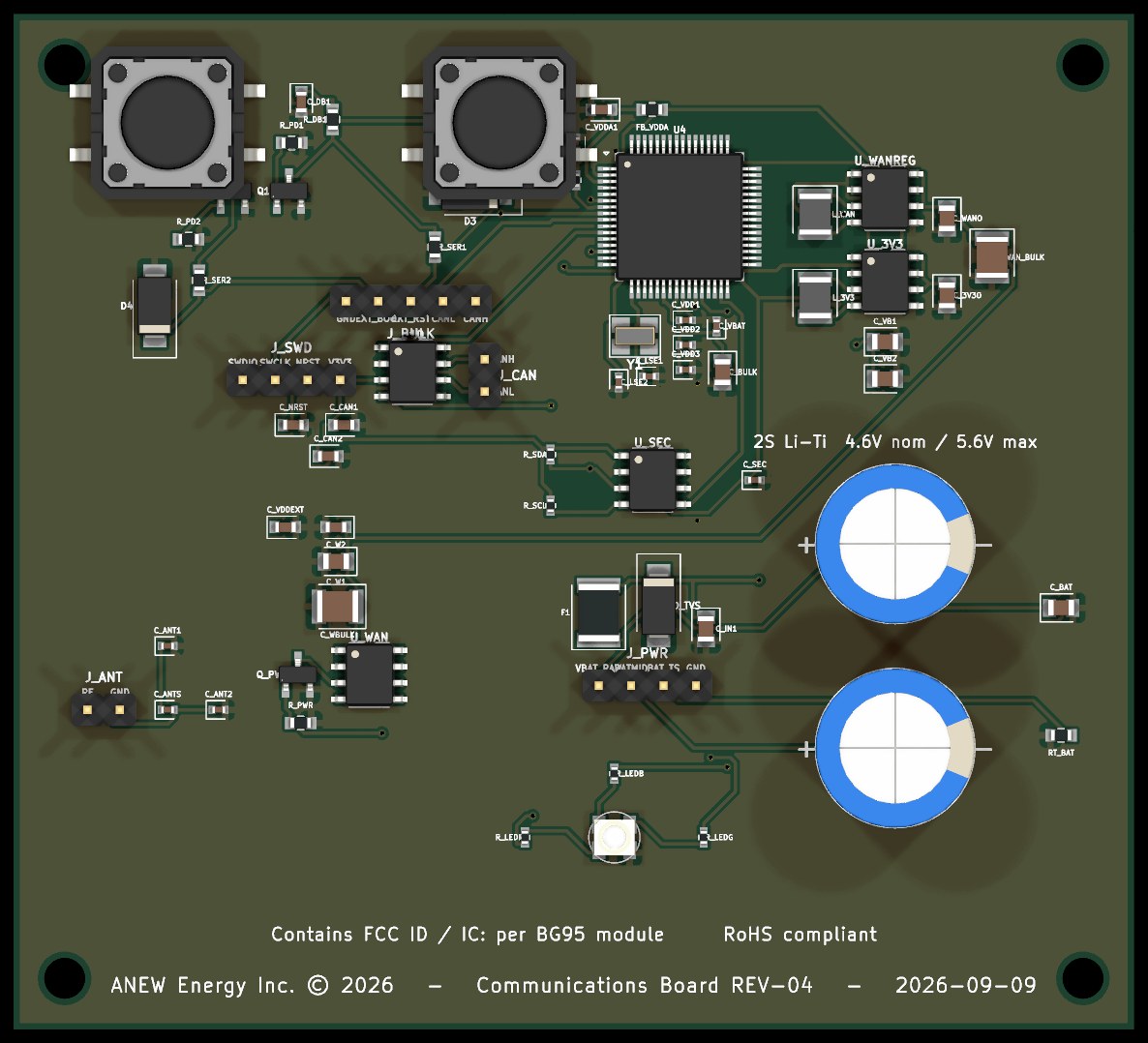
Communications board REV-04, in design-for-manufacturing review. Pilot units exist; fleet data does not yet. How the board works →
- 1
Sell the power before you buy the hardware
A power purchase agreement on the system sells its electricity before the system is financed. The project starts with contracted revenue from a named buyer instead of a forecast, and that is the difference between a loan application and a bond.
- 2
Prove every kilowatt-hour
The communications board measures output at the source and signs each reading with a hardware identity that cannot be copied. Nobody has to take your word for it, or ours.
- 3
Pool it into certified paper
Thousands of signed, contracted systems pool into a weekly country basket. The basket is verified and drawn as a series under a planned Climate Bonds-certified note programme, and the contracted power services the coupon every month.
ANEW Energy is registered with the Climate Bonds Initiative and working toward certification, planned to be in place by the time the products are in production. It is not yet certified. Nothing here is an offer to sell, or a solicitation of an offer to buy, any security.
A tree with every product
Buy ANEW technology and we plant a tree you can follow.
Pick it, name it, find it on the map and watch the CO₂ it holds grow. Or receive a young tree and plant it yourself. Concept with a working demo: the first planting, in Costa Rica, has not happened yet.