ANEW eSCOUT
Size it. Cost it. Fund it.
THE ANEW MOBILE APP · MONITOR · MANAGE · FUND
Video transcript
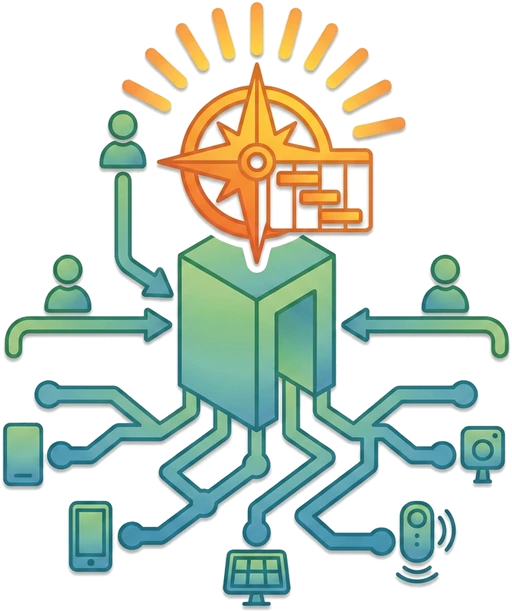
Okay, let's talk about how to connect all this stuff and your user journey. So you're going to somehow find us and eventually hopefully download the mobile app. We call it Escout and the name is a, prerequisite to scout out all the different things that need to get addressed in order to go renewable and create renewable energy. So we're building a micro grid and let's just assume that you've downloaded the app, it's on your phone, you've come home and you're like, let's explore this.
It starts asking you questions about different things like how much was your power bill last month? Where do you live? And it'll go out onto the National Renewable Energy Laboratory's website and it'll look at your location and then it'll calculate how much wind, how much solar, how much water you have in that area and then it'll make a recommendation on how much you need to make that transition. It asks you questions like do you plan on buying an electric vehicle or two electric vehicles in the next few years? So it kind of adds all these variables together and during this process you get assigned a project manager. So we believe that great project management is the success of all projects. So you don't pay for it, we take care of that. But you'll have somebody assign and they can start messaging you, you can ask questions and anyhow, the journey starts with that and then you need to get it installed.
So let's say you've audited your site and I'm up here on the plantation at my mother in law's home and she's got a little bit of wind and she's got a lot of rain and there's a lot of sunshine. So maybe she needs two solar panels and one wind turbine and a battery pack and she wants to sell her excess power back to the grid. So we have an any energy transformer and a battery pack. And so we then she doesn't have the skills to install it and so she messages a local installer that's certified in making these installations. They've gone through all the training classes, they've got all the tools, they know how to do this. They come up here and they're like, hey, you know, this recommendation looks pretty good. But you've got a very large roof on your home. Let's put two water turbines on here, one on one end of the house, one on the other. So they modify the capital equipment and and then they give a price on what it costs to install and you can bring in a second installer to get a second opinion on it or even a third installer.
So now you've got capital equipment, you've got the cost of installation. Now we need to do all the paperwork that allows my mother in law to sell power back to the grid. And so every part of the world has some kind of compliance to be able to connect to the grid. And so here in Costa Rica they've made a new law that anybody has excess power can sell it back to the grid. It goes into effect I think next month or the month after. And so we have to be able to comply with these regulatory paperwork, scenarios. So our AI platform goes out, it finds the paperwork, it completes the paperwork. So you don't have to do that. It runs it by the project manager and then we can submit that to get approval. So we need to get some approvals along the way.
Now we need to get insurance. And so the mobile app goes out and it, and it shops around for insurance. We might go to Lloyd's of London, Chubbs, all these different insurance companies and we buy insurance. So when we borrow money to launch this, these lenders are going to need insurance that if there's a, you know, a hurricane or a fire, you know, that's going to get replaced and, and they can keep you know, making money, you know, the people that loan the money.
So, so anyhow, this mobile app does all that and then it takes like if there's you know, 500 people, a thousand people, it packages them all together at the end of the week and it says, all right, let's go and pull down a green bond. And you can check like, hey, I want to sell my excess power back to the grid. I want to sell my tax credits, I want to sell, you know, carbon credits, you know, all these different things. The crypto guys might get involved, they might like to help with climate. They're trying to find a way to get in. And so we have this funding source that's ready to make the purchase. You just keep paying your bill is really how we want it. So whatever your electric bill is, and eventually the products pay for themselves and the loan gets paid off and, and you have free energy after that's done.
So we kind of start doing a countdown. So you're gonna, in this mobile app you're gonna see all the capital equipment in there and then you're gonna, you know, bring it to life and it's gonna start counting down all the carbon calories that were used to create this. So, you know, under a lot of these rules with ESG and compliance with climate bonds is where we're gonna get our money, because there's, there's a lot of money out there that's looking for projects like this. We have to certify that we know how much carbon energy went in and started polluting the atmosphere. And then we count down to where we start going negative and we start making, you know, clean energy, which is where we want to be.
So, I know this sounds kind of complex, but, it's kind of an easy journey through here, and it'll educate you along the way. And there are seven different water ways that we take you on this journey. And at the end, you can start monitoring your devices and watching it count down and how much power it's making. And if there's a service event, it'll let you flag the service provider if something needs to get fixed, like a stick gets stuck in the wind turbine, things like that. So anyhow, we track the whole hysteresis of ownership from cradle to grave. And, this is where we do it, is on this mobile app. It's part of buying the products at a new energy. We include it, it's no extra cost. And, everybody wins. So the finance people, you know, they, they win, they get, you know, a secured asset that only they can finance and nobody else can buy the electricity from it and things like that. So, so anyhow, take a look at this, this page here. And anyhow, that's what we've got. And hopefully you, can get involved and make, it a new way forward. So anyhow, have a beautiful day. Pura vita, as they say here in Costa Rica. That means have a pure life. And, we'll talk again soon.
One app, three jobs
Monitor. Manage. Fund.
eScout is the ANEW app that takes you from “I'm interested” to “my site is producing” — on a phone, in English or Spanish. It audits your site with real resource data, sizes the system with eWizard, collects labour bids from certified installers, and then does the part nobody else does: it adds up the whole cost of developing your site and puts your financing options beside it.
Behind it all is one thing that makes a lender, a carbon registry and a warranty desk agree: every ANEW machine emits a signed, timestamped measurement anchored to a hardware identity that is clone-resistant. Your dashboard, your funding and your warranty read the same record — so they cannot disagree.
◷ Walk it now on anewenergy.earth · full app with the first installations
The Journey
Seven acts, no seams.
Most clean-energy journeys break at the handoffs: the quote does not know the site, the loan does not know the quote, the warranty does not know the machine. eScout runs all seven acts on one project record, so nothing is re-entered and nothing is lost between them.
Discover & Onboard
Find ANEW through a QR code, a community referral or this website. eScout opens in your language, you enter minimal contact details, and a remote project manager is assigned to you from that moment.
Audit & Size
eScout audits the location, the renewable resource and your consumption. eWizard sizes the wind, water, solar, storage and installation-kit quantities and produces the bill of materials and a first quote.
Quote & Choose
Certified installers see the job, visit the site, accept or adjust the kit — it re-prices — and submit labour costing, and the EPC team draws the engineered site design for the regulator and the funders. You compare star ratings and written reviews and choose your installer.
Fund
The package — equipment, installation, site development and contingency — is assembled, validated, and taken to capital. Escrow is arranged with the recipients and the draw milestones are set.
Install & Commission
Your PM runs the site-development plan with the installer: ground locate, foundation, conduit, wiring, mounting, grid connection, and the inspection sequence. Then the machine comes online and signs its own commissioning.
Produce & Monitor
Live production and avoided carbon on your dashboard, fed by the signed stream. Where the jurisdiction allows, surplus goes back to the grid — settled against the same records you are looking at.
Service & Warranty
Warranty starts at commissioning. A claim is judged on the machine's own signed health record rather than a phone call and a guess — and a replacement inherits the funding without interrupting it.
Sizing and generation outputs are estimates from your site inputs, shown as a range. They are not a guaranteed production figure.

The Number Nobody Gives You
Equipment is the easy part. A site is the real cost.
Ask for a solar quote today and you get a price for panels. What you actually pay for is a site: excavation, a foundation, conduit, wire, mounts, a grid connection, permits, six different inspectors and the days it takes to line them all up. eScout is the first app that adds the whole thing up before you commit — and then finances the total, not the equipment.
| What goes into your number | Who prices it | When it firms up |
|---|---|---|
| Equipment & bill of materials★ Where most quotes stop | eWizard, from your own site audit | Act 2 — before anyone visits |
| Installation kits & consumables | eWizard, adjusted by your installer | Act 3 — re-prices when the kit changes |
| Installer labour | Certified installers bidding against each other | Act 3 — after the site visit |
| Site development | The site-development plan, cost-plus once installers are engaged | Act 3–5 — plan build and approvals |
| Permits, code & inspections | Local authorities; scheduled and cleared by your PM | Act 5 — sequenced, logged, signed |
| Contingency | Applied to the package as a buffer | Act 4 — carried into the funding |
| ANEW project management | ANEW's fee for the PM and the platform | Act 4 — stated in the package |
| Extended warranty & future servicesOptional | Quoted with the labour bid | Act 3 — your choice |
Permits and inspections are the one line above that nobody will quote you — because it is not a price, it is a queue. Look up the real median permit, inspection and interconnection time for any US jurisdiction →
Before a plan is built: does the site qualify?
eScout works a qualification gate with you first, so nobody pays for a design that cannot be installed. It captures the site address and location, checks power and cellular coverage at the site, confirms there is access and clearance to move and rotate the equipment into position, records the plug type with a photo of the receptacle, notes landmarks so couriers and technicians can find the place, and sets the language everything else will be delivered in.
If the site does not qualify, you find out on your phone in Act 2 — not from a truck that has already arrived.
Why it becomes cost-plus — and why that is honest
A site-development plan can only be priced properly once a licensed installer has walked the ground. That is why eScout sequences the site visit before the plan is costed: the estimate you started with is engineering, the number you fund is a bid.
ANEW does not self-perform installations. Independent, insured, bonded, background-checked and product-certified vendors do the physical work as subcontractors, and ANEW supplies the project manager who coordinates every stakeholder, schedules and clears the inspections, captures the signatures and drives the job to a clean commissioning.
Costs, fees, contingency and cost-plus terms are set per project and per jurisdiction. Nothing shown here is a price quotation.

Ways To Pay For It
Four paths to the same site — including one with no loan at all.
The reason clean energy has not reached everyone is not technology. It is that the people who need it most cannot borrow against it. eScout carries the total cost of your site into whichever structure actually fits you.
Own It
Buy the system outright, with the package offset by the credits and structures your own site earns — tax abatement, carbon, and a power purchase agreement where one is available. The funding request covers the whole site, not just the equipment.
Rent It
Energy-as-a-Service: you buy nothing. The equipment stays owned upstream and you pay for outcomes — power delivered, or a flat monthly service fee. No loan, no down payment, no credit check. The credit question moves off you and onto the asset's own metered cash flow.
Host It
Host the equipment on your land or roof and share in the revenue from the stored power it delivers. Every kilowatt-hour is metered and signed, so the split is arithmetic rather than trust.
Fund It As a Community
Where an individual cannot be the borrower, the group can be: a cooperative, a savings group or an NGO contracts for the pool, mission capital funds the pool, and equipment is delivered under rental. Where it helps, a pay-as-you-go option lets a household pre-pay small amounts through a licensed mobile-money partner.
Shrink the Bill First
Before anything is borrowed, eScout looks for money that is already yours: renewable-energy tax abatements that can be transferred, verified carbon reductions a registry can issue against, rebates, and a power purchase agreement for the output. Every one of those lowers what has to be financed.
Contracts Into Cash
For businesses and installers, signed off-take contracts and purchase orders can be turned into working capital through a factoring partner — so a won project does not wait on a payment cycle to begin.
Where the capital comes from
Twelve classes of capital sit behind the funding journey, each tagged and tracked on your project record. eScout routes your validated package to the ones that fit your site, your segment and your jurisdiction.
| Source of capital | What it funds | Who it suits |
|---|---|---|
| Lender marketplace | Conventional project and equipment lending, shopped across lenders | Homeowners and businesses with credit access |
| Green banks | Concessionary and climate-mandated lending, reached by API handshake | Projects that meet green-bank criteria |
| Donor-advised funds | Philanthropic working capital directed to SDG-aligned projects | Households and communities without credit access |
| Sovereign, tribal & SDG funds | Long-horizon direct or joint-venture investment | Community-scale and nation-scale deployments |
| Forgiveness-structured notes | Principal written down as impact milestones are met | Underserved markets |
| Green bonds & note programmes | Portfolios of large and small projects bundled together | Fleet and portfolio owners |
| Power purchase agreements | The output, sold forward to an off-taker | Sites with a creditworthy buyer nearby |
| Carbon credits | Verified emission reductions, issued by a registry and traded on a venue | Any site producing measured clean energy |
| Renewable-energy tax abatements | Future credits transferred to reduce your outlay | Taxpayers and their transferees |
| Purchase-order factoring | Signed contracts converted to immediate working capital | Businesses and installers |
| Equipment rental / Energy-as-a-Service | The asset itself, owned upstream and rented to you | Anyone who should not be taking a loan |
| Climate-tech accelerators | Non-dilutive introductions into investor networks | Larger projects and sponsors |
Money moves when the machine says so
Escrow draws are not released on a paper form or somebody's word. They are released against a signed attestation from the equipment itself — which is why the machine has a hardware identity in the first place.
Born at the factory
Before it ships, each unit validates its communications and stores its calibration, then signs its birth. Only a born unit can be bound to funding — there is nothing trustworthy to anchor a loan to before that.
Bound to your funding
The funding package references each unit by its clone-resistant fingerprint. Your dashboard shows what financed your equipment; the record shows which units the capital is attached to.
Installed, then commissioned
At test-and-validate the unit signs its own commissioning. That single signed signal releases the next escrow draw and starts the warranty clock at the same instant — the installer invoices escrow, not you.
Producing — and still paid if the internet is down
A remote site can hit a milestone with no signal. The unit records the signed attestation locally with the timestamp of the moment it happened and uploads it when the link returns. The delay is in the transport, never in the evidence.
The discipline we hold ourselves to: ANEW produces trusted measurements — it does not trade. ANEW never holds your money and never settles. Licensed lenders commit capital, a licensed escrow agent holds and releases it, accredited registries issue credits, and regulated venues trade them. Our part is the signed proof and the software rails. Device identity is described as hardware-anchored and clone-resistant — never “hackproof.”
Financing structures shown are illustrative and are not an offer, a commitment, or investment, tax or legal advice. Availability depends on the structure, the market and the jurisdiction, and every funding path is subject to the applicable licensing and due-diligence requirements. Figures are always shown as ranges.

Why a Lender Says Yes
A bank will not lend against a promise. It will lend against proof.
Anyone can build a clean-energy app. What is hard is making every machine emit a signed, timestamped measurement, anchored to an identity that cannot be cloned, that a bank, a carbon registry and a warranty desk will all accept. That record is the asset. eScout is how you act on it.
It matters most for stored energy. Power dumped onto the grid at midday competes with everyone else's midday power. Power stored and delivered when the grid is short is dispatchable — and a cash flow a lender can actually underwrite. Proving exactly when and how much stored energy was delivered is what turns your roof into something financeable.
- One record, four uses — your dashboard, the lender's settlement, the credit provenance, the warranty's evidence
- Bound to a specific machine, not to an address or a spreadsheet
- Follows the asset through sale, refinance, repair and replacement without breaking
- Consumed by banks and registries through a read-only interface — never a transactional one
What the record carries
- IdentityHardware-anchored, clone-resistant
- MeasurementValue + disciplined time + provenance
- Lifetime energyNever-reset accumulator
- CarbonEmbodied-carbon debt → countdown
- FundingBound at birth, follows the asset
- LifecycleBorn → financed → installed → commissioned → producing → serviced → retired
- Consumer accessRead-only, consent-gated
Market context on stored versus dumped power is drawn from public 2025–26 industry data and describes the market, not the performance or economics of any ANEW product.
The Knowledge Platform
Don't take our word for it — walk the whole thing.
Everything on this page is live on anewenergy.earth, ANEW's knowledge platform: a working mobile experience you open on your own phone, in English or Spanish. Onboard, audit a site, watch a system size itself, compare installer bids, assemble a funding package, commission a machine, and see the dashboard and carbon countdown that follow.
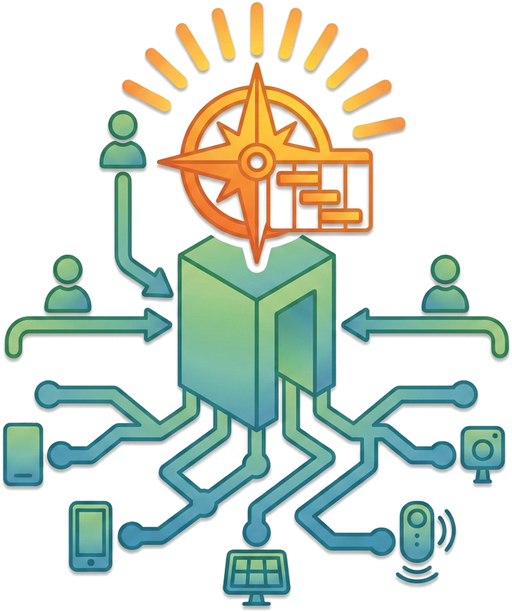
The live experience runs on representative data so it can be explored safely. It is a demonstration of how the platform works — not live money movement, and not a financial offer.
The App Set
Five apps. One project record.
You only ever see eScout. Behind it, your installer, your vendor network and your dashboard are looking at the same customer, the same project and the same machines — which is why nothing has to be re-entered and nothing goes missing at a handoff.
| App | Who uses it | What it does |
|---|---|---|
| eScout★ Yours | You | Site audit, consumption, project-manager assignment, costing, naming, the funding journey, and surplus-to-grid where permitted |
| eWizard | You, then your installer | Sizes wind, water, solar, storage and kit quantities; produces the bill of materials and quote; re-prices when the kit is adjusted |
| Installer app | Certified installers | Job notifications, site visit, photos and GPS, kit adjustment, labour quoting, the daily safety log and site-development execution |
| Vendor portal | The vendor network | Onboarding, staff and credentials, certification status, calendars and ongoing local service |
| Customer dashboard | You, for the next fifty years | Production and avoided carbon from the signed stream, project status, notifications, warranty and service history |

Built For The Real World
Connectivity is not a dependency of power.
Offline, the mission continues
If the internet drops, the equipment keeps delivering. Records buffer locally and catch up when the link returns, and the dashboard shows a graceful comms-lost state that recovers on its own. Billing may be gated; power is not — the platform fails toward delivering energy.
Scan a QR, see a soul
Anyone standing at a machine can scan it and see its public record: alive and producing, lifetime clean energy, the carbon countdown, and a verified-provenance badge. The code carries an opaque token only — never an owner's location, and never who financed it.
The last hundred meters
GPS gets a technician to the site; it cannot pick one machine out of ten identical ones. eScout and the service app home in on the faulted unit by Bluetooth signal strength — warmer, colder — and confirm it by QR before anyone opens a cover.
Your data, your call
Location, photos, audio, video and usage are captured with consent in Act 1 — up front, not buried in a settings screen later. Community and household data is never sold or monetised without explicit consent, and what a household exposes is a different question from what a utility exposes about its own fleet.
- Consent captured before the audit, not after
- The public QR view never shows your location or your financier
- Banks and registries read through a read-only interface, never a transactional one
Two customers, one platform
A utility with thousands of machines and a household with three are genuinely different products — so the fleet views are designed deliberately, not scaled up from the homeowner screen. Both sit on the same signed record.
- HomeownerOne simple dashboard · QR vitals · the guided funding journey
- FleetMap + roll-up health · filter to open service events · bulk dispatch
- AccessRole-based — operator, admin, installer, financier, viewer
- ReportingExport plus a read-only data interface

Mission Before Margin
The same app serves a utility and a woman weaving baskets.
ANEW serves two markets at once, deliberately. Enterprise and well-capitalised customers bring margin, reference deployments and the anchor cash flows that make a portfolio bankable. Households and communities that cannot qualify for a conventional clean-energy loan bring the reason we are doing this — and they are cross-subsidised by the first group.
In practice that means a woman with a workshop and no bank account can end up with a panel and a small battery on her roof: her cooperative contracts for it, mission capital funds the pool, the equipment is owned upstream and rented to her for less than she was paying for kerosene and phone charging — and every kilowatt-hour she stores is signed and counted. That count is what releases the next village's funding.
- No credit history required on the rental and community paths
- The credit question moves from the person to the asset's metered cash flow
- Impact is evidenced by signed production data, not by a report
- Local language from the first screen — because Market B is often Spanish-first
Two markets, one spine
- EnterpriseFleet dashboards · reporting · grid export · procurement
- UnderservedGuided funding · minimum outlay · local language
- Capital AConventional lending · PPAs · green banks
- Capital BDonor-advised · sovereign & SDG · forgiveness notes · rental
- SharedOne customer record · one project · one signed measurement
Cross-subsidy between the two markets is a stated commitment of the company, not a verified financial model, and the community funding patterns described depend on local partners and per-country regulation.
Your Project Manager, Included
eScout assigns you a remote project manager in Act 1 and keeps them with you to commissioning — coordinating stakeholders, building the site-development plan, and scheduling and clearing the electrical, structural, soil, ground-locator, permit and utility inspections, with every acceptance logged. Need someone standing next to you? On-site project managers are available upon request.
In the United States, some jurisdictions now issue a solar permit the moment it passes an automated code check. See which ones — and what the wait is where they do not →

Where the Data Comes From
Every ANEW machine is online, secure, and self-aware.
eScout does not estimate what your site is doing. It reads what your machines report — through the same communications platform that ships inside every ANEW product, so a battery, a turbine and a junction box all speak one language.
Hardware-Anchored Identity
Each unit carries a hardware-anchored, clone-resistant identity that fixes the machine to its funding asset — so its power purchase agreement, carbon credits and tax credits stand on proof of this unit's generation.
Always Connected
Cellular, Wi-Fi, Bluetooth and mesh radio, with a two-vendor cellular standard so a unit stays online across networks and borders. Networking is configured at the factory — it arrives deploy-ready.
Live Telemetry
Each machine reports its own generation and health in real time — proof of what it produced, not an estimate of what it should have produced.
Its Own Customer Portal
Every machine gets a birth certificate.
From the moment it powers on, each unit opens its own portal on anewenergy.earth — a permanent identity record and live dashboard: where it was made, what it is producing, its state of health, its warranty, its carbon and credit history, and its funding. A birth certificate that keeps writing itself across a targeted 50-year life. When a unit is replaced under warranty, the successor is linked to it and the funding re-points without interrupting the cash flow.
- Permanent device identity, hardware-anchored
- Live generation, health and environmental data
- Warranty, service and end-of-life recovery tracking
- Carbon credits, PPA and tax-credit history in one place
On the Portal
- IdentityHardware-anchored device ID
- GenerationLive kWh & performance
- HealthSelf- & environment-monitoring
- FundingCarbon · PPA · tax credits
- LifecycleWarranty → replacement → recovery
In the Wild
This started as a pin on a map.
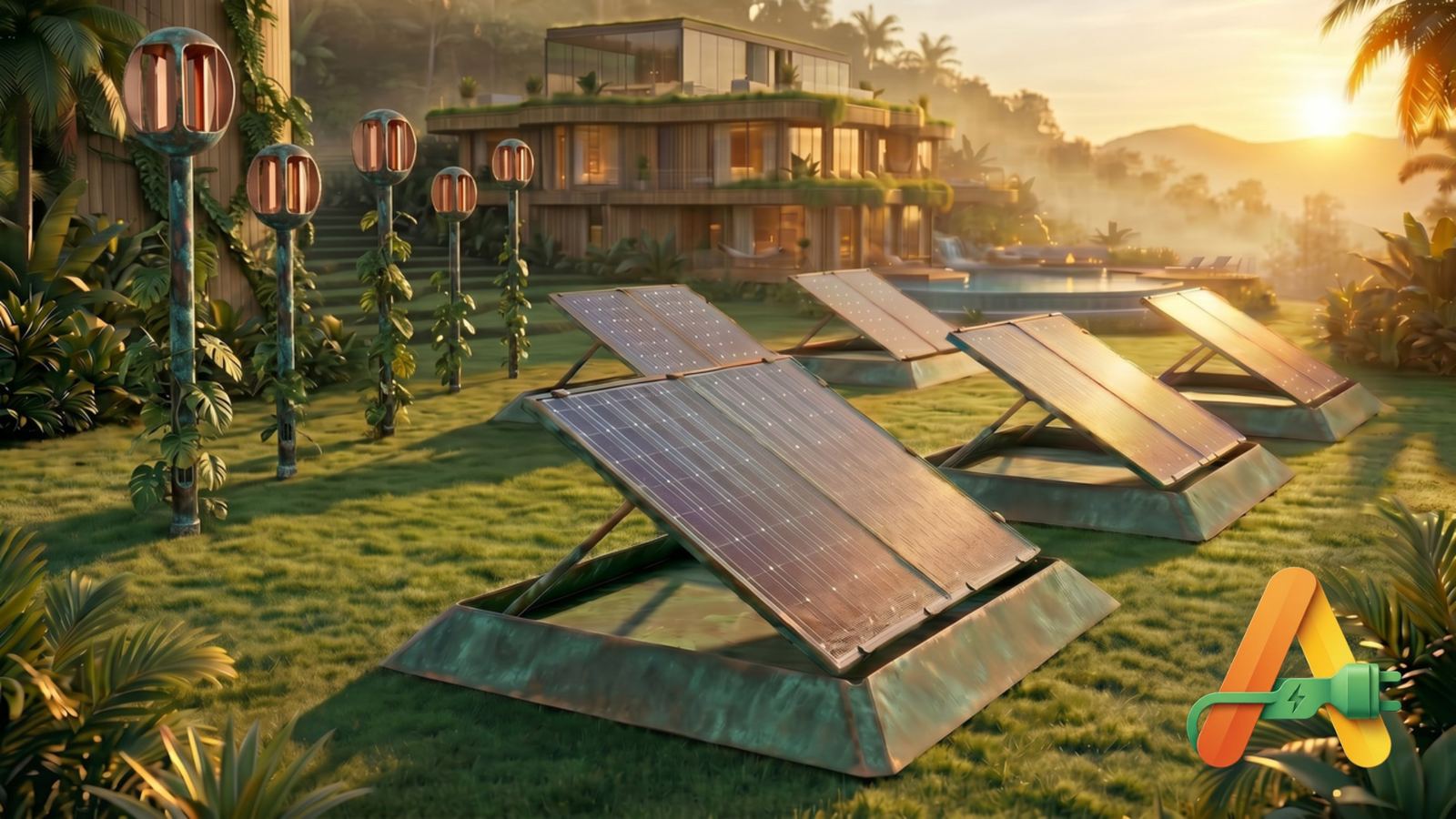
Start with your own roof. It costs nothing to look.
Audit your site, see the whole number, and see what could pay for it — before you talk to anyone.

A micro-grid only works if it's sized to its site. eScout measures the real resource — sun, wind, water and load — so generation, storage and grid-tie are matched from day one, and 24/7 output is engineering rather than hope.
ANEW reference design — architectural rendering generated with Runway.